
币安币

Search documents
突发!加密货币集体大跳水!单日蒸发3300亿元,比特币跌破6.3万,超11万人爆仓!
Sou Hu Cai Jing· 2026-02-25 03:12
Group 1 - Bitcoin's price dropped from approximately $65,000, reaching around $62,000, with a 24-hour decline fluctuating between 3.5% and 4.5%, indicating a fragile rebound and potential for further technical selling if it falls below $63,000 [1] - Ethereum's price fell below $1,900, with an intraday drop exceeding 8%, and other major cryptocurrencies like XRP and Binance Coin also experienced significant declines, reflecting widespread market sell-off pressure [3] - The stock prices of companies closely related to cryptocurrencies, such as Robinhood and Strategy, fell by 5.7% and 5.6% respectively, indicating a chain reaction from the cryptocurrency market to traditional financial markets [3] Group 2 - The immediate trigger for the market downturn was the announcement by President Trump to raise global tariff levels to 15%, interpreted as a significant escalation in global trade tensions, causing investors to withdraw from high-risk assets like Bitcoin [4] - Geopolitical tensions, particularly between the U.S. and Iran, have increased, yet Bitcoin did not exhibit its expected safe-haven characteristics, leading to a reevaluation of its role in extreme risk scenarios [4] - Internal market issues, such as high leverage positions, exacerbated the downturn as forced liquidations occurred, creating a vicious cycle of price declines and further sell-offs [5][6] Group 3 - The "Fear and Greed Index" for cryptocurrencies dropped to single digits, indicating extreme fear in the market, which can lead to irrational selling and further price declines [7] - Analysts from major financial institutions view the Bitcoin drop as a typical risk sentiment reset rather than a unique event for the cryptocurrency market, suggesting a tactical de-risking by investors in response to short-term uncertainties [7] - The current liquidity conditions in the financial system remain tight, with no signs of improvement, as indicated by the contraction of the Federal Reserve's balance sheet, suggesting ongoing pressure on the cryptocurrency market [8]


全球数字资产:市场回调,监管博弈
Di Yi Cai Jing· 2026-02-10 11:02
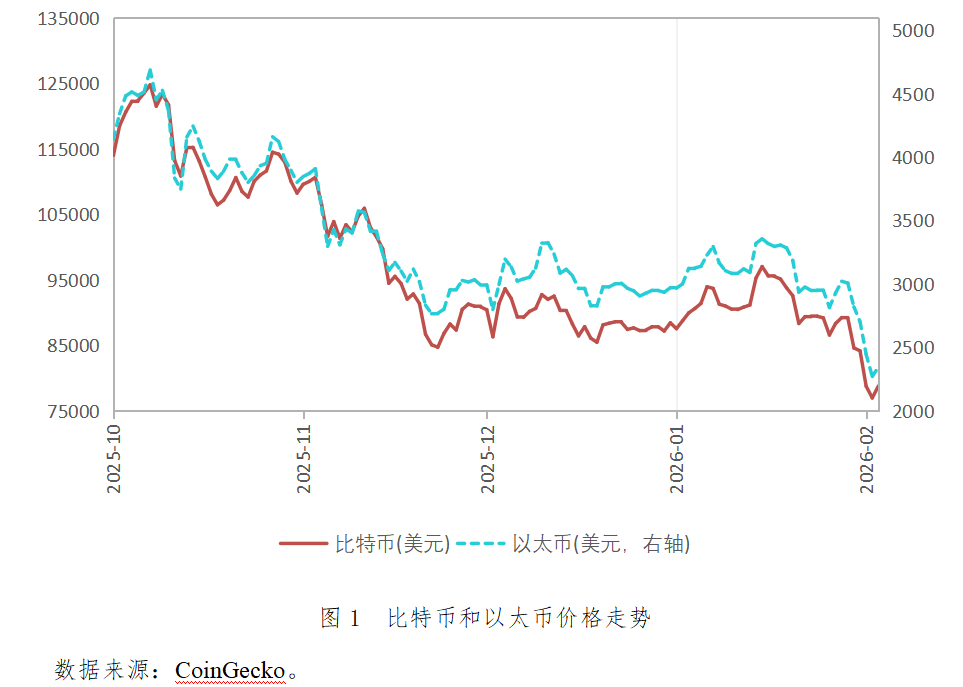
Market Overview - The digital asset market experienced a significant downturn in Q4 2025, with the total market capitalization dropping approximately 27.1% to $2.93 trillion by January 31, 2026 [1][3] - Bitcoin's closing price was $84,100, reflecting a decline of about 26.4%, while Ethereum fell to approximately $2,702, down 35.9% [1][3] - The contraction in the market was influenced by changes in liquidity expectations, delays in key regulatory legislation in the U.S., and a cautious shift in market sentiment [1][3] Stablecoin Market - The stablecoin market saw a slowdown in growth, with total market capitalization increasing only 2.3% to $293.29 billion by January 31, 2026 [1][5] - USDT and USDC continue to dominate the market, with USDT's market cap at approximately $184.8 billion, accounting for about 59.7% of the total [1][5] Regulatory Developments - Global regulatory frameworks are evolving to integrate digital assets while simultaneously addressing risk prevention [1][8] - The U.S. legislative process for the Digital Asset Market Structure Bill (CLARITY Act) has been stalled due to industry conflicts, highlighting the struggle for control over market infrastructure between new crypto entities and traditional financial capital [1][10] - The U.K. has proposed new regulations to align digital assets with traditional securities, indicating a move towards stricter compliance for crypto service providers [1][9] Real World Assets (RWA) - The market for Real World Assets (RWA) has seen a substantial increase, with a 41.1% growth to approximately $23.7 billion from Q3 2025 to January 31, 2026 [2][17] - U.S. Treasury securities represent the largest segment of RWA, accounting for 40% of the total [2][17] Digital Currency Developments in China - The People's Bank of China has initiated a new generation of the digital yuan, transitioning from digital cash to digital deposit currency, marking a significant development in its operational framework [1][15] - The new system emphasizes a dual-layer operational structure involving central banks and commercial institutions, enhancing the integration of digital currency into the existing financial system [1][15][16]
经济热点快评|“一律严格禁止”!打击虚拟货币出实招
Sou Hu Cai Jing· 2026-02-07 06:27
Core Viewpoint - The People's Bank of China and eight other departments have reiterated a strict prohibition on virtual currency activities, classifying them as illegal financial activities, and emphasizing the risks associated with such investments [1][3]. Group 1: Regulatory Stance - The recent notification reinforces a long-standing policy against virtual currencies, stating that they do not hold the same legal status as fiat currencies and are illegal to operate within the country [3]. - Previous regulations from 2013 and 2021 have consistently defined virtual currencies like Bitcoin and stablecoins as non-currencies, reiterating their prohibition in domestic markets [3]. Group 2: Market Impact - Following the announcement, Bitcoin's price fell below $70,000 for the first time since November 2024, with a maximum drop of 9.74% within 24 hours, leading to significant losses for many investors [1]. - Other cryptocurrencies, including Ethereum, Solana, Binance Coin, and Dogecoin, also experienced substantial declines, resulting in severe financial repercussions for investors [1]. Group 3: Investor Guidance - Investors are advised to avoid falling for myths of quick wealth in the cryptocurrency market and to develop a proper investment mindset, enhancing their risk awareness and ability to identify potential dangers [4].

人民日报:“一律严格禁止”,打击虚拟货币出实招
Xin Lang Cai Jing· 2026-02-07 05:13
Core Viewpoint - The People's Bank of China and eight other departments have reiterated a strict prohibition on virtual currency-related activities, classifying them as illegal financial activities [1][3]. Group 1: Regulatory Stance - The recent notice emphasizes that virtual currencies do not have the same legal status as fiat currencies and that all related activities are strictly prohibited within the country [3][4]. - This regulatory stance has been consistent since 2013, with previous notices reinforcing the illegality of virtual currency transactions and their classification as illegal financial activities [3][4]. Group 2: Market Impact - Following the announcement, Bitcoin's price fell below $70,000 for the first time since November 2024, with a maximum drop of 9.74% in 24 hours, leading to significant losses for investors [1]. - Other cryptocurrencies, including Ethereum, Solana, Binance Coin, and Dogecoin, also experienced substantial declines, resulting in many investors facing severe financial repercussions [1]. Group 3: Investor Caution - Investors are warned against believing in myths of quick wealth in the cryptocurrency market and are encouraged to adopt a correct investment mindset and enhance their risk awareness [4].

比特币跌破6万美元大关!本周暴跌25%,4个月价格“腰斩”
Sou Hu Cai Jing· 2026-02-06 03:59
Core Insights - Bitcoin price has experienced a significant decline, dropping below $60,000 for the first time since October 2024, marking a 52.81% decrease from its historical high of $127,000 reached on October 5, 2025 [1][3] - The recent sell-off was driven by pessimistic investor sentiment and ongoing sell-offs in the international financial markets, with Bitcoin's price falling approximately 25% over five days starting February 1 [3] - Market liquidity and confidence have contracted, exacerbated by increased leverage liquidations, with over 586,219 traders liquidated in the last 24 hours, totaling $2.665 billion [3] Market Dynamics - Bitcoin's price has fallen below the average holding cost of U.S. spot ETFs (approximately $87,830), indicating that most institutional holdings are now at a loss, which further suppresses bottom-fishing interest [3] - Retail investor interest has cooled, leading to reduced trading volumes and increased volatility, with market sentiment indicators showing a shift towards risk aversion [3][4] - Historical data suggests that Bitcoin has previously experienced declines of over 75% during major bear markets in 2014, 2018, and 2022, indicating that the current drop has not yet reached extreme historical levels [4] Broader Cryptocurrency Market - Other cryptocurrencies such as Ethereum, Solana, Binance Coin, and Dogecoin have also seen significant price declines, reflecting a broader market trend [4] - The current market sentiment is increasingly risk-averse, with price movements being driven more by balance sheet mechanisms rather than narrative logic [4]

【环球财经】比特币价格跌破7万美元
Xin Hua She· 2026-02-05 22:30
Core Viewpoint - The cryptocurrency market is experiencing significant declines, with Bitcoin falling below $70,000 for the first time since November 2024, driven by investor pessimism and ongoing sell-offs in international financial markets [1] Group 1: Market Performance - Bitcoin's price index dropped to a low of $66,835 on the morning of February 5, with a maximum decline of 9.74% over the past 24 hours [1] - Other cryptocurrencies, including Ethereum, Solana, Binance Coin, and Dogecoin, also saw substantial price decreases [1] Group 2: Investor Sentiment - Deutsche Bank analyst Marion Labre states that the market sell-off indicates traditional investors are losing interest, leading to increased pessimism regarding cryptocurrencies [1] - James Butterfield, head of research at a UK cryptocurrency investment firm, highlights that $70,000 is a critical psychological price level for Bitcoin, suggesting that if it cannot hold this level, prices may drop further to the $60,000 to $65,000 range [1]
比特币价格跌破7万美元
Xin Hua She· 2026-02-05 17:34
Core Viewpoint - The cryptocurrency market is experiencing significant declines, with Bitcoin falling below $70,000 for the first time since November 2024, driven by investor pessimism and ongoing sell-offs in international financial markets [1] Group 1: Market Performance - Bitcoin's price index dropped to a low of $66,835 on the morning of February 5, marking a maximum decline of 9.74% within the past 24 hours [1] - Other cryptocurrencies, including Ethereum, Solana, Binance Coin, and Dogecoin, also saw substantial price decreases [1] Group 2: Investor Sentiment - Analysts from Deutsche Bank indicate that the market sell-off signals a loss of interest among traditional investors, contributing to increased pessimism regarding cryptocurrencies [1] - James Butterfield, head of research at a UK cryptocurrency investment firm, highlights that $70,000 is a critical psychological price level for Bitcoin, suggesting that failure to maintain this level could lead to further declines to the $60,000 to $65,000 range [1]
美联储货币政策“鹰派”预期上升
Xin Lang Cai Jing· 2026-02-01 22:24
Core Viewpoint - The prices of major cryptocurrencies, including Bitcoin and Ethereum, experienced significant declines on January 31 due to market expectations of a "hawkish" monetary policy from the Federal Reserve, influenced by President Trump's nomination of Kevin Walsh as the next Fed Chair [1][2]. Group 1: Cryptocurrency Price Movements - Bitcoin's price fell to $77,082.48, with a maximum decline of 8.32% in the past 24 hours [1]. - Ethereum's price dropped to $2,354.67, experiencing a maximum decline of 12.84% within the same timeframe [1]. - Other cryptocurrencies such as Solana, Dogecoin, and Binance Coin also saw substantial price drops [2]. Group 2: Market Analysis and Sentiment - Analysts attribute the sell-off in high-risk cryptocurrencies to the strong expectations of a hawkish monetary policy from the Federal Reserve, which has led to a stronger dollar and a significant pullback in precious metal prices [2]. - Marcus Tielen, founder of 10x Research in Singapore, noted that the market perceives cryptocurrencies not as a hedge against currency depreciation but rather as "over-speculative assets," indicating a potential retreat from speculative trends once loose monetary policies end [2].
比特币等加密货币大幅下挫
Sou Hu Cai Jing· 2026-02-01 21:08
Core Viewpoint - The prices of major cryptocurrencies, including Bitcoin and Ethereum, experienced significant declines on January 31 due to market expectations of a "hawkish" monetary policy from the Federal Reserve, influenced by the nomination of Kevin Walsh as the next Fed Chair by President Trump [1][2]. Group 1: Cryptocurrency Price Movements - Bitcoin's price fell to $77,082.48, with a maximum decline of 8.32% in the past 24 hours [1]. - Ethereum's price dropped to $2,354.67, experiencing a maximum decline of 12.84% within the same timeframe [1]. - Other cryptocurrencies such as Solana, Dogecoin, and Binance Coin also saw significant price drops [2]. Group 2: Market Influences - The market's strong expectation of a hawkish monetary policy from the Federal Reserve has led to a stronger US dollar and a significant pullback in precious metal prices [2]. - The announcement of Kevin Walsh's nomination as the next Fed Chair has intensified these hawkish expectations, prompting sell-offs in high-risk and high-volatility assets like cryptocurrencies [2].
美联储新主席提名宣布后,加密货币大幅下挫
Sou Hu Cai Jing· 2026-02-01 09:49
Core Viewpoint - The prices of major cryptocurrencies, including Bitcoin and Ethereum, experienced significant declines on January 31 due to market expectations of a "hawkish" monetary policy from the Federal Reserve, following the nomination of Kevin Walsh as the next Fed Chair by President Trump [1] Group 1: Cryptocurrency Price Movements - Bitcoin's price fell to $77,082.48, with a maximum decline of 8.32% in the past 24 hours [1] - Ethereum's price dropped to $2,354.67, with a maximum decline of 12.84% in the past 24 hours [1] - Other tokens such as Solana, Dogecoin, and Binance Coin also saw significant price drops [1] Group 2: Market Analysis - Analysts believe that the market's expectation of Walsh's "hawkish" monetary policy has led to a stronger dollar and a significant pullback in precious metal prices, resulting in a sell-off of high-risk, high-volatility cryptocurrencies [1] - Marcus Tielen, founder of 10x Research in Singapore, stated that cryptocurrencies are no longer viewed as a hedge against currency depreciation but rather as "over-speculative assets" [1] - The end of loose monetary policy is expected to lead to a retreat in speculative trading in cryptocurrencies [1]