
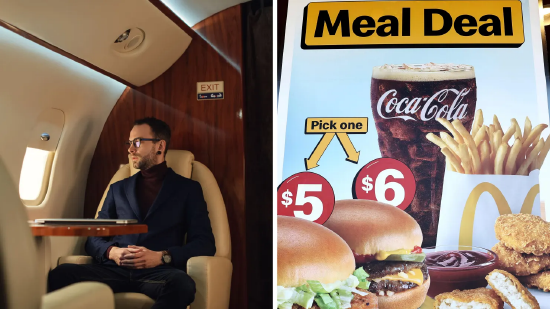
平价套餐

Search documents
财富不平等加剧,美国K型经济特征空前显著
Xin Lang Cai Jing· 2026-01-30 12:45
Core Insights - The economic gap between the wealthy and the poor in the United States is continuously widening, with economists indicating that this trend shows no signs of ending [1][25] - The "K-shaped economy," which has been a focal point for consumers, business leaders, policymakers, and investors since the COVID-19 pandemic, is now considered a core characteristic of the U.S. economy rather than a temporary trend [1][25] Economic Disparity - The Gini coefficient, a key measure of wealth concentration, has reached a 60-year high, reversing the trend of decline seen during the pandemic [4][29] - As of the third quarter of 2025, the wealth held by the richest 1% of Americans is projected to reach nearly 32% of the nation's total wealth, while the bottom 50% holds only 2.5% [8][31] - The share of GDP allocated to employee compensation has fallen to its lowest level in over 75 years, indicating that ordinary workers are receiving a smaller portion of the economic "pie" [8][31] Consumer Behavior - The economic divide is directly influencing consumer spending habits, with high-income households increasing their expenditure on luxury goods and services, while low-income households are cutting back on non-essential spending [11][34] - Households earning less than $75,000 are spending a lower percentage on travel and experiences compared to 2019, while those earning over $150,000 are increasing their spending in these areas [11][34] - The relative total spending of the top 20% of earners has reached a multi-decade high, while the remaining 80% have seen their spending drop to historical lows [12][34] Structural Issues - The K-shaped economic structure is viewed as a fundamental issue rather than a cyclical one, with roots tracing back to economic policies from decades ago [16][25] - The decline in unionization rates has weakened workers' bargaining power, contributing to economic disparity [16][36] - The economic recovery post-COVID has disproportionately benefited high-income individuals, with stock market gains further widening the wealth gap [17][37] Future Outlook - Economists predict that wealth inequality will continue to worsen, exacerbated by policies that cut welfare programs for the poor [21][40] - Concerns are raised about the sustainability of a K-shaped economy, with experts warning that relying on high-income consumers for economic growth is problematic [22][41] - The U.S. economy is seen as fragile, dependent on a few key sectors for growth, which raises concerns about its long-term stability [24][43]

麦当劳(MCD.US)涨3% Q2营收和利润均超预期
Zhi Tong Cai Jing· 2025-08-06 14:52
Core Viewpoint - McDonald's reported a strong Q2 performance, indicating that its focus on pop culture collaborations and value meal strategies is effectively alleviating consumer economic concerns [1] Financial Performance - Q2 revenue increased by 5% year-over-year to $6.84 billion, surpassing analyst expectations of approximately $6.7 billion [1] - Adjusted earnings per share for Q2 were $3.19, exceeding the average analyst forecast of $3.14 [1] Same-Store Sales - Global same-store sales (restaurants open for at least 13 months) rose by 3.8% year-over-year, outperforming Bloomberg's analyst average expectations [1] - The international market led the growth, while the U.S. market showed a slight improvement with a same-store sales increase of 2.5%, reversing a 0.7% decline from the previous year [1]
