医疗保健行业

Search documents
道指首破5万点创历史新高 分析师:市场已适应全球不确定性 投资者信心真实存在
智通财经网· 2026-02-06 23:49
Group 1 - The Dow Jones Industrial Average (DJIA) surged over 1200 points, approximately 2.5%, closing at a historic high of 50,115.67 points, marking the fastest completion of a 10,000-point increase from 40,000 to 50,000 since May 2024 [1] - The upward trend in the DJIA has shifted from a focus on technology stocks to a broader range of sectors, benefiting traditional industries and defensive sectors, with notable performances from Goldman Sachs, Caterpillar, Amgen, and Sherwin-Williams [1] - The strong corporate earnings, resilient U.S. economy, and the Federal Reserve's interest rate cuts last year have collectively driven the overall market higher [1] Group 2 - Gina Bolvin, President of Bolvin Wealth Management Group, indicated that the DJIA's breakthrough of 50,000 is more of a confirmation than a celebration, reflecting investor confidence amidst higher interest rates and global uncertainties [2] - Healthcare stocks, particularly Johnson & Johnson and Merck, have shown resilience, ranking as the second and fifth best-performing components of the DJIA over the past 12 months [2] - Investors are increasing allocations to high-dividend and defensive consumer staples stocks, with Coca-Cola and Walmart being among the top gainers in the DJIA over the past year [2] - Despite the market's broadening focus, technology and AI sectors remain strong, with Nvidia's stock rising approximately 44% over the past year, making it the third-largest gainer in the DJIA [2]



美国1月裁员创17年同期新高!降息预期再度升温,3月会转向吗?
Sou Hu Cai Jing· 2026-02-05 15:34
Labor Market Conditions - The U.S. labor market is showing significant signs of weakness, with January layoffs reaching 108,435, a year-on-year increase of 117.8%, marking the highest level for January since the 2009 financial crisis [1][3] - The Challenger report indicates that the number of new job postings in January fell to 5,306, a decline of 13% year-on-year, representing the worst January data since records began in 2009 [1][3] Industry-Specific Layoffs - The transportation sector experienced the highest layoffs, totaling 31,243, primarily due to UPS announcing a layoff of 30,000 employees after ending its partnership with Amazon [3] - The technology sector followed with 22,291 layoffs, including 16,000 from Amazon as part of a management restructuring [3] - The healthcare sector saw 17,107 layoffs, the highest monthly figure since April 2020, driven by inflation, high labor costs, and reduced reimbursement rates [3] Economic Outlook and Policy Implications - The increase in layoffs and initial jobless claims, which rose to 231,000, significantly above the expected 212,000, has led to market speculation regarding potential interest rate cuts by the Federal Reserve [4] - The market's expectations for maintaining interest rates in March decreased from 90.1% to 84.2%, while the probability of a 25 basis point rate cut increased to 15.8% [4] - Internal divisions within the Federal Reserve are evident, with some members advocating for more aggressive rate cuts, while others express concerns about inflation and the need to maintain current rates [6]


财富不平等加剧,美国K型经济特征空前显著
Xin Lang Cai Jing· 2026-01-30 12:45
Core Insights - The economic gap between the wealthy and the poor in the United States is continuously widening, with economists indicating that this trend shows no signs of ending [1][25] - The "K-shaped economy," which has been a focal point for consumers, business leaders, policymakers, and investors since the COVID-19 pandemic, is now considered a core characteristic of the U.S. economy rather than a temporary trend [1][25] Economic Disparity - The Gini coefficient, a key measure of wealth concentration, has reached a 60-year high, reversing the trend of decline seen during the pandemic [4][29] - As of the third quarter of 2025, the wealth held by the richest 1% of Americans is projected to reach nearly 32% of the nation's total wealth, while the bottom 50% holds only 2.5% [8][31] - The share of GDP allocated to employee compensation has fallen to its lowest level in over 75 years, indicating that ordinary workers are receiving a smaller portion of the economic "pie" [8][31] Consumer Behavior - The economic divide is directly influencing consumer spending habits, with high-income households increasing their expenditure on luxury goods and services, while low-income households are cutting back on non-essential spending [11][34] - Households earning less than $75,000 are spending a lower percentage on travel and experiences compared to 2019, while those earning over $150,000 are increasing their spending in these areas [11][34] - The relative total spending of the top 20% of earners has reached a multi-decade high, while the remaining 80% have seen their spending drop to historical lows [12][34] Structural Issues - The K-shaped economic structure is viewed as a fundamental issue rather than a cyclical one, with roots tracing back to economic policies from decades ago [16][25] - The decline in unionization rates has weakened workers' bargaining power, contributing to economic disparity [16][36] - The economic recovery post-COVID has disproportionately benefited high-income individuals, with stock market gains further widening the wealth gap [17][37] Future Outlook - Economists predict that wealth inequality will continue to worsen, exacerbated by policies that cut welfare programs for the poor [21][40] - Concerns are raised about the sustainability of a K-shaped economy, with experts warning that relying on high-income consumers for economic growth is problematic [22][41] - The U.S. economy is seen as fragile, dependent on a few key sectors for growth, which raises concerns about its long-term stability [24][43]

大型科技股表现强势,港股通互联网ETF易方达(513040)、恒生科技ETF易方达(513010)等受关注
Mei Ri Jing Ji Xin Wen· 2026-01-27 10:49
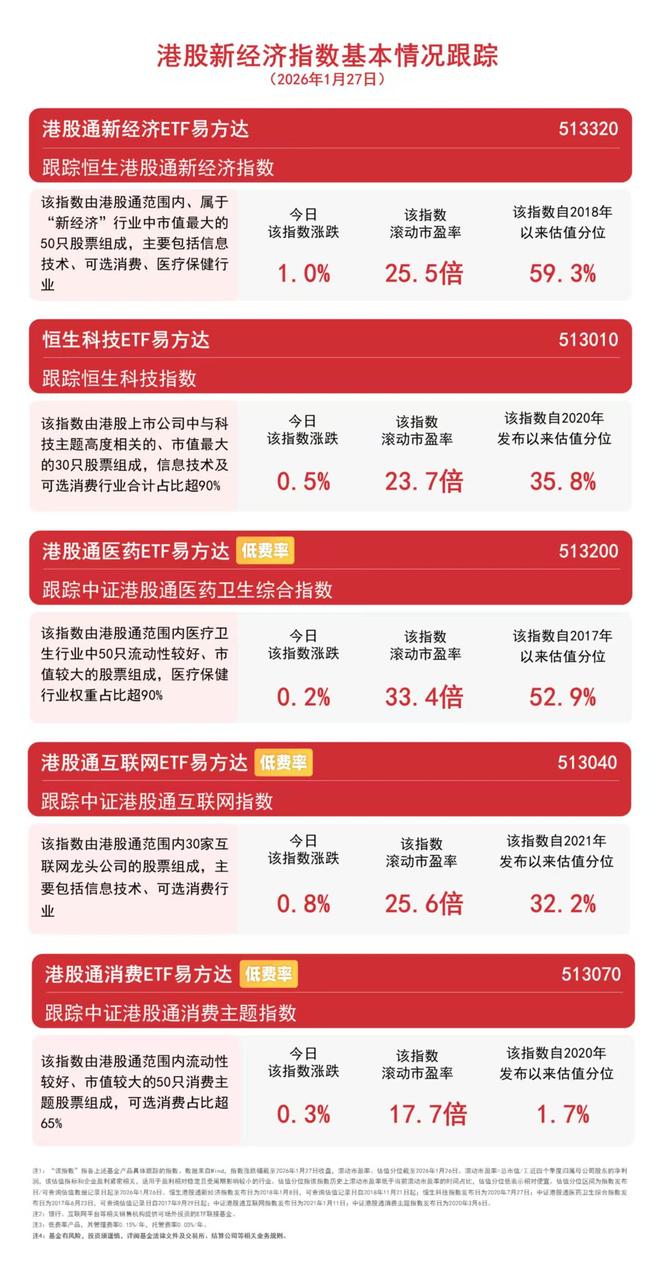
Group 1 - The Hang Seng Hong Kong Stock Connect New Economy Index increased by 1.0%, while the CSI Hong Kong Stock Connect Internet Index rose by 0.8%, the Hang Seng Technology Index by 0.5%, the CSI Hong Kong Stock Connect Consumer Theme Index by 0.3%, and the CSI Hong Kong Stock Connect Healthcare Comprehensive Index by 0.2% [1] - Dongwu Securities indicates that the Hong Kong stock market is in a trend of gradual upward movement, with AI applications expected to accelerate and the semiconductor industry entering a comprehensive price increase phase [1] - Southbound capital flow shows that the information technology sector is one of the main industries for net inflows in the Hong Kong Stock Connect, suggesting a dynamic focus on AI technology in market positioning [1] Group 2 - The E Fund Hong Kong Stock Connect New Economy ETF tracks the Hang Seng Hong Kong Stock Connect New Economy Index, which consists of 50 stocks from the "new economy" sector with the largest market capitalization [2] - The E Fund Hong Kong Stock Connect Technology ETF tracks the Hang Seng Technology Index, comprising 30 stocks highly related to technology, with over 90% of the index made up of information technology and consumer discretionary sectors [2] - The E Fund Hong Kong Stock Connect Healthcare ETF tracks the CSI Hong Kong Stock Connect Healthcare Comprehensive Index, consisting of 50 liquid and large-cap stocks in the healthcare sector, which accounts for over 90% of the index [2] - The E Fund Hong Kong Stock Connect Internet ETF tracks the CSI Hong Kong Stock Connect Internet Index, made up of 30 leading internet companies, primarily in information technology and consumer discretionary sectors [3]
特朗普“泄密”!提前12小时发帖曝光美非农就业数据
Hua Er Jie Jian Wen· 2026-01-09 19:03
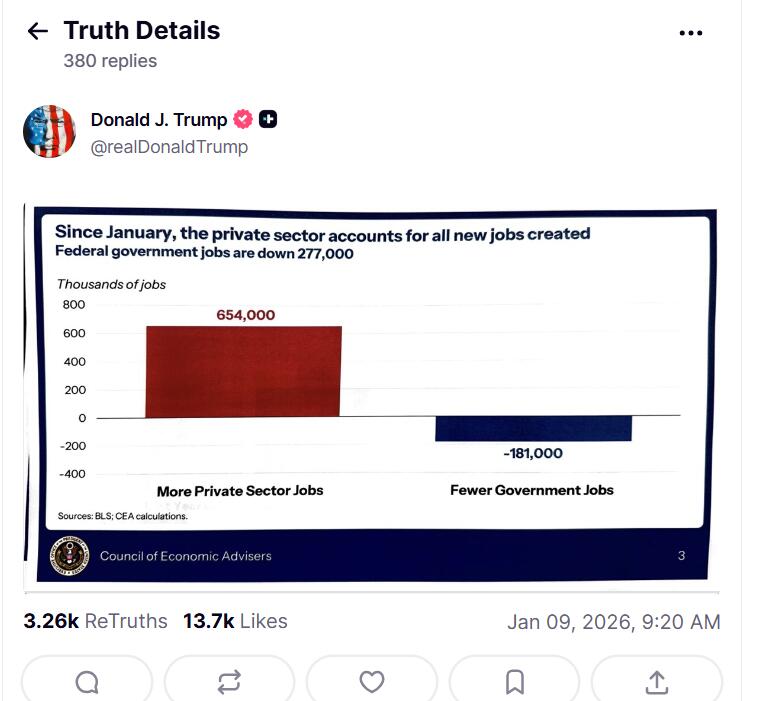
Core Insights - President Trump disclosed part of the U.S. employment data ahead of its official release, revealing that the private sector added 654,000 jobs since January, while government jobs decreased by 181,000 [1][2] - The official report from the Bureau of Labor Statistics (BLS) showed that non-farm employment increased by only 50,000 in December, falling short of the expected 65,000, marking the worst annual performance since the pandemic [3][6] - The private sector's job growth in December was only 37,000, significantly lower than the previous year's figures, indicating a weak labor market [6][8] Employment Data Summary - The BLS reported a total increase of 584,000 non-farm jobs for the year, the lowest since the pandemic caused a loss of 9.2 million jobs [3][6] - The average monthly job addition in the private sector for 2025 was 61,000, the weakest since 2003 without an economic recession [6][8] - Employment growth was primarily in the leisure and hospitality sectors, with healthcare adding 21,000 jobs in December, but other sectors like retail, construction, and manufacturing saw declines [8] Historical Data Revisions - The BLS revised previous months' data significantly, with October's job loss adjusted from 105,000 to 173,000 and November's from a gain of 64,000 to 56,000, totaling a downward revision of 76,000 jobs [10] - The three-month moving average for job growth now shows a decline of 22,000 jobs, indicating a weakening labor market trend [10] Unemployment Rate Insights - Despite weak job growth, the unemployment rate fell from 4.6% to 4.4%, attributed to a decrease in labor force participation to 62.4% [12] - The drop in unemployment has diminished expectations for a Federal Reserve rate cut in January, with traders anticipating no changes in the upcoming meeting [12] - Average hourly earnings increased by 0.3% month-over-month, with a year-over-year growth of 3.8%, outpacing inflation by about 1 percentage point [12]
2025年美国就业市场举步维艰,2026年也难见喘息
Zhi Tong Cai Jing· 2025-12-19 13:50
Group 1 - The job market in the U.S. is facing significant challenges, with predictions indicating limited improvement in employment prospects through 2026 [1][2] - The unemployment rate is expected to remain high, with a notable increase of 0.5 percentage points from June to November, reaching 4.6%, which is unusual outside of recession periods [1][2] - The healthcare sector is projected to dominate job growth, contributing nearly all net new jobs by 2025, while non-farm employment outside this sector is expected to decline [1][2] Group 2 - The labor market is showing signs of weakness, with wage growth slowing down significantly compared to 2022 and 2023, leading to a widening "K-shaped economy" where inequality is increasing [3] - Concerns about job security are prevalent, with 55% of employed Americans worried about unemployment, and nearly half believe it would take at least four months to find a comparable job if they lost their current position [3] - The unemployment rate for Black Americans has risen sharply from 6% in May to 8.3% in November, highlighting disproportionate impacts on this demographic during economic downturns [3][5] Group 3 - Economic growth is anticipated at 2% in 2026, driven by strong consumer spending and business investment, but hiring is expected to remain low, with the average unemployment rate projected to be higher than this year [5] - There are warnings that if hiring does not improve, the risk of larger-scale layoffs could increase, indicating a prolonged period of low recruitment [5]
全球资产配置每周聚焦(20251128-20251205):弱美元下流动性修复,权益商品普涨-20251208
Shenwan Hongyuan Securities· 2025-12-08 03:11
Market Overview - The US ADP employment and PMI data for November were both below expectations, with PMI at 48.2 (expected 49) and ADP employment decreasing by 32,000 (expected an increase of 10,000), reinforcing the Fed's rate cut expectations[3] - The 10Y US Treasury yield rose to 4.14%, up 12 basis points, while the US dollar index fell by 0.46% to 99.0, indicating a continued weak dollar environment[3][9] - Most global equity indices rose, with the Korean Composite Stock Price Index leading the gains, while the Brazilian stock market saw significant declines[3][8] Fund Flows - Both domestic and foreign capital flowed out of the Chinese equity market, with foreign capital exiting by $5.02 million and domestic capital by $20.15 million in the past week[3][15] - Global money market funds saw inflows of $1,123.3 million, while US equity funds experienced inflows of $16.3 million, contrasting with a $25.2 million outflow from Chinese equity funds[15][16] Valuation Metrics - The Shanghai Composite Index's valuation percentile is at 84.3%, second only to the S&P 500 and CAC 40, but remains significantly lower than US equities in absolute PE terms[3][14] - The risk-adjusted return percentile for the Shanghai Composite has decreased from 88% to 80%, indicating a decline in relative performance[3] Risk Sentiment - The implied volatility for the Shanghai Composite options has shown a significant increase, reflecting greater market uncertainty and diverging views on price levels[3][6] - The S&P 500 closed at 6,870.40, remaining above the 20-day moving average, with a put-call ratio of 1.07, indicating stable market sentiment[3][6] Economic Data - The probability of a 25 basis point rate cut by the Fed in December is at 86.20%, with a 90.20% chance of rates falling to 3.5%-3.75% by January 2026, suggesting a high likelihood of further easing[3][6]
降息预期主导市场情绪:海外市场周观察(1124-1130)
Huafu Securities· 2025-12-01 05:11
Group 1 - The core view of the report indicates that the expectation of interest rate cuts by the Federal Reserve is driving market sentiment, leading to a strong performance in U.S. stocks and an increase in gold prices [2][8] - The report highlights that the U.S. retail sales for September increased by 0.2%, which was below the market expectation of 0.4% and the previous value of 0.6% [8] - The report notes that the probability of a 25 basis point rate cut in December has increased, with several Federal Reserve officials expressing support for such a move due to concerns about the labor market [9][10] Group 2 - In terms of asset prices, major global asset classes showed mixed performance, with COMEX silver rising by 12.88% and NYMEX platinum by 10.52%, while the U.S. dollar index fell by 0.71% [28][30] - The report states that the Nasdaq Composite Index had the highest increase among global equity markets, rising by 4.91%, followed by the S&P 500 at 3.73% and the Shenzhen Component Index at 3.56% [33][39] - The materials sector in the U.S. stock market saw the largest gain of 6.43%, while the healthcare sector in Hong Kong also performed well with a 4.94% increase [39] Group 3 - The report indicates that the global commodity market experienced mixed results, with COMEX silver showing the largest gain at 12.88% [46] - The report mentions that the 10-year government bond yields varied globally, with Japan's yield rising to 1.81% and France's yield falling to 3.41% [51][55] - The report highlights that the U.S. labor market remains resilient, with initial jobless claims for the week ending November 22 at 216,000, lower than the expected 225,000 [8][9]
就业失业双涨:美国经济到底谁在说谎?
虎嗅APP· 2025-11-23 10:01
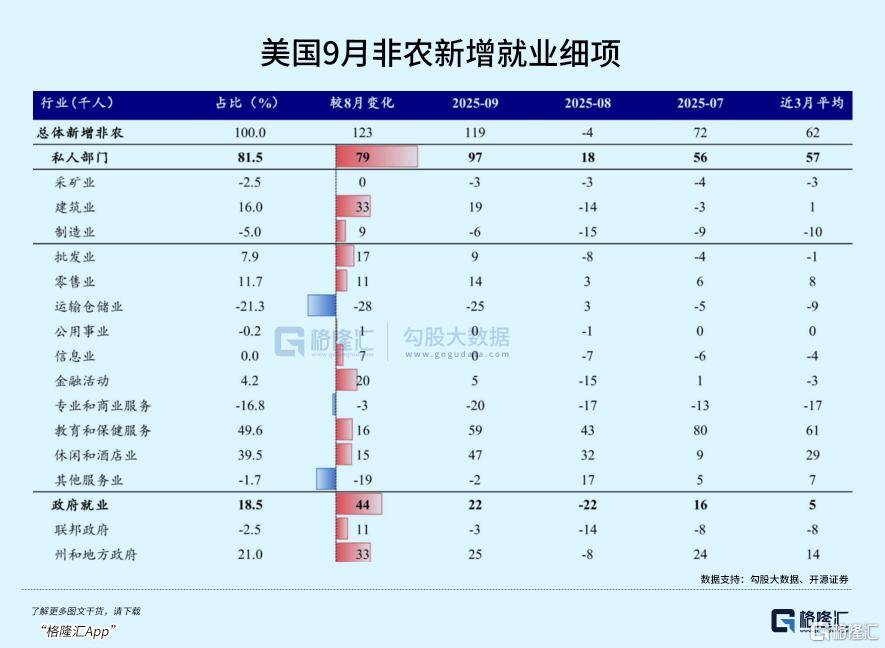
Core Viewpoint - The article discusses the unexpected strength of the U.S. non-farm payroll data for September, highlighting both positive and negative signals in the labor market, and suggests that the apparent economic prosperity may be fragile and accompanied by underlying structural issues. Group 1: Non-Farm Payroll Data Analysis - The U.S. added 119,000 jobs in September, significantly exceeding the expected 51,000, and far above the Dallas Fed's estimate of 30,000 jobs per month [7] - The unemployment rate unexpectedly rose to 4.4%, and revisions to previous months' data showed a downward adjustment of 33,000 jobs, undermining the strength of the September figures [11][12] - The service sector was the main contributor, adding 87,000 jobs, with leisure and hospitality accounting for 47,000 of those jobs, linked to a rebound in consumer spending [18] Group 2: Structural Issues in the Labor Market - There is a structural imbalance in the labor market, with the labor force participation rate rising to 62.4%, indicating an influx of 500,000 workers, but job growth lagging behind, leading to a higher unemployment rate [33] - The average duration of unemployment increased to 21 weeks, with 21% of unemployed individuals taking over 27 weeks to find new jobs, indicating decreased labor market fluidity [37] - Job growth is concentrated in low-wage sectors, which has led to a stagnation in overall wage growth, with average hourly earnings increasing only by 0.2% [42] Group 3: Economic Outlook and Federal Reserve Implications - The article suggests that the strong September data may be a short-term rebound rather than a trend reversal, with ongoing structural issues and tightening credit conditions posing risks to the economy [53] - The Federal Reserve faces internal divisions regarding interest rate policy, with hawks emphasizing employment resilience and doves focusing on rising unemployment rates [50] - Current expectations for the December Federal Reserve meeting indicate a 60% probability of maintaining interest rates, reflecting uncertainty due to data gaps and internal disagreements [52]

脆弱的繁荣
Sou Hu Cai Jing· 2025-11-22 10:53
Core Insights - The U.S. non-farm payroll report for September showed a surprising increase of 119,000 jobs, significantly exceeding expectations of 51,000, which has implications for Federal Reserve interest rate decisions [2][4]. Employment Data Summary - Total non-farm employment increased by 119,000, with private sector jobs contributing 81.5% of the total [3]. - The unemployment rate unexpectedly rose to 4.4%, indicating a potential imbalance in the labor market despite job growth [4][22]. - The service sector was the primary driver of job growth, adding 87,000 jobs, with notable contributions from leisure and hospitality [9][10]. Sector Performance - The leisure and hospitality sector added 47,000 jobs, reversing previous declines, while healthcare added 43,000 jobs, reflecting ongoing demand due to an aging population [9][10]. - Government employment increased by 22,000, primarily in education, as schools ramped up hiring for the new academic year [10][12]. - The transportation and warehousing sector saw a decline of 28,000 jobs, highlighting sector-specific challenges [3]. Data Adjustments and Methodology - August's job numbers were revised down significantly, with a total downward adjustment of 33,000 jobs over July and August, raising questions about the reliability of the data [4][14]. - The discrepancy between establishment survey (119,000 jobs) and household survey (251,000 jobs) indicates structural differences in data collection methods [18][19]. Labor Market Dynamics - The labor force participation rate increased to 62.4%, with a notable influx of younger workers, but this also contributed to the rise in unemployment [23][25]. - Job growth was concentrated in lower-wage sectors, leading to a decline in average wage growth, with average hourly earnings increasing only by 0.2% [29][30]. Economic Outlook - The strong job numbers may be a short-term rebound rather than a trend reversal, with potential risks from tightening credit conditions and global demand slowdown [39][40]. - The Federal Reserve faces a dilemma with mixed signals from the labor market, leading to internal divisions on interest rate policy [36][38].