广发诚享混合A

Search documents
预警!新规之下,广发基金或成基金经理降薪重灾区
Xin Lang Cai Jing· 2025-12-23 14:23
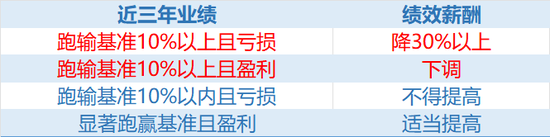
Core Viewpoint - In a generally recovering market, the average return rate of actively managed equity products reached 30% this year, benefiting many investors. However, for GF Fund's investors and fund managers, the situation is grim as over 30% of their products underperformed the market, with six of the bottom twenty funds belonging to GF Fund [1][19]. Group 1: Performance Overview - GF Fund managed to maintain its position as the third-largest in the industry despite poor performance this year [19]. - As of the end of the third quarter, 94 out of 142 of GF Fund's products, accounting for over 66%, underperformed their benchmarks over the past three years, placing them at the bottom among large active equity fund companies [19][20]. - The new regulatory guidelines link fund managers' compensation directly to their performance, with those underperforming by more than 10% facing a salary reduction of over 30% [19][20]. Group 2: Key Fund Managers and Products - Notable underperforming products include "GF High-end Manufacturing Stock A," which has a return rate of -85.79% this year and -41.71% over three years, making it the worst performer in the market [4][23]. - Fund manager Zheng Chengran, who managed several poorly performing products, has seen an average loss of 30% across his managed funds over the past three years [25][27]. - Liu Gesong, another prominent fund manager, has also faced significant underperformance, with an average shortfall of 39% across his five managed products [10][31]. Group 3: Broader Implications - The poor performance of GF Fund's products raises questions about the overall investment research and management strategies of the company, indicating a systemic issue rather than isolated failures of individual fund managers [37]. - The concentration of performance risk among a few key fund managers highlights a significant flaw in GF Fund's operational structure, as nearly 44% of the underperforming products are managed by just three individuals [37].

机构风向标 | 天合光能(688599)2025年二季度已披露前十大机构累计持仓占比45.83%
Xin Lang Cai Jing· 2025-08-23 01:46
Group 1 - Trina Solar (688599.SH) reported its semi-annual results for 2025, with 21 institutional investors holding a total of 1.006 billion shares, representing 46.14% of the company's total share capital as of August 22, 2025 [1] - The top ten institutional investors collectively hold 45.83% of the shares, with a slight decrease of 0.46 percentage points compared to the previous quarter [1] Group 2 - In the public fund sector, four funds increased their holdings, accounting for a 0.90% increase, while two funds saw a slight decrease in holdings [2] - Seven new public funds were disclosed during this period, including several ETFs focused on the Sci-Tech Innovation Board [2] - One foreign fund, Hong Kong Central Clearing Limited, reduced its holdings by 0.60% compared to the previous quarter [2]

广发百亿基金经理郑澄然4产品近三年跑输基准
Zhong Guo Jing Ji Wang· 2025-08-08 07:18
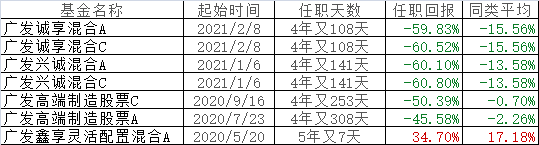
Core Insights - A report by Zhito Finance highlights that 64 fund managers have underperformed their benchmarks by over 10% in the past three years, with some managing over 10 billion yuan [1] - Notably, fund manager Zheng Chengran, who oversees 14.834 billion yuan, has seen significant losses, with his funds losing nearly 60% during his tenure [1][2] Fund Performance Summary - Zheng Chengran's funds, including Guangfa Chengxiang Mixed A and Guangfa Xingcheng Mixed A, have all experienced declines exceeding 45%, with the maximum drop reaching 60.8% [2] - The cumulative returns for these funds this year are all negative, with the smallest decline at 3% and the largest over 14%, contrasting with the Shanghai Composite Index's performance of -0.1% [3] - Over a three-year period, all funds managed by Zheng Chengran have reported losses, with declines of at least 30% [3] Detailed Fund Data - Performance metrics for Zheng Chengran's funds are as follows: - Guangfa Chengxiang Mixed A: -59.83% over three years [4] - Guangfa Xingcheng Mixed A: -60.10% over three years [4] - Guangfa High-end Manufacturing Stock A: -59.53% over three years [4] - Guangfa Xinxiang Flexible Allocation Mixed A: -36.98% over three years, showing a positive return of 82.12% [4]
公募基金改革方案出台:打破"旱涝保收",与基民“同甘共苦”
Sou Hu Cai Jing· 2025-05-08 09:42
Core Viewpoint - The China Securities Regulatory Commission (CSRC) has officially released the "Action Plan for Promoting the High-Quality Development of Public Funds," marking a systematic reform in the public fund industry, which exceeds 30 trillion yuan, addressing the long-standing issue of "emphasizing scale over returns" [2] Group 1: Key Reforms - The reform targets 25 measures, including floating management fees and interest binding, aiming to link management fees to performance, ensuring that funds with poor performance will charge lower management fees [2][3] - A floating fee mechanism will end the "guaranteed income" model, requiring active management equity funds to implement performance-linked floating management fees, addressing investor dissatisfaction with the "charging regardless of profit or loss" model [3] Group 2: Performance Assessment Changes - The plan replaces short-term rankings with long-term assessments, incorporating performance benchmarks and fund profitability into the evaluation system, with a focus on three-year assessments [3] - Fund managers whose products underperform benchmarks by over 10 percentage points for more than three years will see a significant decrease in performance-related compensation, while those who exceed benchmarks can receive moderate increases [3] Group 3: Strengthening Accountability - The plan enhances the responsibility of fund company executives and managers by increasing their investment proportion and lock-up period, linking compensation to investment returns [4] - The reform aims to address issues where fund managers manage multiple products with poor performance, directly impacting their personal income [4] Group 4: Implementation Timeline - The CSRC aims to implement these policies over approximately three years, facilitating a substantial shift in the industry from "emphasizing scale" to "emphasizing returns" [4]