开源推理VLA模型Alpamayo

Search documents
英伟达放大招,智能驾驶板块强势拉升,智能车ETF(159888)大涨3.59%
Mei Ri Jing Ji Xin Wen· 2026-01-06 06:05
Core Viewpoint - The smart driving sector experienced a significant surge on January 6, with the smart car ETF (159888) rising by 3.59%, driven by positive developments at the CES event in Las Vegas and the announcement of new AI models by Nvidia [1] Group 1: Market Performance - As of 1:50 PM on January 6, stocks such as Wanji Technology, Suoling Co., Lianchuang Electronics, Beidouxing, and Zhejiang Sebao reached their daily limit up [1] - Haoen Automotive and Huace Navigation saw their shares increase by over 12% [1] Group 2: Technological Developments - Nvidia announced the launch of the open-source inference VLA model Alpamayo, which includes open-source AI models, simulation tools, and datasets aimed at accelerating the development of safe autonomous vehicles [1] Group 3: Industry Outlook - Aijian Securities predicts that 2026 will be a pivotal year for the maturity of advanced automotive driving technologies, with breakthroughs in policies, user acceptance, and business models [1] - The report highlights that leading automotive companies with full-stack self-research capabilities in algorithms and data loops are expected to benefit the most from the enhancement of smart driving value [1]

无人驾驶概念大涨
Di Yi Cai Jing· 2026-01-06 05:54
Group 1 - The autonomous driving sector saw significant stock price increases on January 6, with Hanxin Technology reaching a 30% limit up and Wanjie Technology up by 20% [1][2] - Other companies in the sector, such as Lianchuang Electronics and Desay SV, also hit their daily price limits, indicating strong market interest and investor confidence [1][2] Group 2 - The annual Consumer Electronics Show (CES) in Las Vegas showcased cutting-edge technologies from January 6 to 9, with NVIDIA announcing the launch of the open-source inference VLA model Alpamayo, aimed at accelerating the development of safe autonomous vehicles [2] - NVIDIA's CEO Jensen Huang emphasized that a significant shift from non-autonomous to autonomous vehicles is expected to occur soon, predicting that a large portion of cars will be autonomous or highly automated in the next decade [3] - NVIDIA's DRIVE AV software will be implemented in Mercedes-Benz vehicles, with the first autonomous vehicle expected to hit the roads in the U.S. in Q1 of this year, followed by Europe in Q2 and Asia later in the year [3]






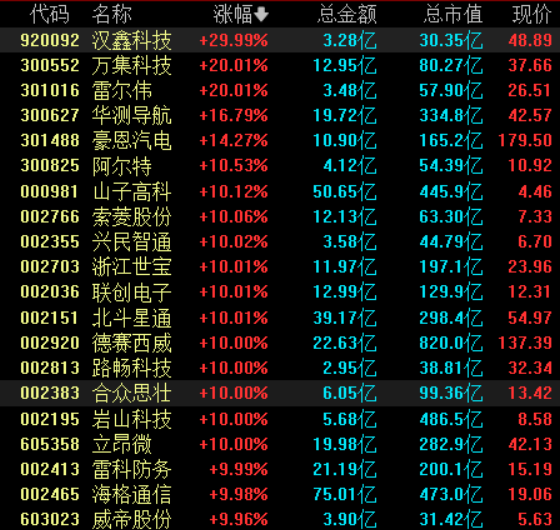
无人驾驶概念大涨
第一财经· 2026-01-06 05:42
Group 1: Market Performance - The autonomous driving concept stocks saw significant gains on January 6, with Hanxin Technology hitting a 30% limit up and Wanjie Technology rising by 20% [1] - Other companies such as Lianchuang Electronics, Desay SV, and Luochang Technology also reached their daily limit up [1] - A detailed table shows various companies' stock performance, with Hanxin Technology at a total market value of 30.35 billion and Wanjie Technology at 80.27 billion [2] Group 2: Technological Developments - The annual Consumer Electronics Show (CES) in Las Vegas showcased cutting-edge technology, with NVIDIA announcing the launch of the open-source inference VLA model Alpamayo, aimed at accelerating the development of safe autonomous vehicles [1] - NVIDIA's CEO Jensen Huang emphasized that a significant shift from non-autonomous to autonomous vehicles is expected to occur soon, predicting that many cars will be autonomous or highly automated in the next decade [3] - NVIDIA's DRIVE AV software will be utilized in Mercedes-Benz vehicles, with the first autonomous vehicle expected to hit the roads in the U.S. in the first quarter of this year [3]

英伟达,重磅发布!黄仁勋:重要时刻要来了
第一财经· 2026-01-06 03:17
Core Viewpoint - The article highlights NVIDIA's advancements in AI and computing architecture, emphasizing the dual transformation occurring in AI and computing, which is reshaping the entire technology stack and creating new applications and ecosystems [6][7]. Group 1: AI and Computing Transformation - Huang emphasized that the computing industry undergoes a platform change every 10 to 15 years, with the current shift driven by AI and computing architecture simultaneously evolving [6]. - AI is both an application and a new platform, leading to a paradigm shift in software development from coding to model training [6][7]. - The modernization of a $10 trillion computing infrastructure is underway, with billions in venture capital flowing into AI, as industries shift R&D budgets towards AI [7]. Group 2: Open Source Models - Huang noted that one of the significant changes in the industry last year was the rise of open-source models, specifically mentioning China's DeepSeek R1 as a remarkable contributor to this global movement [7][8]. - Multiple open-source models were showcased, including three from China: Kimi K2, Qwen, and DeepseekV3.2 [8]. Group 3: Physical AI and Autonomous Driving - Huang stated that the next phase of AI development involves entering the physical world, requiring AI to learn common sense about physical properties [10]. - NVIDIA is working on a system that allows AI to learn about the physical world, which is crucial for applications like autonomous driving [10][12]. - Huang believes that the transition from non-autonomous to autonomous vehicles is imminent, with a significant portion of cars expected to be autonomous in the next decade [14]. Group 4: New Chip Platform - Rubin - The Rubin platform includes six new chips, with the Rubin GPU achieving a reasoning power of 50 PFLOPS, five times that of the previous Blackwell platform [21]. - The Rubin platform's design allows for a tenfold reduction in reasoning token costs and a fourfold decrease in the number of GPUs needed for training [21][22]. - The new Vera Rubin NVL72 chip is expected to significantly enhance performance, with reasoning and training capabilities reaching 3.6 EFLOPS and 2.5 EFLOPS, respectively [24]. Group 5: Collaborations and Future Developments - NVIDIA announced a deepened collaboration with Siemens to integrate its physical AI models into Siemens' industrial software, covering the entire lifecycle from chip design to production [16]. - The first autonomous vehicles using NVIDIA's DRIVE AV software are set to hit the roads in the U.S. in the first quarter of this year, with further expansions planned for Europe and Asia [16].