彭博终端(Bloomberg Terminal)

Search documents
黄仁勋每天都用的AI工具,要抢金融行业饭碗了?
3 6 Ke· 2026-02-27 00:15
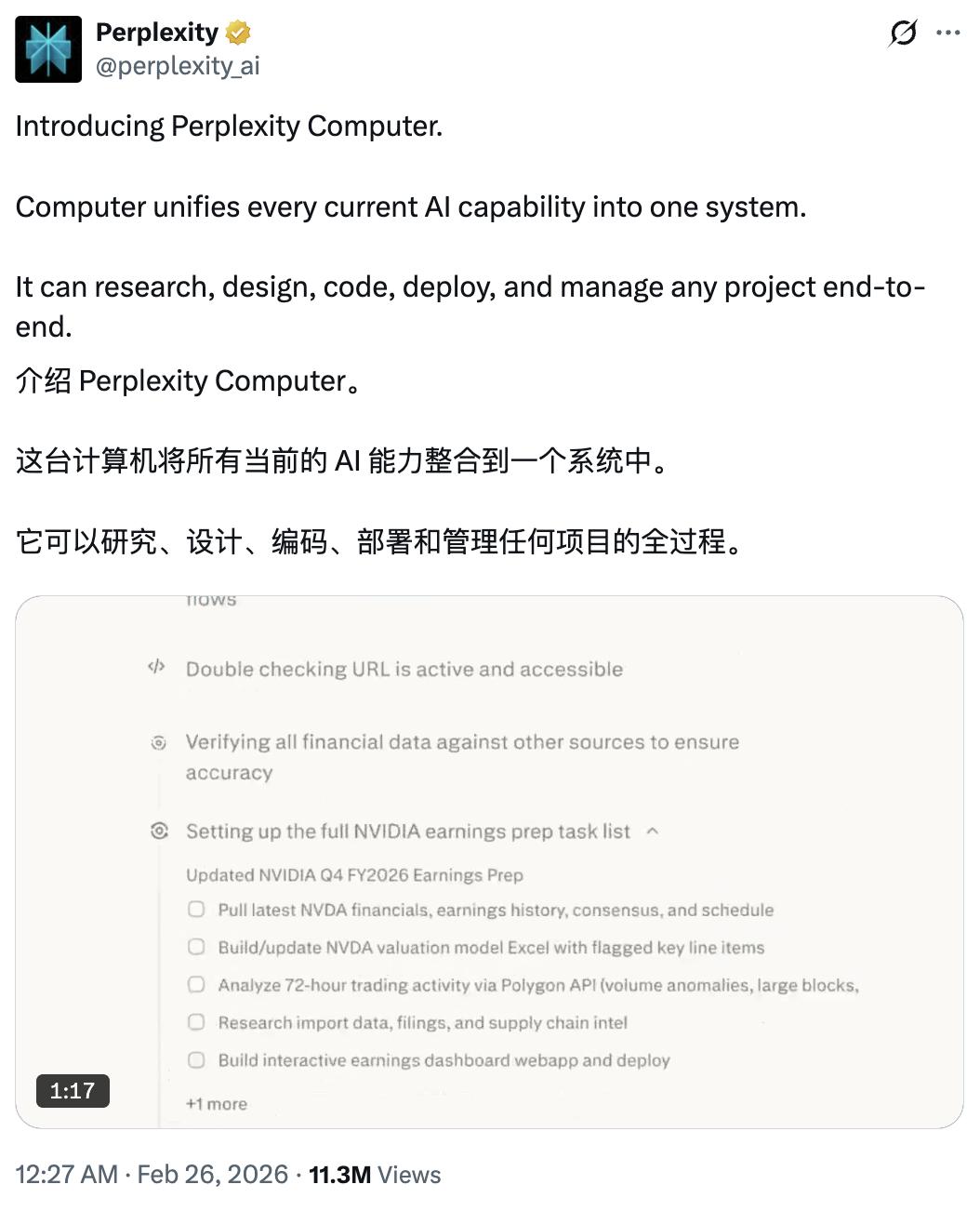
Core Insights - The emergence of Perplexity Computer, a new AI system capable of managing entire project workflows, is poised to disrupt the financial industry by offering a cost-effective alternative to traditional financial tools like Bloomberg Terminal [2][4][5]. Company Overview - Perplexity, founded in August 2022, has rapidly gained traction, achieving over 10 million monthly active users and processing billions of queries monthly. By the end of 2025, its valuation is projected to reach $20 billion [13][17]. - The company has attracted significant investments from notable figures, including Nvidia and Jeff Bezos, highlighting its strong market position and potential for growth [13][17]. Product Features - Perplexity Computer integrates 19 top-tier models into a single system, allowing for task-specific model deployment, enhancing its operational efficiency [8][12]. - The system's unique scheduling capability enables it to automatically assign tasks to different models based on requirements, streamlining complex processes [8][12]. Market Position - Perplexity aims to redefine search functionality, contrasting with Google's ad-centric model by providing direct answers through its "Answer Engine" powered by retrieval-augmented generation (RAG) technology [17][24]. - The company has successfully captured a portion of high-value search traffic from Google, generating $50 million in annual revenue with a small team of 150-200 employees [23][24]. Challenges and Future Directions - Perplexity faces challenges in monetization, as the cost of AI search is significantly higher than traditional search methods, necessitating the exploration of alternative revenue models [25][26]. - The company is shifting focus towards AI agents to enhance its service offerings, potentially allowing for transaction execution and commission-based revenue streams [26][27].

1万亿美元蒸发背后:垂直软件的护城河,正在被大模型重写
Hua Er Jie Jian Wen· 2026-02-18 06:41
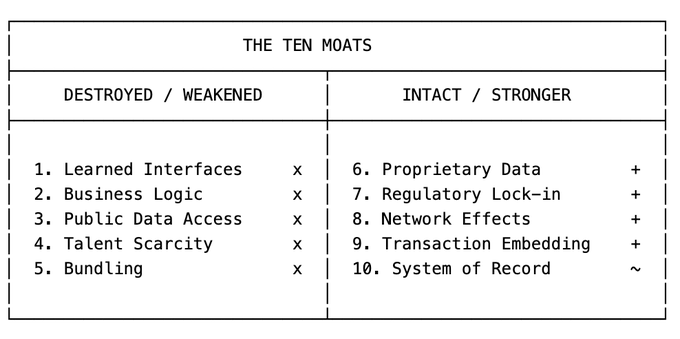
Core Insights - The article discusses how large language models (LLMs) are systematically dismantling the competitive advantages of vertical SaaS companies, leading to a significant market reevaluation of their value [1][11][40] - It highlights the drastic changes in the software landscape, where traditional barriers to entry are being lowered, resulting in increased competition and reduced pricing power for established players [41][44] Group 1: Disruption of Traditional Moats - "Usability" is no longer a competitive advantage as LLMs simplify complex software interfaces into conversational formats, eliminating the need for extensive training [1][14] - Business logic that once required years of coding can now be encapsulated in simple Markdown documents, drastically reducing the time for competitors to replicate workflows [2][20] - Companies relying on organizing public data for profit are at risk as LLMs can inherently understand and process these documents, commoditizing their business model [3][25] Group 2: Talent and Development Changes - The scarcity of talent that once posed a barrier to entry is diminished as domain experts can now directly translate their knowledge into software without needing programming skills [4][26] - The development process has shifted from requiring specialized engineers to being accessible to anyone with domain expertise, allowing for rapid iteration and deployment of software solutions [20][22] Group 3: Market Dynamics and Competition - The competitive landscape is shifting from a few dominant players to a fragmented market with hundreds of new entrants, leading to a collapse in pricing structures [7][41] - The threat of "pincer movement" from both AI-native startups and established horizontal platforms entering vertical markets is intensifying competition [45][49] Group 4: Value of Proprietary Data - Companies with exclusive, non-replicable data will see their value increase, as LLMs enhance the utility of such data rather than diminish it [5][32] - Proprietary data becomes a critical asset in the AI era, providing companies with significant pricing power and competitive advantage [5][32] Group 5: Regulatory and Compliance Barriers - Certain regulatory and compliance requirements create structural barriers that LLMs cannot easily penetrate, ensuring the stability of companies operating in heavily regulated industries [6][35] - Companies embedded in transaction processes are less vulnerable to disruption from LLMs, as their operational frameworks are essential for revenue generation [37][39] Group 6: Long-term Implications - The overall result of these changes is a significant reduction in barriers to entry, allowing new competitors to emerge rapidly and challenge established firms [40][41] - The market is beginning to differentiate between companies with genuine competitive advantages and those that are vulnerable to LLM-driven commoditization [56]

1万亿美元蒸发背后:垂直软件的护城河,正在被大模型重写
硬AI· 2026-02-18 06:41
Core Insights - The article discusses how large language models (LLMs) are systematically dismantling the traditional moats that vertical SaaS companies relied on for survival, leading to a harsh market revaluation of software stocks [1][12][52]. Group 1: Disruption of Traditional Moats - "Usability" is no longer a moat, as LLMs simplify complex software interfaces into conversational formats, eliminating the steep learning curves associated with traditional platforms like Bloomberg [2][3]. - Business logic that once required extensive coding can now be encapsulated in simple Markdown files, drastically reducing the time needed to replicate workflows from years to weeks [4][26]. - Companies that relied on organizing public data for profit are at risk, as LLMs can inherently understand and process these documents, diminishing the value of information asymmetry [5][30]. Group 2: Value of Proprietary Data - Companies holding exclusive, non-replicable data (e.g., Bloomberg's real-time trading data) will see their value increase, as LLMs will enhance the demand for such unique data [6][40]. - Regulatory compliance and transaction embedding remain strong moats, as LLMs cannot bypass regulatory requirements or replace the need for established financial infrastructures [7][47]. Group 3: Changing Competitive Landscape - The competitive landscape is shifting from a few dominant players to a multitude of competitors, as the barriers to entry have lowered significantly due to LLMs [8][9]. - The threat of "pincer movement" is emerging, with numerous AI-native startups entering vertical markets while horizontal platforms like Microsoft are also encroaching into these spaces [10][60]. Group 4: Long-term Implications - The article emphasizes that the market's valuation adjustments are not due to immediate revenue loss but rather a reassessment of the pricing power and moats that previously justified high valuations [56][58]. - The transition is expected to be gradual, with existing contracts and customer relationships providing some buffer against immediate impacts [56][57].