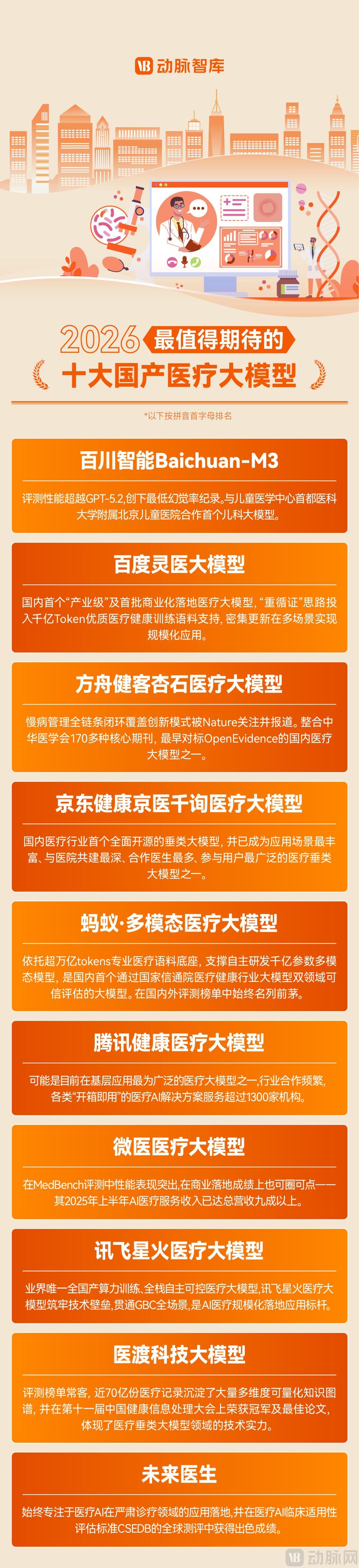
微医医疗大模型

Search documents
无惧OpenAI,2026年国内最值得期待的十个医疗大模型
3 6 Ke· 2026-02-09 01:31
Core Insights - The medical large model sector is experiencing significant advancements, particularly with the recent launches from OpenAI, Anthropic, and Google, indicating a competitive landscape in healthcare AI [1][3][4] - Domestic companies in China, such as Baichuan Intelligence and Ant Group, are making substantial progress, showcasing their capabilities and innovations in the medical AI field [5][6][10] Group 1: OpenAI's Developments - OpenAI launched ChatGPT Health and OpenAI for Healthcare, which comply with HIPAA regulations and aim to enhance patient care services [2] - ChatGPT Health integrates a new module based on the latest GPT-5 model, allowing users to connect personal health data while ensuring data privacy [2] - OpenAI for Healthcare targets medical institutions, offering enterprise-level solutions for clinical environments, including automated documentation [2] Group 2: Competitors' Responses - Anthropic released Claude for Healthcare, directly competing with OpenAI's offerings, highlighting its commitment to the healthcare sector [3] - Google updated its open-source medical large model, MedGemma 1.5, improving its capabilities in text, medical records, and medical imaging [3] Group 3: Domestic Innovations - Baichuan Intelligence launched Baichuan-M3, surpassing GPT-5.2 in benchmark tests, with a hallucination rate of only 3.5%, which was later improved to 2.6% [4][5] - Ant Group's medical model has gained significant traction, achieving 30 million monthly active users and doubling daily inquiries within a month [5] - JD Health and other domestic firms are also releasing new models and solutions, contributing to a vibrant competitive landscape in China's medical AI sector [5][10] Group 4: Benchmarking and Performance - HealthBench and MedBench are the primary benchmarking systems for evaluating medical large models, assessing safety, clinical applicability, and professional reasoning [7][8] - The performance of medical large models is crucial, with ongoing iterations and resource investments being necessary for advancements [8] Group 5: Industry Trends and Future Outlook - The medical large model sector is expected to grow significantly, with various domestic models emerging as strong contenders in 2026 [6][10] - The integration of local clinical guidelines and data security measures positions domestic models as more suitable for the Chinese market [6] - The increasing support from the government and the focus on localized solutions are likely to enhance the competitiveness of domestic models [6]



知名机构集体“投”出来的AI医疗答卷:微医控股成年度“AI+最强变革者”
Sou Hu Cai Jing· 2026-02-02 16:19
Core Insights - The article highlights the significant role of Tencent's investment in WeDoctor Holdings, emphasizing its strategic focus on AI-driven healthcare solutions and the recognition of its long-term growth potential by top-tier institutions [1][2][3] Group 1: Company Performance - WeDoctor Holdings reported a revenue of 30.8 billion yuan in the first half of 2025, marking a year-on-year growth of 69.4%, with AI service revenue exceeding 90% of total income [2][6] - The company achieved a remarkable 131.4% increase in health management membership service revenue, reaching 23.89 billion yuan in the first half of 2025 [6] - The operational efficiency improved significantly, with adjusted loss rate narrowing from 7.0% to 4.2%, and the company achieved positive operating cash flow for the first time [7][8] Group 2: AI Integration and Recognition - WeDoctor Holdings was awarded the title of "AI+ Strongest Transformer" at the 2025 AI Gravity List, recognizing its deep integration of AI technology in healthcare [3][4] - The company's medical AI model consistently leads in authoritative evaluations, demonstrating its clinical auxiliary capabilities and reliability [4] - The AI-driven healthcare model has shown significant improvements in patient management metrics, such as blood pressure control rates among various patient groups [7][8] Group 3: Market Position and Future Outlook - WeDoctor's innovative AI healthcare model is being replicated in various regions, indicating its potential for broader application and impact [8] - The company is positioned for a successful IPO, with its financial metrics reflecting a growth trajectory that aligns with industry standards for tech companies [9][10] - The involvement of prominent investors like Tencent and Sequoia Capital underscores the confidence in WeDoctor's growth and the potential of AI in healthcare [10]
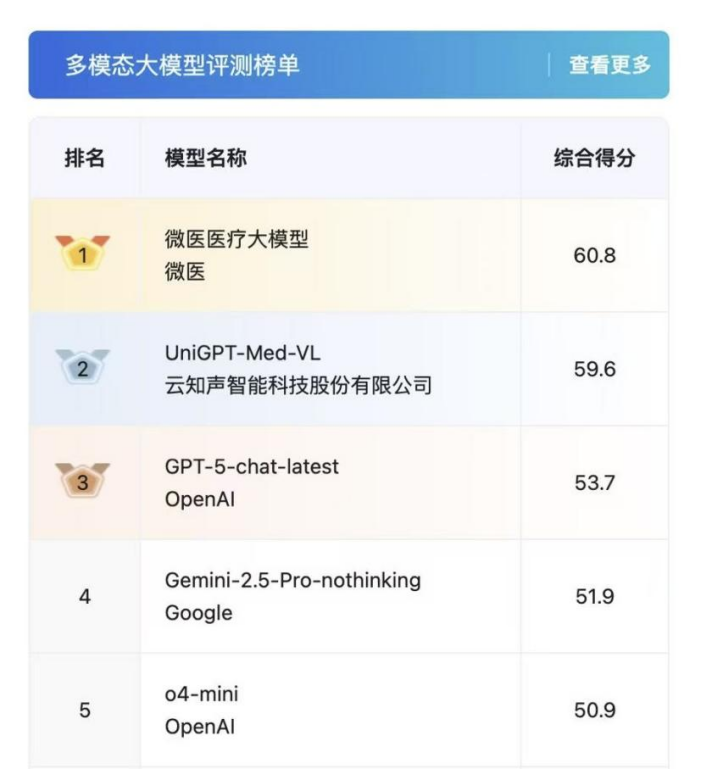
微医医疗大模型领跑MedBench 4.0综合榜单
Huan Qiu Wang· 2026-01-13 04:31
Core Insights - MedBench has released its latest evaluation results, highlighting the performance of medical AI models, with WeDoctor's medical model leading the rankings [1][3] Group 1: Evaluation Results - WeDoctor's medical model achieved a comprehensive score of 60.8, ranking first among various models evaluated [2] - The evaluation included models from other companies, such as UniGPT-Med-VL and OpenAI's GPT-5, which scored 59.6 and 53.7 respectively [2] Group 2: MedBench 4.0 Features - MedBench 4.0 focuses on "practical evaluation breakthroughs" and "ecological open co-construction," covering three main technical paradigms: multi-modal models, large language models, and intelligent agents [2] - The platform aligns with national guidelines and includes 60 self-constructed evaluation sets, with over 700,000 professional evaluation questions to assess models in various medical scenarios [2] Group 3: WeDoctor's Model Capabilities - WeDoctor's model excelled in multi-modal capabilities, particularly in clinical core scenarios such as medical imaging and report analysis, filling a technical gap in Chinese medical multi-modal evaluation [3] - The model ranked in the top three for evaluations of large language models and intelligent agents, showcasing its leading position in medical AI development [3] Group 4: Real-World Application - WeDoctor's model is closely integrated with real-world medical processes, ensuring that its development aligns with clinical needs and standards [4] - The model's capabilities are applied across various services in WeDoctor's AI hospital, creating a closed-loop conversion from technical capability to commercial value [4] Group 5: Future Directions - WeDoctor aims to deepen its applications in medical AI, leveraging its validated model to build a more intelligent and accessible healthcare ecosystem [4]
成立2年,估值250亿,这个70后第四次创业
Sou Hu Cai Jing· 2025-12-09 10:54
Core Insights - Hippocratic AI, an AI healthcare startup, has achieved a valuation of $3.5 billion (approximately 249 billion RMB) after raising $126 million in its latest funding round, marking a doubling of its valuation in less than a year [2][3] - The company focuses on developing non-diagnostic AI solutions to address global healthcare resource shortages, with applications in patient communication, information collection, and follow-up [2][12] Funding and Growth - Since its inception in May 2023, Hippocratic AI has completed multiple funding rounds, raising over $400 million in total [3] - The latest funding round (C round) took place in November 2025, raising $126 million, led by prominent investors including Andreessen Horowitz and General Catalyst [5] - The company has established partnerships with over 50 large healthcare systems and pharmaceutical companies across six countries, completing over 115 million clinical patient interactions without safety issues [7][18] Product and Technology - Hippocratic AI's core technology is a medical-specific large language model named Polaris, designed to ensure safety and practicality in patient interactions [12] - The company has launched a "Healthcare AI Agent App Store," allowing healthcare professionals to create and customize AI applications without programming knowledge, with over 1,000 non-diagnostic medical scenarios covered [17] - The AI agents have demonstrated high reliability, achieving a clinical evaluation accuracy rate of 99.38%, significantly surpassing the average of 81% for registered nurses in the U.S. [15] Market Position and Strategy - The company targets non-diagnostic patient communication tasks, such as pre-operative preparation and chronic disease management, effectively replacing traditional medical call centers [17] - The business model operates on a usage-based SaaS subscription, with costs approximately one-fourth of traditional human services, and high patient satisfaction ratings [17] - The global AI healthcare market is transitioning from concept to value realization, with a focus on addressing specific, measurable problems that meet regulatory requirements [21]


微医控股亮相云栖大会 AI医疗健康应用引人关注
Xin Lang Zheng Quan· 2025-09-26 02:36
Group 1 - The annual Cloud Summit held in Hangzhou showcased advancements in AI technology and its applications in healthcare, with a focus on the integration of AI in medical services [1][2] - Micro Medical Holdings presented its AI-driven healthcare solutions, including the "Micro Medical AI General Hospital" and the AI health assistant "Micro Xiao Yi," which attracted significant attention [1][2] - The forum titled "AI Agent Defines Future Life: Evolving from 'Tool' to 'Digital Partner'" featured a keynote speech by Xu Hongxia, emphasizing how AI is reshaping healthcare services and management [1][2] Group 2 - AI technology is addressing structural challenges in China's healthcare system, such as uneven resource distribution and high chronic disease prevalence, by shifting the focus from "treatment-centered" to "health-centered" care [2][3] - The Tianjin AI Health Community, driven by the Micro Medical AI General Hospital, has seen significant improvements in outpatient volume and reduced average costs, alongside enhanced health metrics for diabetes management [2][3] - The AI-driven healthcare model has achieved a "two increases and one decrease" outcome, benefiting patients, healthcare providers, and insurance funds [3] Group 3 - The Micro Medical AI General Hospital has developed various AI agents, including AI doctors and AI pharmacists, to enhance the entire medical service process from pre-diagnosis to post-treatment [3][5] - The AI doctor has improved the quality of care in grassroots healthcare settings, achieving a 99.97% compliance rate for reminders on inappropriate prescriptions, thereby enhancing medical safety [3][5] Group 4 - The Micro Medical large model integrates clinical data and decision-making pathways, establishing a robust foundation for health-centered value-based care [5] - The model includes over 13,000 specialized medical rules and 222,000 medication review rules, ensuring evidence-based compliance in AI decision-making processes [5] Group 5 - The "Micro Xiao Yi" health management product offers personalized health monitoring and management services, utilizing user health profiles and wearable devices to create a closed-loop service [6][9] - The product provides real-time health advice and connects users to medical services, enhancing the overall healthcare experience [6][9] - "Micro Xiao Yi" is positioned as the first clinical-grade AI health assistant covering the entire medical process, aiming to improve health management and patient engagement [9]