思元(MLU)芯片

Search documents
从寒武纪到沐曦,超1.5万亿算力军团,谁是背后隐秘捕手?
创业邦· 2025-12-19 14:57
Core Insights - The article discusses the strategic investment approach of Lenovo Capital, which has successfully positioned itself as a key player in the AI computing sector by investing in four leading companies: Cambricon, Hygon, Moore Threads, and Muxi [3][5][36] - Lenovo Capital's foresight in recognizing the impending demand for computing power has allowed it to capture significant market opportunities, with its investments in companies that have collectively surpassed a market value of 1.5 trillion RMB [5][36] Investment Strategy - Lenovo Capital began its systematic investment in AI computing as early as 2017, when AI chips were still largely experimental, demonstrating a commitment to long-term industry insights rather than following market trends [9][10] - The firm made significant investments in Cambricon, Hygon, Moore Threads, and Muxi, with a clear understanding of the evolving landscape of computing needs driven by AI applications [10][11] Complementary Technology Ecosystem - The four companies represent a complementary technology ecosystem rather than direct competitors, each fulfilling distinct roles in the AI computing landscape [12][13] - Cambricon is positioned as a specialized unit with its MLU chips designed for AI computing efficiency, while Hygon serves as a mainstream player with its x86-compatible CPUs [14][15] - Moore Threads aims to create a versatile GPU architecture, and Muxi focuses on high-performance GPUs specifically optimized for AI training and inference [19][20] Collaborative Synergy - Lenovo Capital's investments have fostered a collaborative environment where the companies can leverage Lenovo's resources for real-world applications, enhancing their product development and market validation [26][28] - The partnership between Lenovo and these companies has evolved from simple supply relationships to co-developing integrated solutions, exemplified by the "DeepSeek" AI integrated machine [28] Future Outlook - Lenovo Capital is not resting on its laurels; it is actively exploring next-generation computing paradigms, including quantum computing and RISC-V architecture, to stay ahead in the rapidly evolving tech landscape [33][34] - The firm’s strategic investments in emerging technologies reflect a comprehensive vision for the future of computing, aiming to overcome traditional limitations and redefine the industry [35][36]





ASIC市场,越来越大了
3 6 Ke· 2025-06-05 11:05
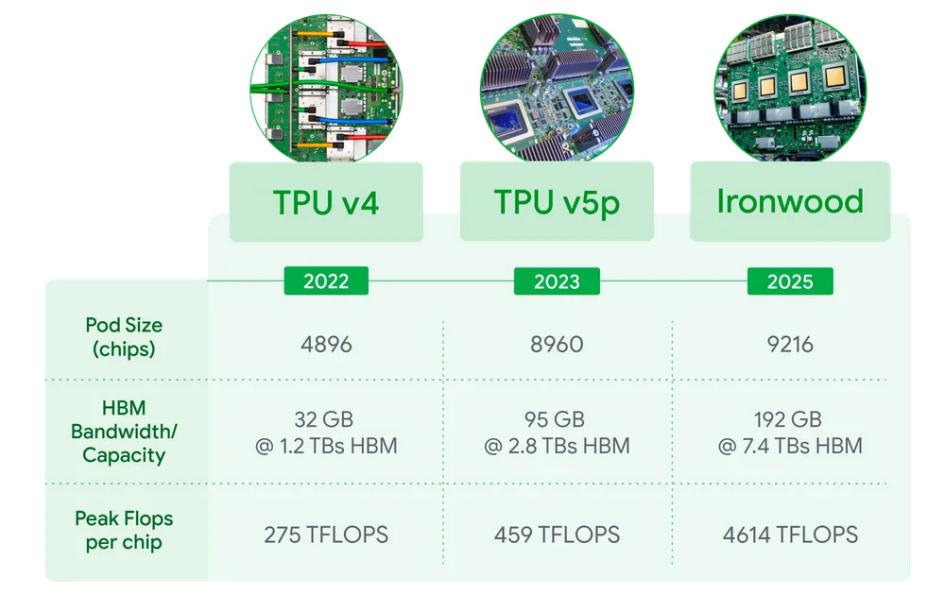
Group 1: Market Growth and Trends - The AI ASIC market is expected to grow from $12 billion in 2024 to $30 billion by 2027, with a compound annual growth rate (CAGR) of 34% [1] - The demand for AI servers is driving major cloud service providers in the US to accelerate the development of ASIC chips, with new products being launched every 1-2 years [2] - In China, the market share of imported chips is projected to drop from 63% in 2024 to about 42% by 2025 due to new export control policies, while domestic chip manufacturers' market share is expected to rise to 40% [2] Group 2: ASIC Technology and Performance - AWS's Trainium 2 ASIC chip can complete inference tasks faster than NVIDIA's H100 GPU, with a cost-performance improvement of 30%-40% [3] - Google's TPU has become a typical representative of ASIC technology, with the latest version, Ironwood, capable of achieving 42.5 exaflops of AI computing power [5][6] - The Ironwood chip features significant enhancements in memory and bandwidth, with each chip equipped with 192GB of high-bandwidth memory [6] Group 3: Competitive Landscape - Broadcom holds a market share of 55%-60% in the ASIC market, with AI-related revenue reaching $4.1 billion, a 77% year-on-year increase [7] - Marvell's ASIC business is a core growth driver, with data center business accounting for approximately 75% of its revenue [9] - Domestic companies like Cambricon and Baidu are actively developing their own ASIC chips, with Baidu's Kunlun chip outperforming traditional GPUs in terms of cost and performance [11][12] Group 4: Challenges and Considerations - The increasing costs of advanced chip design pose challenges for companies looking to develop their own ASICs, with TSMC's 2nm wafers costing around $30,000 each [15] - The question arises whether every company truly needs its own CPU, given the high costs associated with chip design [16]