恒星敏感器

Search documents
天银机电20260322
2026-03-24 01:27
Company and Industry Summary Company: Tianyin Electromechanical (天银机电) Industry Overview - The demand for star sensors is surging due to the explosion of laser inter-satellite communication, with the configuration per satellite increasing from 2 to a "2+4+1" model, with an average price of 70,000 to 80,000 RMB per unit, leading to a value of approximately 500,000 RMB per satellite [2][3] - China plans to launch 250,000 satellites, estimating an annual market size of 15 billion RMB for star sensors, with long-term potential exceeding 10 billion RMB [2][4] Core Insights and Arguments - The industry has high barriers to entry, primarily due to the decades-long accumulation of a global star map database and in-orbit verification records [2][6] - The company holds the highest market share in the low Earth orbit satellite market, outperforming competitors such as the 502 Institute of the Fifth Academy of Aerospace and the 803 Institute of the Eighth Academy [2][5] - The production capacity bottleneck lies in the backend environmental testing (vibration, vacuum, radiation, etc.), with plans to increase production by 2026 to meet the delivery demands of the commercial space boom [2][9] Competitive Landscape - The main competitors are the 502 Institute and the 803 Institute, but the company maintains a competitive edge due to its self-research and production capabilities, which are not subject to restrictions from the US and Japan [2][5][10] - The market is mature, and the price of star sensors has significantly decreased, making it difficult for new entrants to compete [5][6] Technical Barriers and Capabilities - The core moat of the star sensor industry includes high reliability requirements due to the "non-repairable" nature of satellites, necessitating extensive in-orbit validation [6][7] - The company has a strong technical foundation based on decades of research from Tsinghua University, enabling it to provide specialized star sensor solutions tailored to customer needs [7][10] Customer Base and Pricing Pressure - The customer base includes satellite manufacturers and laser communication payload clients, with a broad coverage and many clients actively seeking collaboration [7][8] - There is a clear demand for price reductions from clients, but the company is open to this only if it can effectively lower costs [8][11] Production Capacity and Automation - Current production capacity is expected to be insufficient to meet future market demand, prompting plans for expansion starting in 2026 [9][10] - The production bottleneck is primarily in the environmental testing phase rather than the manufacturing process itself [9][10] Financial Outlook - The company anticipates a loss of approximately 15 million RMB in 2025, with expectations for significant growth in 2026, particularly in the Tianyi Aerospace business, which is projected to double [15] - Shanghai Hanxun is expected to achieve significant growth due to demand for low Earth orbit satellite ground reception and electronic countermeasure needs [2][15] Traditional Business and Future Trends - The traditional military business has faced challenges due to anti-corruption actions affecting contract processes, but the company is optimistic about returning to normal operations [11][12] - The traditional home appliance parts business remains stable but is expected to decline in proportion as the company seeks breakthroughs in other industries [12][14] Summary of Key Points - The star sensor market is poised for rapid growth driven by China's satellite launch plans and technological advancements in laser communication [2][3][4] - The company is well-positioned in a competitive landscape with high barriers to entry and a strong technical foundation [5][6][7] - Future growth is anticipated in both the aerospace sector and traditional businesses, with strategic plans to manage costs and expand production capacity [15]

商业航天未来展望系列
2026-03-04 14:17
Summary of Commercial Aerospace Conference Call Industry Overview - The commercial aerospace sector aims to reduce costs through "high frequency + reusability," with potential launch cost reductions of 70%-90% if scalable reuse is achieved, similar to the early cost reduction path of electric vehicles [1][3] - The bottleneck in the industry chain is concentrated in the launch segment, with domestic capabilities currently at approximately 18 satellites per launch compared to over 100 by SpaceX [1][7] - A significant policy push is expected, with the 9th guideline of the Sci-Tech Innovation Board allowing commercial rocket companies to apply for the fifth set of listing standards, potentially leading to five companies, including Blue Arrow Aerospace and China Science and Technology, going public in 2026 [1][8] Key Insights and Arguments - Commercial aerospace is viewed as a long-term strategic direction for the country, with substantial growth potential as it is still in the early market stage [3] - The core of commercial aerospace lies in its "business" nature, focusing on low costs to create a sustainable profit loop, contrasting with traditional aerospace's high-reliability, cost-agnostic approach [6] - The launch frequency is expected to increase from "monthly/semi-monthly" to "weekly," significantly enhancing cost reduction potential [5] Investment Opportunities - Investment priorities are ranked as rockets > satellites, with key companies to watch including Srey New Materials, Chaojie Co., Tianyin Electromechanical, and Top Group [1][11] - The satellite payload and components segment faces a potential contradiction in business models due to reliance on "volume to offset price" without sufficient scale, but upcoming large-scale satellite procurements may provide growth opportunities [11] Technological Developments - Space photovoltaics are emerging as a new growth area, with P-type heterojunction cells being a short-term alternative due to their cost and industrialization advantages [1][12] - The main technology routes for space photovoltaic cells include traditional gallium arsenide cells, which are efficient but costly, and P-type heterojunction cells, which offer lower costs and higher maturity [12][13] Market Dynamics - SpaceX's potential IPO could significantly impact global commercial aerospace valuations, with its current valuation exceeding $1 trillion and possibly reaching $1.5 trillion [10] - The domestic market is expected to see a surge in commercial rocket launches and reusable technology testing, with key events scheduled for 2026 [9] Mechanical Industry Impact - The commercial aerospace sector is expected to benefit the mechanical manufacturing sector, particularly in precision manufacturing and advanced manufacturing technologies like 3D printing [16][17] - Companies like Tianyin Electromechanical are transitioning from traditional appliance components to aerospace-related products, with a significant increase in revenue from aerospace operations [17][18] Conclusion - The commercial aerospace industry is poised for significant growth driven by technological advancements, policy support, and increasing market demand, presenting various investment opportunities across the supply chain.
Spacex太空感知-天银机电星敏感器产业解读电话会
2026-02-02 02:22
Summary of SpaceX and Tianyin Electromechanical Conference Call Industry Overview - The low Earth orbit (LEO) internet satellite market is transitioning to the second generation, increasing the configuration of star sensors to 6-8 units per satellite, alongside a rising demand for laser communication devices, significantly boosting market demand [1][2] - China's laser communication devices now standardly include star sensors, which have become a national standard [1] Key Points on Star Sensors - The price of star sensors varies based on orbital height and precision requirements: - Low orbit: 60,000 to 100,000 yuan - Medium orbit: several hundred thousand yuan - High orbit: can exceed 3 million yuan [1][3] - The demand for star sensors is expected to increase significantly as China plans to launch 25,000 LEO internet satellites over the next 14 years, with an annual market value potentially reaching 15 billion yuan based on a price of 500,000 yuan per sensor [3][9] Technological Developments - SpaceX's Starlink has integrated data from approximately 30,000 star sensors to create a new space situational awareness system, enhancing collision avoidance capabilities without the need for additional equipment [1][5] - The Chinese commercial space sector is actively developing, with a gradually improving star sensor supply chain, though it still lags behind companies like SpaceX in terms of technological innovation and market influence [1][6] Competitive Landscape - Tianyin Electromechanical holds over 50% market share in the LEO internet constellation market, with technology levels close to international standards and significant price advantages [1][7] - The company has achieved domestic substitution for star sensors, with competitive pricing compared to international markets [7] Market Segmentation and Client Base - The satellite market is segmented into communication, navigation, remote sensing, and scientific experimental satellites, with communication satellites being the primary focus for Tianyin Electromechanical [7][8] - The demand for star sensors is high in the communication sector, with projects like the G60 satellite requiring multiple sensors per unit [8] Future Projections - China is expected to launch 250,000 LEO internet communication satellites over the next 14 years, with a significant annual replenishment demand of over 30,000 units after an 8-year lifecycle [9] - The company is planning to expand production capacity to meet future market demands, including the potential introduction of a new flexible production line [15] Challenges and Opportunities - The Chinese commercial space sector faces challenges in rocket launch capacity, with a need to enhance capabilities to meet the growing satellite launch demand [11][14] - Tianyin Electromechanical has previously attempted to export to the U.S. but faced restrictions; however, it continues to explore markets in Europe, Africa, and Asia [12] Conclusion - The star sensor market is poised for significant growth driven by the transition to second-generation satellites and increasing demand for laser communication systems. Companies like Tianyin Electromechanical are well-positioned to capitalize on these trends, although they must navigate competitive and regulatory challenges in the global market.
天银机电:2025年全年净利润同比预减77.88%—83.41%
2 1 Shi Ji Jing Ji Bao Dao· 2026-01-29 09:32
Core Viewpoint - Tianyin Electromechanical is forecasting a significant decline in net profit for 2025, with estimates ranging from 15 million to 20 million yuan, representing a year-on-year decrease of 77.88% to 83.41% [1] Group 1: Business Segments - The refrigerator compressor parts business is expected to be negatively impacted due to a combination of early demand release from government policies and a slowdown in global economic growth, leading to weakened external demand [1] - The radar and aerospace electronics segment faces intensified competition in bidding processes, with clients conducting extensive audits, resulting in stricter compliance requirements and increased pressure on profit margins and cash flow for 2025 [1] - The ultra-wideband signal capture and analysis system business is experiencing delays in client processes and slower execution of existing contracts, leading to sales performance falling short of expectations [1] - The aerospace segment, particularly Tianyin Interstellar, is anticipated to see significant growth in sales, order volume, and net profit due to increased government support for the aerospace industry and accelerated satellite constellation projects [1] Group 2: Financial Adjustments - The company is preparing for potential goodwill impairment, estimating a provision of 3.5 million to 6 million yuan based on cautious assessment and discussions with accounting and evaluation firms [1] - Non-recurring gains and losses are expected to impact net profit by approximately 2.58 million yuan, primarily from government subsidies and donations recognized in the current period [1]
天银机电(300342.SZ):目前暂无太空碎片清除的相关技术储备
Ge Long Hui· 2026-01-22 00:58
Group 1 - The core viewpoint of the article is that Tianyin Electromechanical (300342.SZ) has products such as stellar sensors, solar sensors, and attitude control modules that are applied in satellites [1] - The company currently does not have any technical reserves related to space debris removal [1]
天银机电:控股子公司天银星际恒星敏感器 客户覆盖面广、市场占有率高并远销国外
Zheng Quan Ri Bao· 2026-01-21 13:41
Group 1 - The core product of the company’s subsidiary, Tianyin Xingji, is the stellar sensor, which has a wide customer base and high market share [2] - The products are also exported internationally, indicating a strong presence in foreign markets [2] - The company actively engages with investors through platforms to provide updates on its business operations [2]

天银机电:公司结合客户要求的技术指标等要素,最终确定单台恒星敏感器产品的价格
Zheng Quan Ri Bao Wang· 2026-01-21 12:44
Core Viewpoint - Tianyin Electromechanical (300342) has confirmed that its subsidiary, Tianyin Interstellar, produces star sensors that meet aerospace-grade standards with precision at the arc-second level [1] Group 1 - The star sensors produced by Tianyin Interstellar can achieve aerospace-grade quality [1] - The precision of the star sensors is at the arc-second level [1] - The pricing of each star sensor is determined based on technical specifications, demand volume, delivery cycles, and payment schedules as per customer requirements [1]
天银机电:控股子公司天银星际在国内率先实现恒星敏感器的批量化生产
Mei Ri Jing Ji Xin Wen· 2026-01-21 12:16
Core Viewpoint - The company, Tianyin Electromechanical, has achieved a leading position in the domestic market for star sensors, with its subsidiary Tianyin Xingji being the first in China to achieve mass production of these sensors [2]. Group 1: Company Performance - Tianyin Electromechanical's subsidiary, Tianyin Xingji, has successfully achieved mass production of star sensors, marking a significant milestone in the industry [2]. - The star sensor products are noted for their high precision, short delivery times, strong reliability, and fast response speeds, which contribute to their competitive advantage in the domestic commercial satellite market [2]. Group 2: Market Position - The company claims to hold a dominant position in the domestic market for star sensors, although specific market share percentages were not disclosed [2].
天银机电:一般每颗卫星使用1-3个恒星敏感器
Zheng Quan Ri Bao Wang· 2026-01-21 12:11
Core Viewpoint - Tianyin Electromechanical (300342) has indicated that each satellite typically uses 1-3 star sensors, while the second-generation low-orbit internet satellites utilizing laser communication technology require an average of 7 star sensors per satellite due to higher positioning accuracy demands [1] Group 1 - The company determines the price of each star sensor product based on factors such as technical specifications required by customers, demand volume, delivery cycles, and payment schedules [1]
龙虎榜复盘丨航天概念集体高潮,海南、福建携手局部反弹
Xuan Gu Bao· 2025-12-24 10:33
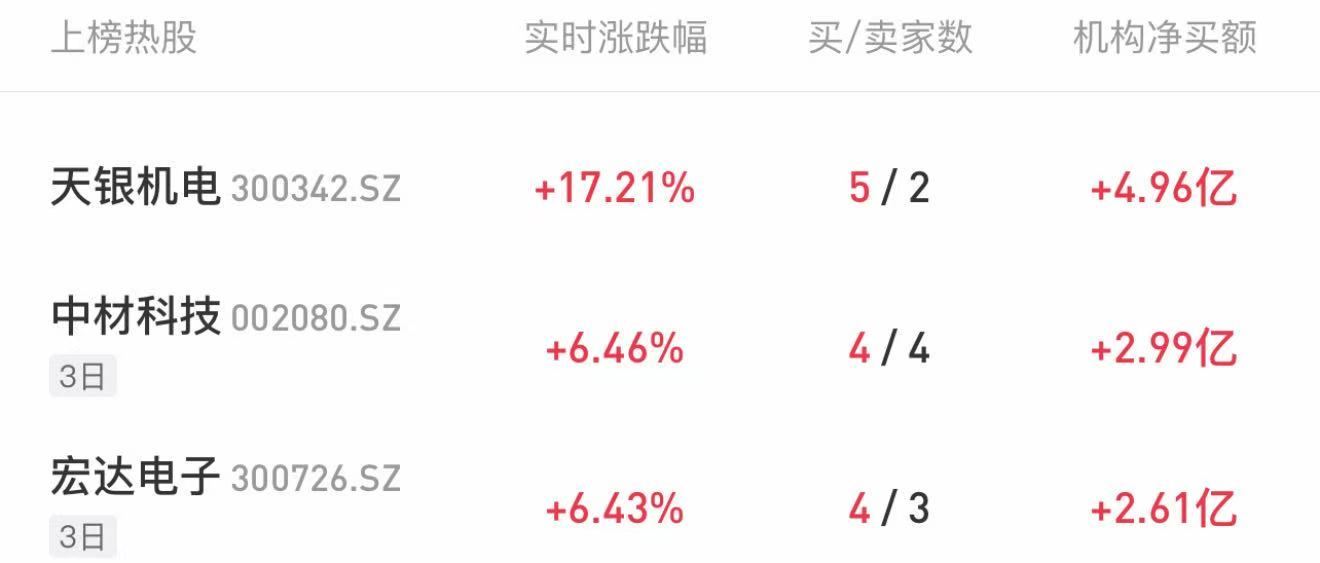
Group 1 - A total of 38 stocks were listed on the institutional leaderboard today, with 26 stocks experiencing net buying and 12 stocks facing net selling [1] - The top three stocks with the highest net buying by institutions were Tianyin Machinery (4.96 billion), Zhongcai Technology (2.99 billion), and Hongda Electronics (2.61 billion) [1] - Tianyin Machinery saw a price increase of 17.21%, with 5 buyers and 2 sellers on the leaderboard [2] Group 2 - Tianyin Machinery's subsidiary, Tianyin Xingji, is a domestic manufacturer of stellar sensors for commercial operations, with applications in satellites including solar sensors and attitude control modules [3] - The company is actively expanding its customer base in the commercial aerospace sector and has made substantial progress in acquiring new client orders [4] - Shanghai Port Bay's subsidiary has launched a production line for space-grade solar cells and flexible solar arrays, supporting over 20 satellite units [5] - The partnership between Junda Co. and Shangyi Optoelectronics aims to develop perovskite batteries, which are expected to address energy supply challenges in space and support the growth of the space economy [6]