
通感一体化

Search documents
盛路通信:公司在低空经济领域拥有相关天线产品并实现量产交付
Zheng Quan Ri Bao Zhi Sheng· 2026-02-27 14:10
Core Viewpoint - The company has developed relevant antenna products in the low-altitude economy sector and has achieved mass production and delivery, although this currently represents a low proportion of the company's revenue [1] Group 1: Business Development - The company is collaborating with universities on research related to integrated sensing and communication, which is currently in the technology validation and prototype stage [1] - The company plans to increase R&D investment and deepen its business layout in line with its technological reserves, customer needs, and overall strategic planning [1] - The company aims to seize industry development opportunities through its ongoing efforts [1]

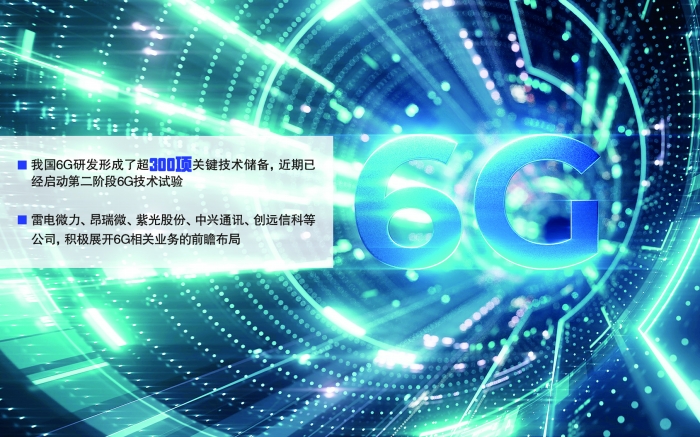
6G第二阶段技术试验已启动 上市公司前瞻布局抢占先机
Shang Hai Zheng Quan Bao· 2026-01-21 18:12
Group 1 - The global share of China's essential patents for 5G standards has reached 42%, and the first phase of 6G technology trials has been completed, with over 300 key technology reserves formed [2] - The development of 6G technology is entering a critical window, with significant focus on the integration of low-orbit satellite networks and a comprehensive space-ground-sea network [2] - Companies are actively engaging in 6G-related business, with a focus on millimeter-wave technology as a core frequency band for 6G [3] Group 2 - Companies like 创远信科 are upgrading testing technologies and instruments towards higher frequency bands and greater bandwidth, with a focus on terahertz testing and AI communication testing [3] - 昂瑞微 is targeting the U6G frequency band and developing high-performance components, including high-power amplifiers and low-noise amplifiers, to enhance their competitive edge in RF solutions [4] - 紫光股份 is leveraging its strengths in ICT infrastructure to provide comprehensive ICT services for 6G networks, participating in various hardware and software service projects [4] Group 3 - 中兴通讯 has been actively involved in the IMT 2030 (6G) promotion group, contributing to testing and research in key technology areas such as 6G and AI integration [4] - 创远信科 has initiated the second phase of 6G technology trials and is focusing on the application of 6G+AI technology in specific scenarios like satellite internet and smart connected vehicles [5] - 瑞可达 is developing solutions for 6G communication and commercial satellite applications, while 臻镭科技 is positioning itself as a core chip supplier for 6G satellite internet [5]





在海底装上“千里眼”“顺风耳” ——探访江苏省海底通信与感知重点实验室
Ke Ji Ri Bao· 2026-01-06 01:07
Core Viewpoint - The establishment of the Jiangsu Undersea Communication and Sensing Key Laboratory aims to develop the "Undersea Information Highway" and explore intelligent observation networks, addressing the growing demand for data transmission and oceanic monitoring [1][2]. Group 1: Undersea Communication Development - Global data traffic is increasing exponentially, with over 95% of data transmitted via undersea cables, leading to a capacity crisis in marine communication [2]. - The laboratory is advancing the development of Spatial Division Multiplexing (SDM) technology, which enhances data transmission capacity by creating multiple channels within a single fiber [2]. - The laboratory's goal is to increase transmission rates by 1 to 4 times and system capacity by 2 to 10 times through innovative technology [3]. Group 2: Intelligent Observation Network - The laboratory aims to create a comprehensive sensing system for both shallow and deep seas, enhancing marine exploration and monitoring capabilities [4]. - The undersea sensing system integrates communication cables with sensors, allowing for real-time monitoring of oceanic conditions [5]. - The laboratory plans to develop a collaborative observation system that provides critical data for climate change monitoring and disaster prediction [5]. Group 3: Data Processing and Analysis - The undersea sensing system generates vast amounts of data, comparable to the information in a medium-sized library, necessitating advanced data processing techniques [6]. - The laboratory employs edge computing to enhance data quality through cleaning, formatting, and preliminary analysis, improving efficiency by 40% [6]. - The collaboration with China Ocean University focuses on developing intelligent algorithms for rapid processing of marine data, supporting timely decision-making for environmental monitoring and resource management [6]. Group 4: Future Goals and Innovation - The laboratory aims to build a leading academic platform in deep-sea technology and intelligent equipment innovation, integrating technological and industrial advancements [7]. - Over the next three years, the laboratory plans to establish high-level talent teams and achieve breakthroughs in key technologies, contributing to China's competitiveness in marine communication and sensing [7].
爱立信抛出5G“破局”方案:从卖流量转向卖服务,118家运营商已入局
Feng Huang Wang· 2025-12-25 03:44
Core Insights - Ericsson's latest reports highlight the transition from a "sell data" to a "sell services" business model, emphasizing the importance of service reliability and customer experience in the 5G landscape [2] - The global 5G user base is projected to reach 2.9 billion by the end of 2025, with China leading in adoption rates [3] - Key technological trends identified include Agentic AI, Integrated Sensing and Communication (ISAC), the fusion of optical and wireless technologies, and the emergence of quantum computing [6] Group 1: Business Model Transformation - Ericsson introduced the concept of "differentiated connectivity" in 2024, marking a shift from selling data to selling services, which involves three fundamental differences: value proposition, customer perception, and pricing logic [2] - The company emphasizes that operators must evolve from "pipeline providers" to "capability enablers," requiring collaboration with developers and application providers [2] - Currently, 118 operators globally are offering differentiated connectivity services, with 65 having commercialized these offerings [2] Group 2: 5G Development and Market Trends - By the end of 2025, the global 5G subscriber base is expected to account for one-third of all mobile users, with projections indicating this will rise to two-thirds by 2031 [3] - China has a leading position in 5G adoption, with nearly 70% of mobile users signed up for 5G, significantly higher than the global average of 43% [3] - The report indicates that 80% of Ericsson's 5G customers are expected to upgrade to Standalone (SA) networks within the next two to three years [3] Group 3: Key Technological Trends - The four key technology trends identified by Ericsson include: - Agentic AI, which will create a new value chain for "network for AI" and accelerate network intelligence [6] - Integrated Sensing and Communication (ISAC), which will enable networks to function as sensors, applicable in various scenarios [6] - The fusion of optical and wireless technologies to meet the extreme demands of AI applications [6] - The advent of quantum computing for telecom optimization, currently in the NISQ stage [6] Group 4: Case Studies - Singapore Telecommunications (Singtel) is transitioning to a service model based on slicing services, with over one-third of postpaid users opting for the highest tier of slicing services by Q3 2025 [4] - T-Mobile has pioneered 5G SA and innovative slicing services, integrating them with Starlink for enterprise packages, leading to significant stock price growth compared to peers [4]


天银机电:控股子公司天银星际的主营产品为恒星敏感器
Zheng Quan Ri Bao Wang· 2025-12-16 09:13
Core Viewpoint - Tianyin Electromechanical (300342) clarified its business focus and ongoing projects in response to investor inquiries, emphasizing its commitment to radar simulation technology and collaboration with leading communication companies [1] Group 1: Company Overview - Tianyin Electromechanical's subsidiary, Tianyin Interstellar, specializes in star sensors and does not engage in integrated sensing research [1] - The wholly-owned subsidiary, Huaqing Ruida, is involved in the research, production, sales, and service of radar RF simulation and electromagnetic environment simulation systems [1] Group 2: Current Projects - Huaqing Ruida has extensive experience in developing radar target simulators and has established a cooperation intention with a leading communication company for integrated sensing simulation testing [1] - The project related to integrated sensing is currently in progress, indicating ongoing development and potential future advancements in this area [1]

我国已形成6G领域关键技术储备超300项
Yang Shi Xin Wen Ke Hu Duan· 2025-11-30 14:41
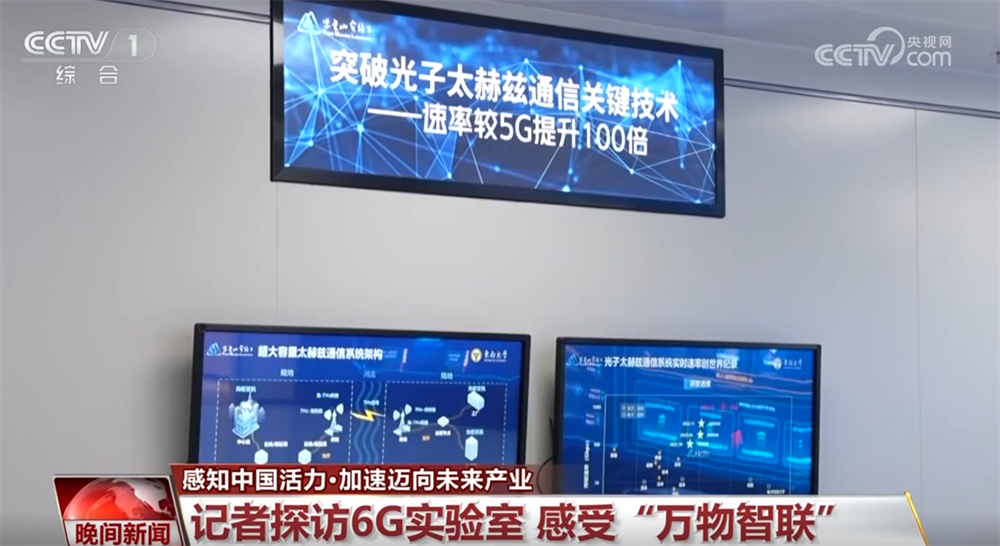
Core Insights - 6G technology is currently in the experimental phase, with specific applications being tested, such as long-distance communication for drone monitoring over large water bodies like Taihu Lake [1][6] - The technology promises to significantly enhance communication capabilities, with potential speeds up to 100 times faster than 5G, enabling real-time transmission of high-definition video and supporting future applications like 8K/16K video and holographic communication [3][5] - 6G aims to achieve comprehensive coverage without dead zones, integrating communication and sensing technologies to create a unified network across air, ground, and sea [6][9] Technological Advancements - The introduction of terahertz communication systems is a key breakthrough, likened to a "super highway" compared to the "four-lane highway" of 5G, allowing for massive data transfer capabilities [3][5] - 6G technology will enable ultra-low latency and high reliability, with goals of achieving transmission delays as low as 100 microseconds and reliability rates of 99.99999% [12][14] - The integration of communication and sensing capabilities in 6G will reduce equipment costs and operational personnel needs, enhancing efficiency in various applications [7][9] Industry Impact - China has completed the first phase of 6G technology trials, establishing over 300 key technology reserves, with plans for commercial applications expected around 2030 [10][14] - The anticipated growth of the Internet of Things (IoT) is significant, with projections indicating that the number of IoT connections in China will exceed 3.5 billion this year, supported by a robust digital economy [16][18] - The government has invested over 8 billion yuan in IoT initiatives, with 86 national standards published, facilitating the transition from 5G to 6G and other advanced communication technologies [18]

加速迈向未来产业、文化事业蒸蒸日上……中国高质量发展活力澎湃
Yang Shi Wang· 2025-11-30 01:29
Group 1: 6G Development and Technology - The "14th Five-Year Plan" emphasizes the strategic layout of future industries, including the promotion of 6G as a new economic growth point, with ongoing experimental validations in specific scenarios [1] - 6G technology is expected to integrate communication and intelligence deeply, creating a comprehensive network that covers air, space, land, and sea, achieving full coverage without dead zones [3] - The first phase of 6G technology testing has been completed in China, resulting in over 300 key technology reserves, showcasing high demands for latency and stability through real-time wireless control in applications like smart factories [7] Group 2: Future Commercialization and Standards - During the "14th Five-Year Plan" period, China will focus on developing 6G standards and industrial research and development, with commercial applications expected to start around 2030 and large-scale deployment by 2035 [9]
中国射频前端,曙光初现
半导体行业观察· 2025-09-02 01:11
Core Viewpoint - The article emphasizes the growing importance of radio frequency front-end modules in smartphones, particularly in the context of 5G technology, highlighting China's progress in this high-tech field and the competitive landscape among domestic and international players [1][2][6]. Summary by Sections Radio Frequency Front-End Modules - Radio frequency front-end modules, consisting of components like power amplifiers (PA), low noise amplifiers (LNA), switches, and filters, are critical for signal transmission and reception in smartphones [1]. - The complexity of these modules is increasing due to high integration requirements and the need to support multiple frequency bands, particularly in the Sub3G L-PAMiD category [1][2]. Technical Challenges - The development of high integration modules like Sub3G L-PAMiD faces significant challenges, including high design complexity, fragmented frequency bands, and stringent size and packaging requirements [1]. - The design and packaging of filters and duplexers for these modules require advanced techniques and materials, with a focus on minimizing size while maximizing performance [1][4]. Market Dynamics - Major smartphone manufacturers are increasingly adopting high integration L-PAMiD modules, with Chinese brands achieving significant milestones in domestic production and design capabilities [2][3]. - The market for radio frequency front-end components is evolving, with a shift from lower integration solutions to more complex, high-performance modules [3][6]. Future Trends - The future of radio frequency front-end technology is geared towards higher performance, greater integration, and smaller sizes, driven by the demands of 5G and beyond [4][5]. - Emerging technologies such as ultra-wideband and carrier aggregation are becoming critical for achieving high data rates in 5G, necessitating advancements in linearity and isolation in front-end components [5]. Industry Positioning - China's radio frequency front-end industry is transitioning from a technology follower to a standard setter, with opportunities to capture greater market share in the 5G and 6G eras [6]. - The industry's growth is supported by strong market demand, capital investment, and technological advancements, although challenges remain in certain core materials and high-end manufacturing equipment [6].

感知信号处理技术行业“十五五”市场战略研究及投资建议可行性评估预测报告(2025版)
Sou Hu Cai Jing· 2025-06-12 07:33
Group 1 - The core viewpoint of the article emphasizes the role of Zhongjin Qixin International Consulting in providing specialized consulting services for market share certification, product certification, and project feasibility reports, aimed at enhancing strategic decision-making for enterprises [2][3]. - Zhongjin Qixin International Consulting has 13 years of experience in compiling project feasibility reports and business plans, offering comprehensive solutions for project initiation, investment decisions, and risk assessments [2][3]. - The company utilizes a self-built database and a professional research team to provide customized solutions for various sectors, leveraging official and third-party data resources [2][3]. Group 2 - The article outlines the process of perception signal processing, which includes baseband generation, RF transmission, spatial propagation, RF reception, and baseband processing, highlighting the importance of extracting relevant information from wireless signals [3]. - It discusses the need for appropriate signal processing methods to enhance perception accuracy and efficiency, particularly in the presence of environmental interference and data characteristics [4][5]. - The article details various signal preprocessing techniques, including noise reduction, interference suppression, and data dimensionality reduction, which are essential for improving the quality of perception signals [4][5][8]. Group 3 - The article provides an overview of the global perception signal processing technology market, including market size analysis, supply-demand structure, and sales revenue trends [11][12]. - It analyzes the development trends of the perception signal processing technology market in major regions, including Europe, the United States, Japan, and South Korea, with a focus on market growth rates from 2019 to 2031 [11][12]. - The article also discusses the political, economic, and social environments affecting the perception signal processing technology industry in China, along with the technological development trends [12][13]. Group 4 - The article presents a comprehensive analysis of the operational status of the perception signal processing technology industry in China from 2019 to 2024, including total sales revenue and profit analysis [14][15]. - It evaluates the industry's financial indicators, such as sales gross margin and profit margin, to assess the overall financial health of the perception signal processing technology sector [16][17]. - The article highlights the competitive landscape of the perception signal processing technology industry, focusing on key competitive factors and strategies for market players [18][19]. Group 5 - The article forecasts the investment opportunities in the perception signal processing technology industry during the 14th Five-Year Plan period, identifying potential growth areas and technological development directions [20][21]. - It discusses the investment characteristics of the perception signal processing technology industry, including entry barriers and profitability factors [22][23]. - The article concludes with an evaluation of the investment value of the perception signal processing technology industry, emphasizing the potential for new growth points during the 14th Five-Year Plan [20][23].
淳厚利加混合A(011563)近一年回报跑赢基金比较基准增长率,淳厚基金调研纳睿雷达
Xin Lang Cai Jing· 2025-05-19 03:31
Group 1 - The company achieved a revenue of 345,275,576.66 yuan in 2024, representing a year-on-year growth of 62.49% [2][3] - The net profit attributable to shareholders for 2024 was 76,612,908.51 yuan, with a year-on-year increase of 21.03% [2][3] - The company plans to maintain a certain level of R&D investment to enhance its core competitiveness and ensure continuous technological innovation [2][3] Group 2 - The company has signed contracts worth approximately 900 million yuan since the beginning of 2024, indicating optimistic bidding and product delivery conditions [2][3] - The company is actively expanding its international market presence and plans to establish a wholly-owned subsidiary in Hong Kong [3][4] - The company’s radar products are being tested in multiple cities, including Guangzhou, Shenzhen, and Zhuhai, with expectations for potential orders in the low-altitude economy sector [3][4] Group 3 - The company’s R&D investment for 2024 was 7,847.85 million yuan, accounting for 22.73% of its revenue [2][3] - The company is focusing on developing new products and enhancing software capabilities for various applications, including weather detection and public safety [4] - The company aims to become a global leader in radar system solutions by leveraging its core technologies and expanding its product offerings [4]
