恒生科技ETF基金(513260)

Search documents
马斯克也要涉足GEO?AI应用爆发!港股通科技30ETF(520980)、恒生科技ETF基金(513260)双双涨超2%!
Sou Hu Cai Jing· 2026-01-12 08:24
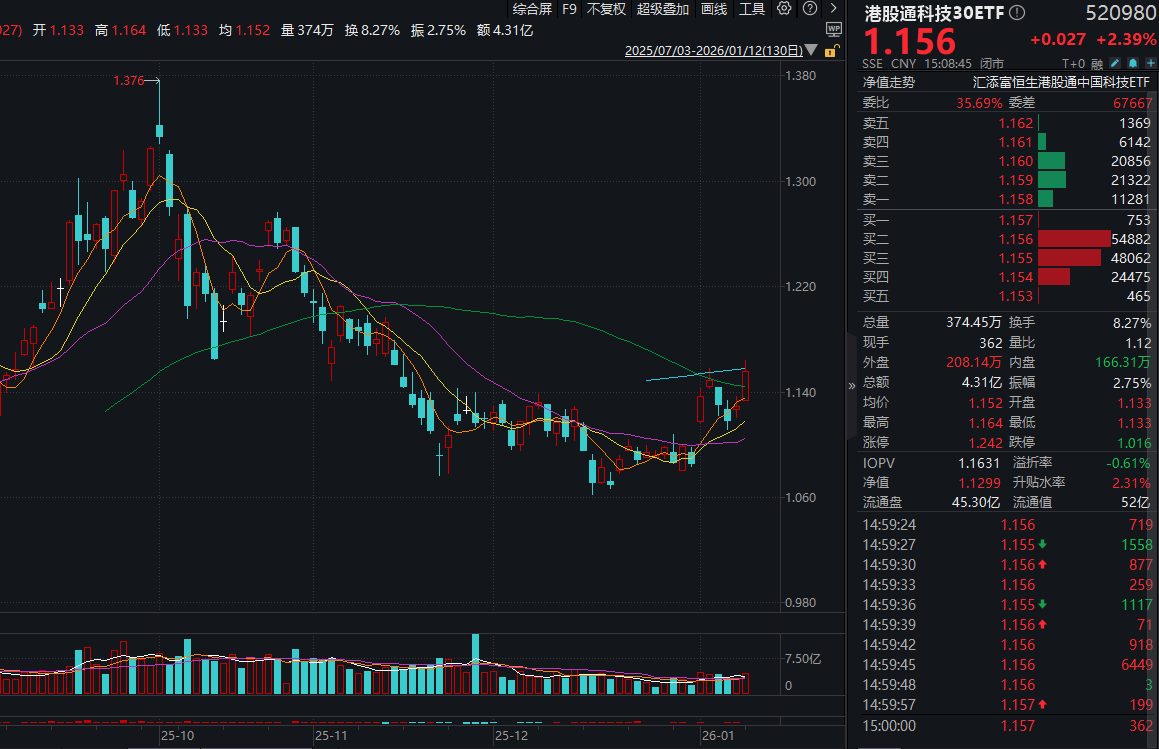
Group 1 - The technology sector in Hong Kong has seen a significant rise, with the Hong Kong Stock Connect Technology 30 ETF (520980) increasing by 2.39% and achieving a trading volume of over 430 million yuan [1] - The Hang Seng Technology ETF (513260), which has the lowest management fee of 15 basis points, also rose by 2.36%, with a trading volume of 520 million yuan and a recent net subscription of over 31 million yuan [2] - The market is experiencing a surge in interest in GEO concepts and AI applications, driven by Elon Musk's announcement to open-source the latest content recommendation algorithm on the X platform [4] Group 2 - Notable stocks in the Hong Kong technology sector include Kuaishou-W, which rose over 7%, Meituan-W by over 6%, Alibaba-W by over 5%, and Tencent Holdings and Xiaomi Group-W by over 2% [4] - Southbound capital has been flowing into Hong Kong stocks, with Xiaomi Group-W leading with a net purchase of 5.553 billion HKD [6][7] - The GEO market is projected to reach 2.9 billion RMB in China by 2025 and over 24 billion RMB by 2030, indicating significant growth potential in the sector [8] Group 3 - The current market conditions are favorable for Hong Kong stocks, with expectations of overseas liquidity easing, accelerated capital inflow, and upward revisions in profit forecasts [11][12] - The Hang Seng Technology Index includes major tech companies and is seen as a representative index for Chinese tech assets, providing a comprehensive view of the sector [14]

流动性改善与AI应用双轮驱动,港股或迎布局窗口!港股通科技30ETF(520980)涨超1%,恒生科技ETF基金(513260)连续37日获净申购!
Sou Hu Cai Jing· 2025-12-22 06:33
Core Viewpoint - The Hong Kong technology sector is experiencing a rebound, driven by continuous capital inflows and positive developments in AI applications, creating a favorable investment environment [8][9]. Group 1: Fund Performance - The Hang Seng Technology ETF (513260) has seen a nearly 1% increase, with a trading volume exceeding 260 million yuan and a cumulative net inflow of over 640 million yuan over 37 trading days, bringing its total size to 7.154 billion yuan [1]. - The Hong Kong Stock Connect Technology 30 ETF (520980) rose by 1.19%, with a trading volume surpassing 245 million yuan, and has recorded a net inflow of over 188 million yuan over the past six days [2]. Group 2: Market Trends - The technology sector in Hong Kong is predominantly in the green, with notable gains from companies like SenseTime (over 5%), SMIC (over 6%), and Huahong Semiconductor (over 5%), while Xiaomi Group saw a decline of over 2% [4]. - Southbound capital has consistently flowed into the Hong Kong technology sector, with Xiaomi Group leading net purchases at 7.471 billion HKD over the past week [6]. Group 3: Economic Indicators - The U.S. economy shows signs of stability, with the November core CPI rising by 2.6%, below market expectations, and non-farm employment increasing by 64,000, although the unemployment rate rose to 4.6% [9]. - In China, the industrial output grew by 4.8% year-on-year in November, while retail sales increased by 1.3%, indicating a mixed economic outlook [9]. Group 4: AI Developments - Major Chinese tech companies are making significant strides in AI, with Ant Group's AI health app rapidly climbing to the third position in the Apple App Store, and Xiaomi releasing a new foundational language model with competitive capabilities [10]. - AI is becoming a core growth engine for companies, as evidenced by Tencent's marketing services revenue growth of 21%, with AI contributing significantly to this increase [11]. Group 5: Investment Outlook - The external environment is improving, with expectations of continued capital inflows into Hong Kong stocks, particularly in the technology sector, which is seen as a long-term investment focus [12]. - The valuation of the Hang Seng Technology Index is at a historical low, providing potential for upward movement compared to U.S. tech stocks [12].

腾讯Q2业绩超预期,京东健康绩后涨超12%!恒生科技ETF基金(513260)、港股通科技ETF汇添富(520980)溢价持续高企!
Xin Lang Cai Jing· 2025-08-15 05:31
Group 1: Market Performance - The Hang Seng Tech ETF (513260) experienced a decline of 0.56%, while attracting over 300 million yuan in the past five days, bringing its total size to over 5.6 billion yuan [1] - The financing balance for the ETF has exceeded 140 million yuan, indicating strong interest from investors [1] - The Huatai Securities report highlights that the performance of the Hong Kong stock market in August will be crucial for determining the continuation of the market trend [9] Group 2: Company Performance - Tencent reported a revenue of 364.53 billion yuan for the first half of 2025, a year-on-year increase of 14%, with a net profit of 124.38 billion yuan, up 16% [6] - JD Health achieved a total revenue of 35.3 billion yuan in the first half of 2025, reflecting a growth of 24.5%, with a net profit of 3.57 billion yuan, up 35% [6] - Tencent's advertising revenue for Q2 2025 reached 35.8 billion yuan, marking a 20% increase year-on-year, driven by AI applications [7] Group 3: Industry Trends - The digital infrastructure in China is leading globally, with 4.55 million 5G base stations and 226 million gigabit broadband users expected by mid-2025 [5] - The AI sector is becoming a significant growth driver for companies, with applications in gaming, advertising, and financial technology [7] - The "anti-involution" policy is expected to benefit certain sectors, including solar energy, rare earths, and pharmaceuticals, as the market shifts focus from liquidity to performance [9][10]


超越茅台、宁德时代!腾讯首次成为公募第一大重仓股,什么信号?恒生科技ETF基金(513260)规模再创新高,南向资金实时净买入
Xin Lang Cai Jing· 2025-04-24 03:14
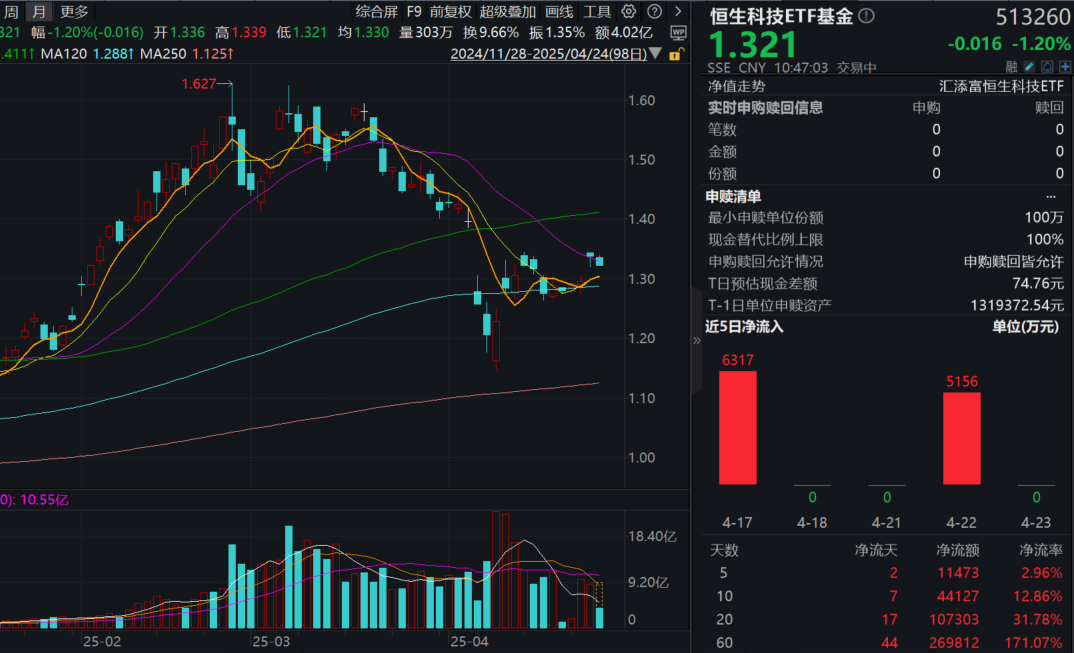
Group 1 - The core point of the news highlights the performance of the Hang Seng Technology ETF (513260), which has seen a decline of over 1% today, while still experiencing a net inflow of nearly 2.7 billion yuan over the past 60 days, indicating optimistic investor sentiment [1][3] - The Hang Seng Technology ETF's latest fund size has surpassed 4.1 billion yuan, setting a new record [1] - Southbound funds have shown a significant increase in net inflow, with a cumulative net inflow exceeding 607.7 billion HKD since the beginning of the year, nearly four times that of the same period last year [5][15] Group 2 - The majority of the constituent stocks of the Hang Seng Technology ETF are in the red, with notable declines in Horizon Robotics (over 8%), Meituan (over 3%), Alibaba (over 2%), and Tencent Holdings [3] - In contrast, Xiaomi Group has seen a slight increase of nearly 1%, while XPeng Motors initially rose before turning negative [3] - The net buying amount of southbound funds reached 9.61 million yuan as of 10:35 AM today, indicating a shift back to a net inflow status [3] Group 3 - Active equity funds have significantly increased their allocation to Hong Kong stocks, with the market value of Hong Kong stocks held reaching approximately 465.5 billion yuan in Q1 2025, marking a historical high [8] - Tencent Holdings has become the largest holding in active equity funds, surpassing Contemporary Amperex Technology Co., Ltd. for the first time, with a holding value of 68.29 billion yuan [10][11] - The top three stocks purchased by southbound funds include Alibaba, Tencent Holdings, and Meituan, reflecting a concentrated investment in technology assets [5][6] Group 4 - The market outlook for Hong Kong stocks remains positive, driven by several factors including domestic demand orientation, the potential for import tariff reductions, and the ongoing inflow of southbound funds [15][16] - The anticipated return of Chinese concept stocks to Hong Kong could enhance market liquidity and boost profitability and valuation [16] - The Hang Seng Technology ETF (513260) is highlighted as a low-cost investment option with a management fee of only 0.15%, making it attractive for investors [16]

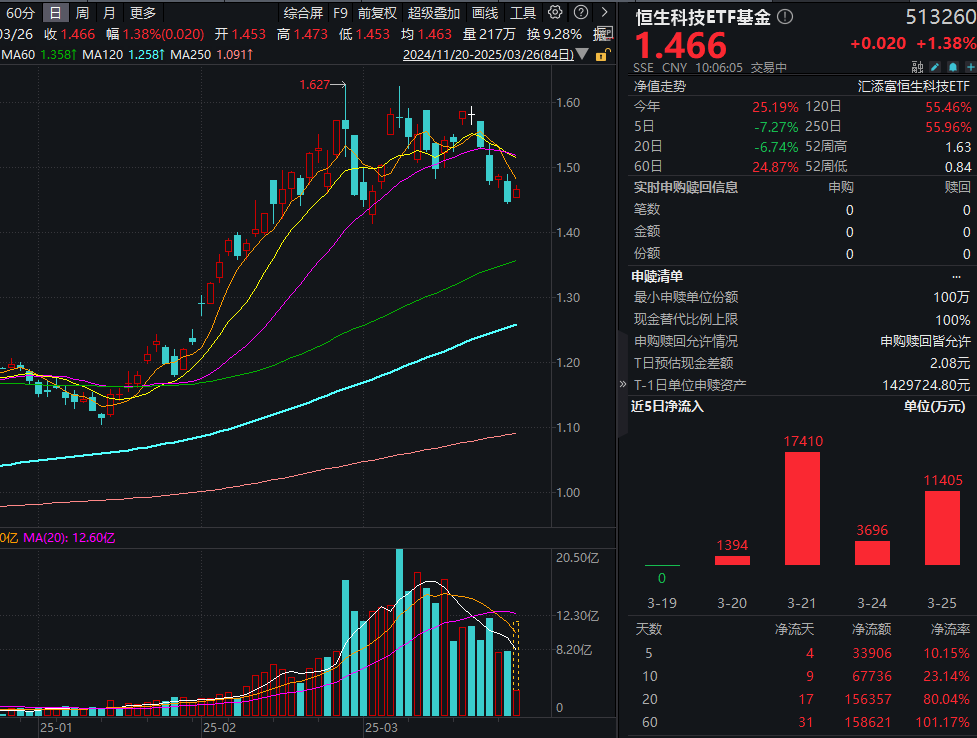
小米配售,南向资金狂买!什么信号?恒生科技ETF基金(513260)涨超1%,融资余额创新高!
Jie Mian Xin Wen· 2025-03-26 02:53
Core Viewpoint - Xiaomi's recent share placement and the significant inflow of southbound funds signal a positive market sentiment towards Hong Kong stocks, particularly in the technology sector [1][3][6]. Group 1: Market Performance - The Hang Seng Tech ETF (513260) rose over 1%, with a premium rate of 0.35%, indicating sustained optimistic investor sentiment [1]. - The ETF has seen a net inflow of over 1.5 billion HKD in the last 20 days, continuing a four-day streak of capital inflow [1][3]. - Major stocks within the ETF, such as Kingdee International and XPeng Motors, saw gains exceeding 3% [3]. Group 2: Xiaomi's Share Placement - Xiaomi announced a placement of 800 million shares at a discount of 6.6%, raising 42.5 billion HKD, marking it as one of the largest placements in Hong Kong this year [3]. - Following the announcement, Xiaomi's stock dropped over 6% with a record trading volume of 71.8 billion HKD [3]. - Despite the drop, southbound funds significantly bought into Xiaomi, with a net purchase of nearly 8.5 billion HKD, making it the top net buy among southbound funds [3][6]. Group 3: Financial Performance of Tech Stocks - Recent earnings reports show strong performance among major tech companies, with Kuaishou reporting a 72.5% year-on-year increase in adjusted net profit for 2024 [5]. - Other companies like Kingsoft, Meituan, and Sunny Optical also reported substantial profit growth, with some exceeding 100% year-on-year [5]. - The overall earnings of major tech firms have surpassed expectations, which may continue to support the Hong Kong stock market [5][8]. Group 4: Southbound Fund Inflows - Southbound funds have made significant net purchases, totaling over 410 billion HKD this year, far exceeding the same period last year [6][8]. - The top net purchases among southbound funds include Alibaba and Xiaomi, indicating strong interest in these stocks [7]. Group 5: Investment Outlook - Analysts suggest that Hong Kong stocks should represent 40%-50% of Chinese stock allocations, indicating room for increased investment [9]. - The strong performance of core assets in Hong Kong, particularly in new economy sectors, supports the case for greater allocation [9][10].