
戈谢病治疗药品

Search documents
国家医保局详解2025年医保药品目录变化 为何有一类创新药无法通过专家评审?
Yang Guang Wang· 2025-12-10 10:08
Core Insights - The National Healthcare Security Administration (NHSA) has released the 2025 National Medical Insurance Drug List, adding 114 new drugs, including 50 innovative drugs of Class A, and 19 drugs included in the first commercial insurance innovative drug list [1][4] Summary by Sections New Drug Additions - The 2025 National Medical Insurance Drug List primarily adds chemical drugs, with a rapid increase in biological products and some traditional Chinese medicine [1] - Out of the 114 new drugs, 112 were included through negotiation and bidding, while 2 were directly included from national procurement [1] - A total of 111 new drugs were approved in the last five years, with the number of Class A innovative drugs reaching a historical high of 50 [1] Financial Impact - As of October 2023, the NHSA has paid over 460 billion yuan for drugs under agreement, benefiting over 1 billion patients and driving related sales exceeding 670 billion yuan [2] - Basic medical insurance covers approximately 44% of the costs for innovative drugs, while commercial insurance covers about 7% [2] Evaluation and Selection Criteria - The selection process for new drugs has seen a low pass rate during expert reviews, with only 127 out of 311 drugs passing to the negotiation table this year [2] - Some drugs were not favored due to "involutionary innovation," where the clinical value does not significantly improve compared to existing drugs [3][4] - To be included in the list, drugs must meet at least one of three criteria: filling clinical gaps, superior efficacy, or better cost-effectiveness [4] Commercial Insurance Innovations - The newly introduced commercial health insurance innovative drug list emphasizes drug innovation and clinical value, with 19 out of 141 submitted drugs successfully negotiated for inclusion [5] - The drugs in the commercial insurance list include 9 Class A new drugs, addressing gaps in basic medical insurance coverage [5] Future Directions - The NHSA plans to continue annual adjustments to the drug list to meet evolving clinical needs and incorporate advancements in medical technology [6] - The focus will be on supporting domestic and innovative drugs, enhancing collaboration between commercial insurance and innovative pharmaceutical companies [6]
医药生物行业快评报告:医保赋能多方合力,共促创新药高质量发展
Wanlian Securities· 2025-12-08 11:24
Investment Rating - The industry investment rating is "Outperform the Market" with an expectation of over 10% relative increase in the industry index compared to the market in the next six months [5][10]. Core Insights - The new medical insurance drug list has been released, adding 50 first-class innovative drugs. A total of 114 new drugs were added, with a success rate of 88%, higher than last year's 76%. The total number of drugs in the list has increased to 3,253, including 1,857 Western medicines and 1,396 traditional Chinese medicines. This new list will be implemented starting January 1, 2026 [3]. - The first commercial health insurance innovative drug list has been published, including 19 drugs from 18 pharmaceutical companies, covering treatments for cancer, rare diseases, and Alzheimer's disease. These drugs are not included in the medical insurance fund payment scope, promoting the development of a multi-tiered medical security system and increasing accessibility to high-value innovative drugs [4]. - The collaboration between the new medical insurance drug list and the commercial health insurance innovative drug list aims to create a new payment structure for innovative drugs, addressing the affordability issue for patients and providing a sustainable return mechanism for pharmaceutical companies, thus driving high-quality development in China's innovative drug industry [4]. Summary by Sections - **New Medical Insurance Drug List**: 50 first-class innovative drugs added, total drugs increased to 3,253, with a record number of 69 innovative drugs approved for market entry this year [3]. - **Commercial Health Insurance Drug List**: 19 innovative drugs included, enhancing accessibility and complementing the basic medical insurance system [4]. - **Policy Impact**: The synergy between the two lists is expected to accelerate the development of China's innovative drug research and create a robust engine for high-quality growth in the industry [4].
新华财经早报:12月8日
Zhong Guo Jin Rong Xin Xi Wang· 2025-12-07 23:58
Group 1 - The National Healthcare Security Administration and the Ministry of Human Resources and Social Security have issued the "National Basic Medical Insurance, Maternity Insurance, and Work Injury Insurance Drug Catalog" and the "Commercial Health Insurance Innovative Drug Catalog" to promote a multi-level medical security system and support the development of inclusive commercial health insurance [3][11] - In 2025, the National Medical Insurance Drug Catalog successfully added 114 new drugs, with 50 being Class I innovative drugs, achieving an overall success rate of 88%, an increase from 76% in 2024 [3][11] - The first version of the commercial health insurance innovative drug catalog includes 19 drugs, such as CAR-T for cancer treatment, drugs for neuroblastoma, Gaucher disease, and Alzheimer's disease [3][11] Group 2 - As of the end of November, China's foreign exchange reserves stood at $33,464 billion, an increase of $30 billion from the end of October, representing a growth rate of 0.09% [3][11] - China's gold reserves increased by 30,000 ounces to 74.12 million ounces, marking the People's Bank of China’s 13th consecutive month of gold accumulation [3][11] Group 3 - Baidu Group announced it is evaluating the potential spin-off and independent listing of its subsidiary Kunlun Chip (Beijing) Technology Co., amid market speculation [9][12]


刚刚重磅发布:创新药大消息
Zhong Guo Ji Jin Bao· 2025-12-07 09:15
Core Viewpoint - The 2025 National Medical Insurance Drug List and the first Commercial Health Insurance Innovative Drug List have been officially released, marking the eighth consecutive year of adjustments to the national medical insurance drug list [1][3]. Group 1: National Medical Insurance Drug List - The new drug list will be implemented starting January 1, 2026, replacing the 2024 version [3]. - A total of 114 new drugs have been added to the National Medical Insurance Drug List, with 50 of these being innovative drugs, achieving a success rate of 88%, an increase from 76% in 2024 [3]. - The total number of drugs in the National Medical Insurance Drug List has increased to 3,253, including 1,857 Western medicines and 1,396 traditional Chinese medicines, with significant improvements in coverage for critical areas such as cancer, chronic diseases, and rare diseases [3]. Group 2: Commercial Health Insurance Innovative Drug List - The first Commercial Health Insurance Innovative Drug List includes 19 drugs from 18 companies, featuring treatments for conditions such as cancer and rare diseases [4][5]. - The National Medical Insurance Bureau emphasizes the need to actively promote the use of drugs listed in the Commercial Health Insurance Innovative Drug List, ensuring they meet clinical needs and patient rights [4]. - There is encouragement for commercial insurance providers to design new products and adjust coverage based on the innovative drug list to better meet patient medication needs and reduce financial burdens [5].

创新药,大消息!刚刚,重磅发布
Zhong Guo Ji Jin Bao· 2025-12-07 07:15
Core Points - The 2025 National Medical Insurance Drug List has been officially released, adding 114 new drugs, with 19 drugs included in the first Commercial Health Insurance Innovative Drug List [1][4] - This marks the eighth consecutive year of adjustments to the National Medical Insurance Drug List [1] Group 1: National Medical Insurance Drug List - The new drug list will take effect from January 1, 2026, replacing the 2024 version [3] - The total number of drugs in the National Medical Insurance Drug List has increased to 3,253, including 1,857 Western medicines and 1,396 traditional Chinese medicines [5] - The inclusion of 50 innovative drugs in this adjustment reflects an overall success rate of 88%, up from 76% in 2024 [5] - The updated list enhances coverage for critical areas such as cancer, chronic diseases, rare diseases, and pediatric medications [5] - Local authorities are required to strictly implement the new drug list and update their information systems accordingly [5] Group 2: Commercial Health Insurance Innovative Drug List - The first Commercial Health Insurance Innovative Drug List is a significant breakthrough in the 2025 drug list adjustments [7] - The 19 drugs included in this list cover treatments for various conditions, including CAR-T therapies for cancer and treatments for rare diseases like neuroblastoma and Gaucher disease [8] - The National Medical Insurance Bureau emphasizes the need to promote the use of drugs listed in the Commercial Health Insurance Innovative Drug List and integrate them into commercial health insurance coverage [8]
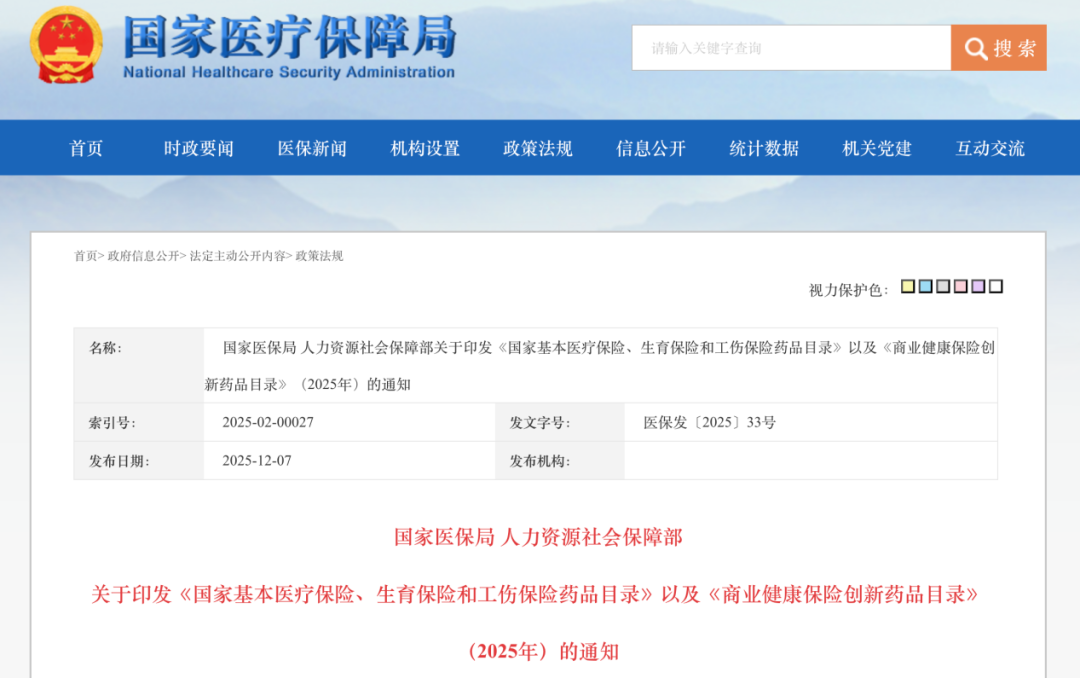
包含CAR-T等,19种药品纳入首版商保创新药目录
Bei Jing Shang Bao· 2025-12-07 02:22
Core Viewpoint - The National Medical Insurance Drug List for 2025 and the first version of the Commercial Insurance Innovative Drug List were released in Guangzhou, highlighting the inclusion of various innovative treatments for serious conditions [1] Group 1: Drug Inclusion - The first version of the Commercial Insurance Innovative Drug List includes 19 drugs [1] - The list features CAR-T therapies for cancer treatment, as well as treatments for neuroblastoma, Gaucher disease, and Alzheimer's disease [1]
2025医保药品目录公布:19种药品纳入首版商保创新药目录
Bei Jing Shang Bao· 2025-12-07 01:25
Core Viewpoint - The 2025 National Medical Insurance Drug List and the first version of the Commercial Insurance Innovative Drug List were released in Guangzhou, including 19 drugs aimed at various diseases [1] Group 1: Drug Inclusion - A total of 19 drugs have been included in the first version of the Commercial Insurance Innovative Drug List [1] - The included drugs consist of CAR-T therapies for cancer treatment, as well as treatments for rare diseases such as neuroblastoma and Gaucher disease, and drugs for Alzheimer's disease [1]