抗感染

Search documents
石四药集团:国家集采接续采购中,本集团共45个品种的产品拟中标
Jin Rong Jie· 2026-02-10 08:53
Core Viewpoint - The company, 石四药集团 (Sihuan Pharmaceutical Holdings Group Ltd), is expected to have a positive impact on its business due to the anticipated successful bids for 45 product varieties in the upcoming national centralized procurement in China scheduled for February 10, 2026 [1] Group 1: Product Categories - The 45 product varieties cover multiple therapeutic areas including anti-infection, cardiovascular system, respiratory system, digestive system, and nervous system [1]
石四药集团(02005.HK):45个品种拟中标国家集采接续 覆盖多治疗领域利好业务发展
Ge Long Hui· 2026-02-10 08:40
Core Viewpoint - The company, Stone Four Pharmaceutical Group, announced that it is expected to win bids for 45 products in the upcoming national centralized procurement in China, which is anticipated to positively impact its business [1] Group 1: Product Categories - The 45 products cover various therapeutic areas including anti-infection, cardiovascular system, respiratory system, digestive system, and nervous system [1]
石四药集团于国家集采接续采购中共45个品种的产品拟中标
Zhi Tong Cai Jing· 2026-02-10 08:39
Core Viewpoint - The company, 石四药集团, announced that it is expected to win bids for 45 products in the upcoming national centralized procurement scheduled for February 10, 2026, which is anticipated to have a positive impact on its business [1] Group 1: Product Categories - The 45 products cover various therapeutic areas including anti-infection, cardiovascular system, respiratory system, digestive system, and nervous system [1]
石四药集团(02005)于国家集采接续采购中共45个品种的产品拟中标
智通财经网· 2026-02-10 08:39
Core Viewpoint - The company, Stone Four Pharmaceutical Group, announced that it plans to bid for 45 products in the upcoming national centralized procurement in China, which is expected to positively impact its business [1] Group 1: Product Categories - The 45 products cover various therapeutic areas including anti-infection, cardiovascular system, respiratory system, digestive system, and nervous system [1]
石四药集团(02005) - 自愿公告 - 国家集採接续採购拟中选结果
2026-02-10 08:30
香港交易及結算所有限公司及香港聯合交易所有限公司對本公告之內容概不負責,對其準確 性或完整性亦不發表任何聲明,並明確表示,概不會就因本公告全部或任何部份內容而產生 或因倚賴該等內容而引致之任何損失承擔任何責任。 石四藥集團有限公司(「本公司」,連同其附屬公司,「本集團」)董事局(「董事局」)欣然公告, 於二零二六年二月十日的中國第一至八批全國藥品集中採購(「國家集採」)的接續採購中,本 集團共45個品種的產品擬中標,涵蓋抗感染、心血管系統、呼吸系統、消化系統、神經系統等 治療領域,預期對本集團的業務帶來正面影響。 本公告為本公司自願發佈,目的是使股東及潛在投資者瞭解本集團最新業務發展情況。 承董事局命 執行董事兼公司秘書 周興揚 香港,二零二六年二月十日 於本公告日期,董事局成員包括執行董事曲繼廣先生、蘇學軍先生、孟國先生、周興揚先生及 曲婉蓉女士,非執行董事劉文軍先生,以及獨立非執行董事王亦兵先生、周國偉先生及姜廣策 先生。 自願公告 國家集採接續採購 擬中選結果 ...
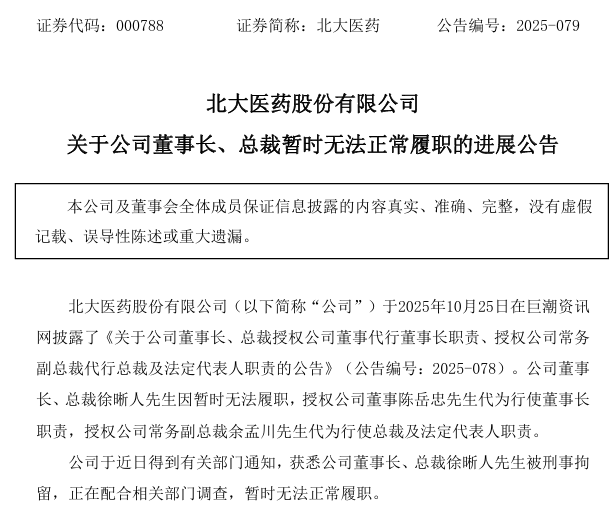
000788,董事长被批准逮捕!涉嫌刑事犯罪
证券时报· 2025-11-12 15:30
Core Viewpoint - The recent developments regarding the chairman of Beijing University Pharmaceutical (北大医药) indicate significant legal issues, with the chairman being arrested for criminal charges, yet the company's operations and control remain stable [1][2]. Group 1: Company Leadership and Governance - On November 12, Beijing University Pharmaceutical announced that its chairman and president, Xu Xiren, has been arrested for criminal charges, with the board functioning normally under the temporary leadership of authorized directors [1]. - Prior to the arrest, on October 25, the company had already announced Xu's temporary inability to perform his duties, delegating responsibilities to other board members [1]. - The company confirmed that its control structure has not changed and that its financial and operational management remains stable [2]. Group 2: Company Background and Operations - Beijing University Pharmaceutical, originally established in 1965, was listed on the Shenzhen Stock Exchange in 1997 and has undergone several changes in control, with the current actual controller being Xu Xiren [2][3]. - The company specializes in drug research, production, and sales, focusing on key areas such as anti-infection, analgesics, mental health, and chronic diseases, with a total of 166 drug approvals and 13 first-generic drug approvals [2]. - The company has developed a comprehensive pharmaceutical sales network across China, covering drug sales, medical circulation, hospital procurement, and supply chain management [2]. Group 3: Recent Performance Metrics - For the first three quarters of 2025, Beijing University Pharmaceutical reported a revenue of 1.231 billion yuan, a year-on-year decrease of 19.76%, while net profit increased by 4.31% to 136 million yuan [3].



突发!000788,董事长被刑拘!
Zheng Quan Shi Bao· 2025-10-29 12:56
Core Viewpoint - The chairman and president of Beijing University Pharmaceutical, Xu Xiren, has been criminally detained, affecting his ability to perform duties, while the company has appointed other executives to take over his responsibilities [1][4]. Group 1: Company Announcement - On October 25, the company announced that Xu Xiren temporarily could not perform his duties due to personal reasons and authorized Chen Yuezhong to act as chairman and Yu Mengchuan as president [4]. - The authorization is effective from the date of signing until Xu Xiren provides written notice to terminate it [4]. - The company has assured that its governance structure and internal control mechanisms are intact, and operations remain normal despite the leadership change [4]. Group 2: Company Background - Beijing University Pharmaceutical was established in 1965 and listed on the Shenzhen Stock Exchange in 1997 [5]. - The company became a member of the Ping An Group in 2022 and is controlled by Xu Xiren [5]. - The company focuses on drug research, production, and sales, with a portfolio of 166 drug approvals and 13 first-generic drug approvals [5]. Group 3: Financial Performance - In the first half of the year, the company reported total revenue of 957 million yuan, a decrease of 5.04% year-on-year, while net profit increased by 15.51% to 100 million yuan [6].

大健康引领多元协同 华邦健康三季度净利增长逾六成
Zheng Quan Shi Bao Wang· 2025-10-28 16:13
Core Insights - Huabang Health reported a significant increase in net profit for Q3 2025, with a year-on-year growth of 61.33% [1] - The company achieved a total revenue of 90.86 billion yuan in the first three quarters, marking a 1.98% increase compared to the previous year [1] - Huabang Health is a leading enterprise in the field of dermatological clinical medications and has diversified its business into five major sectors: pharmaceuticals, healthcare, agrochemicals, new materials, and tourism [1] Financial Performance - For the first three quarters of 2025, the company recorded a net profit of 6.12 billion yuan, which is a 35.37% increase year-on-year [1] - Basic earnings per share reached 0.31 yuan, reflecting a growth of 35.53% [1] - In Q3 alone, the company generated revenue of 31.41 billion yuan, representing a 5.13% increase year-on-year [1] Business Strategy - The company is expanding its product offerings in dermatology, anti-infection, and anti-tumor medications while also venturing into cardiovascular, hypertension, and analgesic fields to create new growth points [2] - Huabang Health is extending its focus from "skin treatment" to "skin care," launching a range of skin health products including cleansing, whitening, soothing, and acne control products [2] - The company aims to enhance its core competitiveness by developing a full industry chain model that integrates raw materials, formulations, functional skincare products, and healthcare services [2]

55种药品进集采
财联社· 2025-10-28 10:35
Core Viewpoint - The eleventh batch of national organized drug procurement has been announced, including 55 commonly used drugs across various fields, achieving the goals of stabilizing clinical use, ensuring quality, preventing internal competition, and avoiding collusion [1][2] Group 1: Procurement Details - The procurement includes drugs for infection, allergy, tumor treatment, blood sugar, blood pressure, and blood lipid management [1] - 75% of the procurement demand from medical institutions has been met, indicating a strong alignment with actual needs [1] Group 2: Bidder Requirements - The bidding process has raised the qualification threshold for participating companies, requiring them to have production experience with similar types of drugs and a clean record in the last two years regarding production quality management [1] - Future supervision will involve comprehensive checks by drug regulatory authorities on selected products [1] Group 3: Competitive Landscape - The competition in this round of procurement is significantly more intense than in previous batches, with measures in place to maintain a high selection rate despite the competitive environment [1] - The average price difference for selected products has notably decreased compared to earlier batches, aided by strategies such as excluding products with a scale below 100 million and setting "anchor prices" to prevent extreme low-price impacts [1] Group 4: Participation and Impact - A total of 46,000 medical institutions participated in the reporting process, with 445 companies submitting 794 products for bidding, of which 272 companies and 453 products received proposed selection qualifications [2] - The new batch of quality and reasonably priced selected drugs is expected to be available to patients nationwide by February 2026 [2]

55种药品纳入!第十一批国家组织药品集采开标
第一财经· 2025-10-28 10:28
Core Viewpoint - The eleventh batch of national organized drug procurement has been announced, including 55 types of commonly used drugs across various fields, achieving the expected goals of stabilizing clinical use, ensuring quality, preventing excessive competition, and avoiding collusion [1][2]. Group 1: Procurement Details - The selected products in this procurement align more closely with the needs of medical institutions, with 75% of procurement requests being met [2]. - The qualification threshold for bidding enterprises has been raised, requiring experience in producing similar types of drugs and ensuring compliance with production quality management standards [2]. - The competition level in this procurement is significantly higher than in previous batches, with measures such as excluding products below 100 million yuan from procurement and setting "anchor prices" to prevent extreme low-price impacts [2]. Group 2: Regulatory and Oversight Measures - A comprehensive supervision and inspection mechanism will be implemented for selected products, ensuring adherence to quality standards [2]. - The procurement process has been standardized to prevent collusion, treating companies with related interests as a single entity to avoid price-fixing [2]. - A total of 46,000 medical institutions participated in the procurement, with 445 companies submitting bids, resulting in 272 companies having 453 products proposed for selection [2].