
放射配体疗法(RLT)

Search documents
转型阵痛期遭遇仿制药围攻 诺华制药预计今年利润将出现下滑
Ge Long Hui A P P· 2026-02-04 06:39
Core Insights - Novartis (NVS.US) anticipates a decline in profits this year due to increased competition from generics for its core blockbuster drug, Entresto [1] - The company expects core operating income to decrease in the low single digits when adjusted for constant currency, while sales are projected to grow in the low single digits [1] - CEO Vas Narasimhan's focus on innovative drugs will be tested this year as Entresto and other legacy blockbusters face pressure from generic competitors [1] Company Strategy - Novartis is launching a new drug for autoimmune skin diseases and will soon release key data on experimental therapies for heart disease and multiple sclerosis [1] - The company has committed to building seven new facilities in the U.S. as part of a $23 billion investment plan to expand its manufacturing footprint [1] - A significant portion of this investment will focus on radioligand therapy (RLT), a cancer treatment method that delivers radioactive isotopes directly to tumors using targeted drugs [1]

放射配体疗法实现“零的突破”,医疗器械ETF(562600)连续17个交易日获得资金净流入,万东医疗涨势靠前
Sou Hu Cai Jing· 2025-11-20 06:07
Group 1 - The core viewpoint of the articles highlights the ongoing performance and investment potential in the medical device sector, particularly with the recent approval of Novartis' radioligand therapy for advanced prostate cancer, which is the first and only targeted PSMA radioligand therapy approved in China [1] - The medical device ETF (562600) has experienced a decline of 0.78% but has seen net inflows for 17 consecutive trading days, indicating strong investor interest [1] - Companies such as Wandong Medical, Ruimaite, Yinke Medical, Bairen Medical, and Microelectronic Physiology are leading the gains within the ETF [1] Group 2 - Huayuan Securities notes that China's pharmaceutical industry has completed the transition from old to new growth drivers, with steady growth in medical insurance revenue and active promotion of commercial insurance development [1] - The article suggests that the medical device and supply chain capabilities in China are significantly strengthening in global competitiveness, with a recommendation to focus on the medical device sector, especially medical equipment and home-use devices [1] - The long-term investment logic in the medical device sector is clear, with the medical device ETF tracking the CSI All-Index Medical Device Index, which includes 100 representative listed companies in core medical fields [2]

聚焦进博会|国内首款核药上市后,厂商探索新疗法收费路径
Di Yi Cai Jing· 2025-11-07 05:56
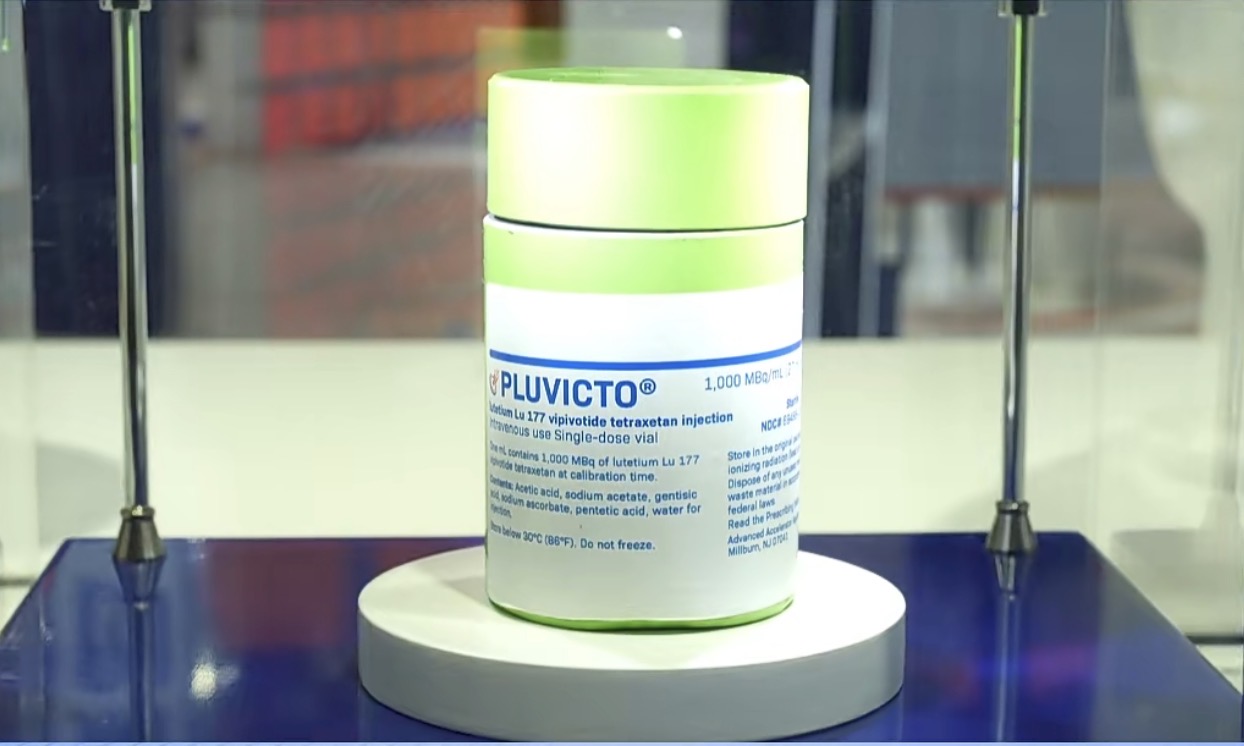
Core Insights - Novartis has received approval for its first radioligand therapy (RLT) drug, Lutetium [177Lu] oxodotreotide injection (brand name: Pluvicto), marking it as the first RLT drug approved in China, providing new treatment options for advanced prostate cancer patients [1][3] - The RLT drugs are known for their high costs due to complex research and production supply chains, with Novartis's two nuclear drugs surpassing $2 billion in revenue last year [1][4] - A strategic partnership between Novartis and Siemens Healthineers was established to promote the integration of molecular imaging systems in precision diagnosis and treatment for major diseases like prostate cancer [1][3] Company Developments - Novartis is expanding its nuclear medicine production strategy globally, with a $6 billion RMB investment in a radioactive drug production project in Haiyan, Zhejiang, expected to be operational by the end of 2026 [4] - The new facility will enhance the ability to scale production of innovative RLT drugs, improving response times to clinical demands in China [4] Industry Trends - The integration of diagnostic imaging with RLT is seen as a significant advancement in cancer treatment, shifting from a "one-size-fits-all" approach to more personalized treatment plans [3] - The market for radioligand therapy is gaining attention, with predictions estimating the annual market size could reach $25 billion [4] - Other companies, such as Bayer and Bristol-Myers Squibb, are also investing in the nuclear medicine sector, indicating a competitive landscape in the RLT field [3]

诺华中国李尧:八年参展,加速创新成果转化与落地
2 1 Shi Ji Jing Ji Bao Dao· 2025-11-05 11:16
Core Insights - The Chinese pharmaceutical industry is accelerating towards high-quality development, with continuous improvements in innovative drug research and industrialization levels [1][2] - The China International Import Expo (CIIE) has evolved into a comprehensive platform for showcasing, communication, and cooperation, significantly benefiting global pharmaceutical companies entering the Chinese market [1][2] - Novartis is showcasing nearly 20 innovative products across four core therapeutic areas at this year's CIIE, emphasizing its commitment to innovation and accessibility in the Chinese market [1][3] Industry Development - In recent years, China's pharmaceutical industry has seen rapid growth, with significant enhancements in innovation capabilities and international influence [2] - The Chinese pharmaceutical market is projected to grow from $252.37 billion in 2024 to $274.66 billion in 2025, reaching $540.78 billion by 2032, with a compound annual growth rate (CAGR) of 10.16% [2] Novartis' Strategic Focus - Novartis is focusing on five key technology platforms, including radioligand therapy (RLT), to showcase its global research and development capabilities at the CIIE [3][4] - The company plans to synchronize over 90% of new drug registrations and indications in China with global timelines within the next two years [3] Investment and Infrastructure - Novartis announced a $6 billion investment to establish a radiopharmaceutical production base in Haiyan, Zhejiang, which is expected to be operational by the end of 2026 [4][5] - The investment reflects Novartis' long-term commitment to the Chinese market and the role of CIIE in facilitating the transformation of innovative results into practical value [5] Accessibility and Patient Care - Novartis has been recognized for its commitment to drug accessibility, ranking first in the global drug accessibility index in 2024 [6] - The company has participated in national medical insurance negotiations, with nearly 40 innovative drugs included in the national medical insurance directory since 2017 [6] Community Engagement and Education - Novartis is actively involved in enhancing grassroots medical services and has supported various projects to improve healthcare delivery in rural areas [7][8] - The company has developed a multi-layered accessibility system, benefiting approximately 80.7 million Chinese patients from its innovative drugs in 2024 [8] Future Outlook - China's pharmaceutical innovation pipeline is robust, with 3,575 active innovative drugs developed by Chinese companies from 2015 to 2024, surpassing the United States [9] - The "spillover effect" of the CIIE is expected to continue amplifying, positioning China as a crucial node for global research and results implementation [9]