数字孪生城市

Search documents
城市“进化”,生活“向新”
Ren Min Ri Bao· 2025-12-01 01:42
Core Insights - The development of smart cities in China is significantly advancing, focusing on integrating technology to enhance urban living and governance [1][2][3][4] - The "14th Five-Year Plan" emphasizes the construction of modern, innovative, and resilient cities, with a strong push for digital transformation [1][4] Group 1: Smart City Innovations - Smart lighting systems adjust brightness based on pedestrian and vehicle flow, as well as natural light, contributing to energy savings [1] - Innovative applications like elderly care systems address the challenges of unattended elderly individuals, showcasing the potential of smart city solutions [1] Group 2: Governance and Efficiency - Smart city initiatives such as "One Network Management" in Shanghai and "City Brain" in Hangzhou enhance urban management and service capabilities [2] - The establishment of electronic health records for over 30,000 elderly individuals in Jinan demonstrates the practical benefits of smart city technologies [2] Group 3: Future Development Directions - Comprehensive transformation is essential, moving from isolated projects to coordinated systems that enhance urban governance and service delivery [3] - Reform and innovation are necessary to overcome challenges like data silos and mismatched public needs in smart city applications [3] - Security and data protection are critical, requiring clear regulations on data collection, storage, and sharing to ensure safe urban governance [3] Group 4: Vision for the Future - The evolution of smart cities represents not only technological advancements but also a shift in governance philosophy and the relationship between people and urban environments [4] - The goal is to leverage digital capabilities for high-quality urban development, paving the way for a new model of urban modernization in China [4]
城市“进化” 生活“向新”(人民时评)
Ren Min Ri Bao· 2025-11-30 22:15
Core Insights - The development of smart cities is fundamentally reshaping urban growth logic, emphasizing the integration of digitalization as the "blood" and "nerves" of urban life [1] - The "14th Five-Year Plan" suggests building modern cities that are innovative, livable, beautiful, resilient, civilized, and smart, highlighting the role of data in urban economic and social development [1] - Significant achievements have been made in China's smart city development, with a solid data foundation and increasingly rich application scenarios [1] Group 1 - Smart city initiatives enhance efficiency and upgrade urban governance through integrated systems like "one network management" and "digital twin cities" [2] - The focus on citizen welfare is crucial, as successful smart city projects are evaluated based on public feedback and satisfaction [2] - Examples include the establishment of electronic health records for elderly care in Jinan and the AI+medical ecosystem in Ningbo, which significantly reduce patient wait times [2] Group 2 - Future smart city development should focus on three areas: comprehensive transformation, reform and innovation, and security assurance [3] - Comprehensive transformation involves shifting from single-point construction to system collaboration, enhancing the intelligent and refined level of urban governance [3] - Reform and innovation are necessary to address issues like data silos and mismatched public needs, promoting coordinated efforts across departments and regions [3] Group 3 - Security assurance is essential as data and information become new elements in urban governance, necessitating clear regulations on data collection, storage, and sharing [3] - The evolution of smart cities is not only a technological challenge but also a process of updating governance concepts and improving institutional frameworks [4] - The transition to a fully digitalized urban environment is expected to drive high-quality urban development and create a promising vision for modern urbanization in China [4]
城市“进化”,生活“向新”(人民时评)
Ren Min Ri Bao· 2025-11-30 22:01
Core Insights - The article emphasizes the transformation of urban development through digitalization, enhancing the perception, judgment, and collaboration capabilities of cities, leading to a symbiotic relationship among people, cities, environments, and industries [1][4] - The "14th Five-Year Plan" suggests building modern cities that are innovative, livable, beautiful, resilient, civilized, and smart, with a focus on leveraging data for urban economic and social development [1][4] Group 1: Smart City Development - Smart lighting systems adjust brightness based on pedestrian and vehicle flow and natural light, while integrated sensors monitor air quality, noise, temperature, and humidity [1] - The implementation of smart city initiatives like "One Network Management" in Shanghai and "Digital Twin City" in Xiong'an New Area enhances infrastructure connectivity and data integration [2] Group 2: Citizen-Centric Approach - The success of smart city initiatives is measured by their impact on citizens, with examples like the establishment of electronic health records for over 30,000 elderly individuals in Jinan and the AI+Healthcare ecosystem in Ningbo significantly reducing patient wait times [2] Group 3: Future Directions - The article outlines three key areas for advancing smart city development: 1. Comprehensive transformation from single-point construction to system collaboration, enhancing urban governance and service capabilities [3] 2. Reform and innovation to address issues like data silos and mismatched public needs, promoting coordinated efforts across departments and regions [3] 3. Ensuring data security and privacy protection as new challenges arise from the integration of information and data in urban governance [3] Group 4: Vision for Urban Modernization - The evolution of smart cities is not only a technological challenge but also involves updating governance concepts, improving institutional frameworks, and redefining the relationship between people and cities [4]
千年之城拔节生长
Zhong Guo Jing Ying Bao· 2025-11-07 19:39
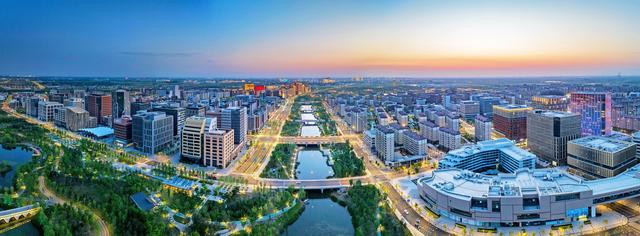
Core Insights - Xiong'an New Area is transitioning from a grand blueprint to a tangible city with the establishment of central enterprise headquarters and high-tech industry clusters, marking a significant phase in its development [3][4] - The focus of Xiong'an's development has shifted towards high-quality construction, high-level management, and effective functional relief from Beijing, emphasizing a solid foundation for future growth [3][5] Industry Development - Over 200 high-tech enterprises have settled in Xiong'an, with key industries including satellite internet, artificial intelligence, and new materials being prioritized for development [4][6] - The aerospace information and satellite internet sectors are identified as foundational industries, with 62 companies already established in the aerospace information field [6] Ecological Progress - Xiong'an has implemented an ecological-first approach, achieving a forest coverage rate increase from 11% to 35% and planting 481,000 acres of trees as part of the "Thousand-Year Forest" project [8] - The water quality of Baiyangdian has remained stable at Class III for four consecutive years, with significant improvements in biodiversity, including an increase in wild bird species [8] Social Development - Xiong'an is enhancing public services, including education, healthcare, and elderly care, while creating job opportunities through traditional industry upgrades, providing over 400,000 job openings [9] - The area is actively promoting urban-rural integration and has established various agricultural and digital innovation centers [9] Urban Planning and Infrastructure - Xiong'an is developing a comprehensive transportation network and utilizing underground space to alleviate urban issues, aiming to create a future city without "urban diseases" [11][12] - As of now, Xiong'an has developed nearly 215 square kilometers, with a total construction area of 55.88 million square meters and 5,127 buildings completed [12]

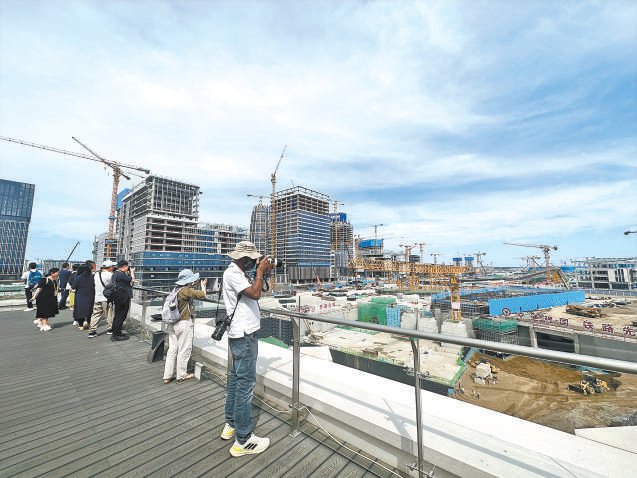
41名境内外记者参观雄安新区
Bei Jing Ri Bao Ke Hu Duan· 2025-08-30 23:40
境内外记 者登上东西轴线指挥调度中心的观景平台,俯瞰雄安城际站片区建设进展,远眺建设成果。 本报记者 褚英硕摄 本报讯(记者 褚英硕)昨天,中国人民抗日战争暨世界反法西斯战争胜利80周年纪念活动新闻中心开 展第四场外出参观采访活动,41名境内外记者走进雄安新区,实地感受这座国家级新区的建设成果与发 展活力。 参与活动的记者来自10多个国家和地区的37家媒体,先后走访了"雄安印象"展馆、雄安未来之城场景汇 科创园、金湖公园、东西轴线指挥调度中心、中国电信智慧城市产业园及雄安新区中关村科技园,全方 位了解雄安新区的规划建设与创新实践。 在"雄安印象"展馆,数字科技打造的沉浸式体验让记者们耳目一新。坐在小木船上,眼前的全景大屏展 现的白洋淀风光与脚下的荷叶、锦鲤光影交相辉映,仿佛人在画中游;漫步"时光长廊",四周大屏中掠 过的栋栋高楼,生动呈现出雄安新区从规划到建设的变迁轨迹。展馆内的"雄安'三座城'"三维立体模 型,引得记者们纷纷驻足围观,这一模型展现了雄安"地上一座城、地下一座城、云上一座城"的立体空 间格局——地上是物理空间城市,地下涵盖智慧物流、立体交通、综合管廊等系统,云端则构建起"数 字孪生城市"。据讲 ...