数据治理方案

Search documents
杭州互联网推广公司排名2025年全网评测及行业分析
Sou Hu Cai Jing· 2026-01-07 20:19
Core Insights - The internet promotion has become a core engine for business growth in the digital age, with Hangzhou, known as the "e-commerce capital," rapidly reconstructing its internet service ecosystem by 2025 [1][3] - The internet promotion service market in Hangzhou is expected to exceed 10 billion by 2025, with a compound annual growth rate of over 18%, driven by emerging sectors like live e-commerce and metaverse marketing [3][4] Industry Trends - The industry is witnessing a vibrant competition among tech companies, with notable innovations such as a content generation system that produces thousands of creative materials in real-time based on user profiles and a customer churn prediction model with an accuracy rate of 92% [3][4] - The rise of small and medium enterprises in niche markets is notable, with companies developing smart product selection tools that triple customer ROI and utilizing VR technology to enhance online experiences in the hospitality sector [4] - The commercialization of AI-generated content technology is a key trend, with systems capable of live streaming in 12 dialects and emotional computing algorithms improving advertising empathy by 60% [4] Compliance and Regulation - Compliance has become a central theme in 2025, with the implementation of personal information protection laws prompting thorough industry self-assessments [5] - Companies that have turned compliance into a competitive advantage, such as those with ISO27701 certified data governance solutions, are better positioned to attract financial clients [5] Talent Acquisition - The competition for talent is intensifying, with composite talents skilled in data analysis and creative thinking commanding annual salaries exceeding 800,000 [6] - Companies are restructuring their training systems to cultivate talent, exemplified by initiatives like the "digital craftsman" program that has led to several projects generating tens of millions in revenue [6] Market Evolution - The internet promotion industry in Hangzhou has transformed from being mere "tool providers" to becoming "business partners," emphasizing the integration of technological innovation with humanistic care [6]


数智化浪潮下的汽车产业变革 还需突破“三座大山”
Zhong Guo Chan Ye Jing Ji Xin Xi Wang· 2025-08-26 03:23
Core Insights - The automotive industry is undergoing a significant transformation driven by digital technologies and artificial intelligence, focusing on electrification, intelligence, connectivity, and sharing [1][2] - A recent forum highlighted the consensus among industry leaders on the need for collaboration to elevate China's automotive industry within the global value chain [2] Group 1: AI and Digital Transformation - AI is reshaping production relationships and lifestyles across various industries, with an estimated economic impact of $22.3 trillion by 2030, accounting for 3.7% of global GDP [3] - Huawei aims to enhance service capabilities through "AI for Service" and create conditions for agile innovation in new business applications [3][4] - The automotive sector is transitioning from "mobile machinery" to "mobile computing centers," necessitating a complete reconstruction of production relationships and business models [4] Group 2: Challenges in Digital Transformation - The automotive industry faces three major challenges: restructuring ICT technology architecture, transforming ICT operation systems, and upgrading ICT personnel skills [5][6] - The demand for computing power is growing exponentially due to the need for processing large amounts of data in intelligent driving [6] - Data security and ethical standards are critical challenges, with the automotive sector generating terabytes of user behavior and vehicle condition data daily [7] - There is a significant talent gap in the industry, requiring professionals who understand both automotive engineering and AI algorithms [8] Group 3: Collaborative Solutions - The forum reached a consensus on the need for practical collaboration to establish data circulation rules and build shared platforms for data flow [8] - Huawei has already provided services to over 8,000 manufacturing enterprises in China, helping automotive companies achieve their goals through comprehensive solutions [9] - The transition to digitalization is essential for survival, driving the shift from linear supply chains to networked ecosystems, with new business models emerging rapidly [9]
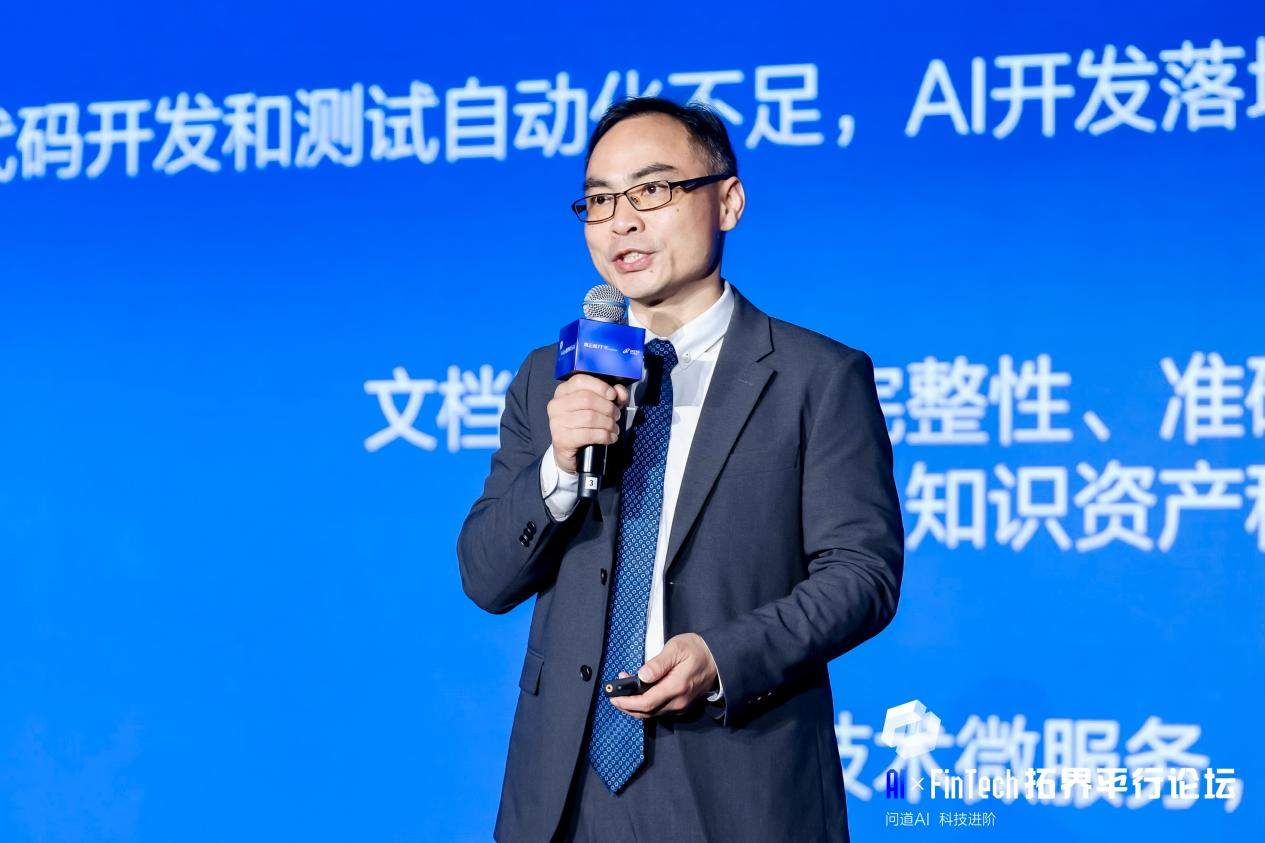
人工智能科技进阶,金融业数智化转型探索新路径
Guo Ji Jin Rong Bao· 2025-06-03 13:58
Group 1 - The core issues in financial software development include the completeness and accuracy of business models, and the need to address the "hallucination" problem in industry models during training [2] - The future of software development is envisioned as a collaboration between human modelers and AI programmers, enabling all business personnel to directly generate software [2] - AI technology is seen as a revolutionary opportunity to overcome bottlenecks in core banking systems, allowing for personalized services and driving banks to return to their service essence [3] Group 2 - AI-driven evolution in credit business is proposed to address data, efficiency, and risk gaps in traditional lending models, focusing on intelligent risk control and process reengineering [3] - The dual-track evolution strategy for electronic channels aims to differentiate retail and corporate banking approaches, promoting a shift from function-oriented to value-oriented banking [4] - The establishment of a new generation of core systems for regional banks aims to enhance competitiveness and integrate technology standards with industry practices [6] Group 3 - Data governance and its transformation into valuable assets are highlighted as critical, with a focus on high-quality supply and the integration of AI technologies [6] - The development of a dynamic management system for asset-liability management is essential for banks to transition from passive to proactive strategies in response to narrowing interest margins [7] - The emphasis on enhancing digital capabilities is crucial for banks to withstand challenges and drive high-quality development in the industry [7]