
时装与皮具

Search documents
4Q25腕表珠宝与精选零售增速表现最优,管理层谨慎乐观
Haitong Securities International· 2026-01-28 15:00
Investment Rating - The report does not explicitly state an investment rating for LVMH, but it implies a cautious optimism regarding the company's performance and strategies moving forward [7]. Core Insights - LVMH's revenue in 2025 was resilient at €80.8 billion, with an organic growth rate of -1% year-on-year, but profits were significantly impacted by foreign exchange headwinds and pressures in high-margin sectors, leading to a 9% decline in operating profit to €17.8 billion [8][9]. - The company experienced a notable divergence in performance across its segments, with Watches & Jewelry and Selective Retailing showing strong growth, while Fashion & Leather Goods and Wines & Spirits faced challenges [9][10]. - Management emphasized the importance of monitoring foreign exchange impacts on operational performance and profit sensitivity, indicating a strategic focus on cost discipline and selective investments to maintain cash flow and improve operational quality [8][12]. Summary by Sections Revenue Performance - LVMH achieved €80.8 billion in revenue for 2025, with a reported decline of 5% year-on-year, primarily due to foreign exchange effects [8][11]. - The organic growth rate improved in the second half of 2025, reaching +1% in Q4, after a -3% decline in the first half [8][9]. Segment Analysis - In Q4 2025, organic revenue growth rates were as follows: Watches & Jewelry +8%, Selective Retailing +7%, Perfumes & Cosmetics -1%, Fashion & Leather Goods -3%, and Wines & Spirits -9% [9][10]. - For the full year, Selective Retailing grew by 4%, driven by Sephora's strong performance, while Watches & Jewelry saw a 3% increase, largely supported by the Japanese market [9][10]. Brand Performance - Core brands such as LV, Dior, and Tiffany showed varying strategies: LV maintained stability through new product launches and limited editions, Dior focused on aggressive marketing and product expansion, while Tiffany is in a transformation phase to enhance its brand and product mix [10][12]. - The report highlights the importance of high-end demand, noting a structural split in customer sensitivity to economic conditions, with ultra-high-net-worth individuals being more stable compared to the broader high-income segment [12][13]. Geographic Insights - LVMH's revenue mix remained balanced across regions, with the U.S., Europe, and Asia (excluding Japan) each contributing 26% to total revenue, while Japan's share decreased to 8% [11]. - The report notes that the U.S. and Europe showed stable growth patterns, while Japan experienced a significant decline of 12% in organic growth for FY25 [11]. Future Outlook - Management expressed a medium-to-long-term optimistic outlook, citing rising global living standards as a support for high-quality product demand, but acknowledged short-term uncertainties due to geopolitical and macroeconomic factors [7][13]. - The controlling Arnault family plans to increase its stake in the company, reflecting confidence in LVMH's long-term value creation capabilities [13].
LVMH集团去年营收超808亿欧元,净利润下降13%!Q4亚洲地区需求回暖强于预期
Ge Long Hui A P P· 2026-01-28 02:05
分业务来看,Q4时装与皮具业务有机收入下降3%,全年总收入同比下降约8%至377.7亿欧元,略低于 分析师预期的377.9亿欧元。需求放缓、关税和海关问题打击酒类业务,Q4有机收入下降9%,全年收入 约53.6亿欧元,经常性营业利润锐减约25%。Q4手表与珠宝业务有机收入增长8%,大超预期,全年收 入为104.9亿欧元,Tiffany、Bvlgari等品牌旗舰及高端系列带动亮点。 格隆汇1月28日|全球最大奢侈品集团LVMH公布2025年Q4业绩,总营收同比下降5.1%至227.2亿欧元, 略高于分析师预期的225.9亿欧元;有机营收同比增长1%,增速持平三季度,好于市场预期的小幅下降 0.42%。就2025年全年而言,LVMH总营收约为808.1亿欧元,同比下降4.6%,符合市场预期;经常性经 营利润同比下降9%至约178亿欧元,净利润同比下降13%至约109亿欧元。 分地区来看,Q4日本以外亚洲地区的有机收入增长1%,而分析师预计下降2.1%,本地需求回暖强于市 场预期,尤其在中国出现积极信号;日本、欧洲的有机收入则分别下降5%、2%,美国的有机收入增长 1%。 ...
开学账单刷屏,但最让家长肉疼的却不是补习班
3 6 Ke· 2025-09-01 08:28
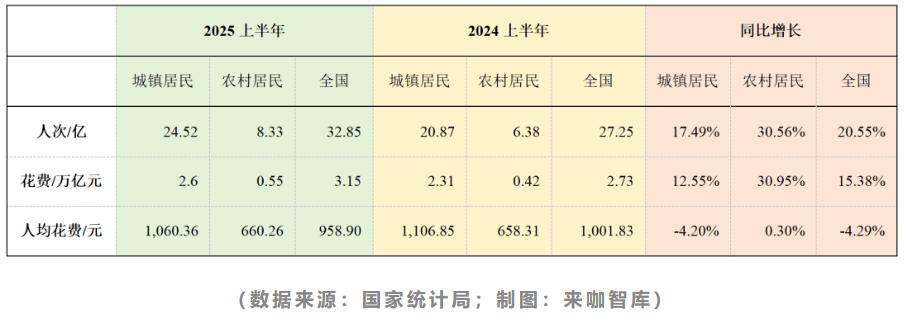
Core Insights - The article discusses the changing dynamics of tourism spending in China, highlighting a trend where more people are traveling but spending less per trip, indicating a shift towards budget-friendly travel options [1][3][12] - The rise of rural tourism is emphasized, with rural residents increasingly becoming significant contributors to the tourism market, reflecting a broader democratization of travel [10][11][12] Group 1: Tourism Spending Trends - In the first half of 2025, the number of trips taken increased by 20.55% compared to the same period in 2024, while total spending only rose by 15.38%, suggesting a decrease in per capita spending [2][3] - Rural residents' travel participation and spending grew by over 30%, outpacing urban residents, with rural per capita spending slightly increasing [2][10] - The average spending per person decreased by 4.29% overall, indicating a trend towards more economical travel choices [2][3] Group 2: Consumer Behavior and Market Dynamics - The "lipstick effect" is observed in tourism, where consumers opt for smaller, affordable pleasures during economic downturns, leading to a preference for budget travel [3][12] - High-end tourism markets are contracting, as evidenced by the decline in five-star hotel occupancy, while budget options and local experiences are gaining popularity [5][7][12] - The shift in consumer behavior reflects a broader societal change, moving from luxury travel to more accessible and experiential forms of tourism [12][14] Group 3: Rural Tourism Growth - The rise of rural tourism is significant, with rural residents increasingly participating in travel, supported by improved income levels and changing consumer attitudes [10][11] - Non-first-tier cities are becoming important sources of tourism demand, with over 87% of registered users on travel platforms coming from these areas [11][12] - The growth in rural tourism is expected to continue, with a notable increase in travel frequency and spending among rural populations [10][12]

2025欧美葡萄酒铝罐开始大流行,贺兰山东麓还有未来吗?
Sou Hu Cai Jing· 2025-08-11 11:47
Group 1: Airline Industry - In early 2025, there were many empty seats on flights to Europe, even during the peak travel season, indicating a decrease in business travel due to a sluggish global economy [2][4] - The number of flights landing at Beijing's T3 terminal has significantly decreased, with the once-busy Frankfurt route not being restored by Lufthansa, likely due to unprofitability from reduced business passenger traffic [4][5] Group 2: Wine and Spirits Industry - LVMH's wine and spirits division saw an 8% decline in revenue and a 33% drop in operating profit in the first half of 2025, marking it as the worst-performing segment of the group [5] - Many Chinese-owned wineries in France are struggling to sell their products, with Bordeaux classified growth wines being offered at discounts of over 30%, a rare occurrence in previous years [5][7] - The trend of selling wineries at lower prices is expected to continue, as many are currently on the market at attractive prices [7] Group 3: Luxury Goods Market - In early 2025, nearly 20 luxury brands closed stores in China, with Beijing being particularly affected, as foot traffic at high-end shopping locations like SKP decreased significantly [9] - LVMH reported a 4% decline in revenue in the first half of 2025, with its fashion and leather goods segment experiencing a 7% organic revenue drop and an 18% profit decline [9] Group 4: Consumer Behavior Trends - The consumption of luxury goods, including high-end wines, is no longer seen as essential, leading to decreased sales in these categories [11] - There is a growing trend in Europe towards smaller, more affordable wine packaging, such as mini bottles and aluminum cans, reflecting a shift in consumer preferences towards cost-effective options [12][15] - The market for low-alcohol and zero-alcohol wines is expanding rapidly in Europe, while Chinese wineries lag behind in adapting to these trends [17][19] Group 5: Market Adaptation - Wineries in the Helan Mountain East region need to embrace market changes and innovate to remain competitive, as seen in successful low-cost, high-value products in other markets [21]
