
星火大模型X1

Search documents
2026年中国GenAI+教育行业发展报告
艾瑞咨询· 2026-03-25 00:08
Core Insights - The article emphasizes that 2025 will be a pivotal year for smart education in China, driven by advancements in Generative AI (GenAI) technologies, which are set to transform educational productivity and personalized learning experiences [1][7][10]. Group 1: GenAI's Role in Education - GenAI is identified as a foundational technology that will enable significant changes in teaching methods, research paradigms, and personalized education [1][2]. - The report introduces a 40/60 split, indicating that approximately 40% of educational tasks can be automated by technology, while 60% remains the domain of human educators, focusing on emotional engagement and complex problem-solving [2][5]. Group 2: Market Growth and Projections - The Chinese AI industry is projected to grow at a compound annual growth rate (CAGR) of 32.1% from 2025 to 2029, potentially exceeding 1 trillion yuan by 2029 [7]. - The education sector is expected to see a significant increase in GenAI-related procurement, with estimates suggesting that by 2025, the total scale of GenAI products and services in education could reach 344.2 billion yuan, growing to 891 billion yuan by 2028 [18][19]. Group 3: GenAI Adoption in Educational Institutions - In schools, GenAI-related procurement is anticipated to account for 25%-35% of total purchases in higher education and 20%-30% in primary and secondary education by 2025 [10][12]. - The demand for GenAI technologies in educational institutions is expected to rise significantly, with a notable increase in projects focusing on smart teaching and campus management [21][24]. Group 4: User Engagement and Behavior - By the end of 2025, the user base for GenAI in education is projected to reach 602 million, marking a 141.7% increase from 2024, with a penetration rate of 42.8% among parents and adult learners [12][13]. - Parents are increasingly using GenAI applications to assist their children with homework, with 57.3% of parents reporting usage in tutoring scenarios [12][44]. Group 5: GenAI's Impact on Learning and Teaching - GenAI is reshaping the educational supply logic, with a total market size for C-end education projected at 1.3 trillion yuan in 2025, increasing to approximately 1.5 trillion yuan by 2028 [15][66]. - The technology is expected to enhance the efficiency of educational delivery, with GenAI products covering 15%-20% of adult education and 10%-15% of K12 education by 2025 [15][18]. Group 6: Regional Variations in GenAI Adoption - There are notable differences in GenAI adoption among different city tiers, with first-tier cities showing a more cautious yet open attitude towards AI tools, while new first-tier cities exhibit a more aggressive investment approach [60][66].



2026年中国GenAI+教育行业发展报告
艾瑞咨询· 2026-02-14 01:19
Core Insights - The article emphasizes that 2025 will be a pivotal year for smart education in China, driven by advancements in Generative AI (GenAI) technologies, which are set to transform educational productivity and personalized learning experiences [1][7][10] - The report highlights a 40/60 split in education, where 40% of educational tasks can be automated by technology, while 60% remains the domain of human educators, focusing on emotional engagement and complex problem-solving [2][5] Group 1: Technological Impact on Education - GenAI technology is expected to bring significant changes in educational information forms, tool applications, spatial scenarios, and organizational structures, aiming for scalable personalized supply and quantifiable teaching outcomes [3][7] - The report identifies that GenAI will facilitate a shift from static teaching information to dynamic interactive agents, enhancing the learning process and classroom engagement [3][5] Group 2: Market Growth and Projections - The Chinese AI industry is projected to maintain a compound annual growth rate (CAGR) of 32.1% from 2025 to 2029, with the market size expected to exceed 1 trillion yuan by 2029 [7][10] - By 2025, the total scale of GenAI-related educational products and services is anticipated to reach approximately 344.2 billion yuan, with a projected CAGR of 37% leading to 891 billion yuan by 2028 [18][19] Group 3: School and Consumer Market Dynamics - In the school sector, GenAI-related procurement is expected to account for 25%-35% of total purchases in higher education and 20%-30% in primary and secondary education by 2025 [10][12] - The consumer education market is projected to reach 1.3 trillion yuan in 2025, with GenAI products covering 15%-20% of adult education and 10%-15% of K12 education [15][18] Group 4: GenAI Usage in Educational Settings - GenAI is significantly penetrating adult learning, K12 self-study, and parental tutoring scenarios, with 57.3% of parents using GenAI applications to assist their children [12][13] - The report indicates that GenAI applications are becoming integral to family education and personal development, with 74.8% of children accessing GenAI through general AI assistants [13][15] Group 5: Parental Attitudes and Concerns - Parents exhibit a cautious yet positive attitude towards GenAI, recognizing its potential to enhance learning while expressing concerns about over-reliance and reduced critical thinking among children [54][60] - The report outlines that GenAI is reshaping parental education spending, transitioning from high-investment strategies to more efficient AI-driven solutions [57][66] Group 6: GenAI Procurement Characteristics - In ordinary universities, 27% of educational procurement projects involve GenAI, with a focus on smart teaching and campus management [21][24] - Vocational colleges show a 35% involvement of GenAI in procurement, emphasizing its application in smart teaching and practical training [28][32] Group 7: Future Trends and Competitive Landscape - The market for educational vertical models is evolving towards a focus on scene cultivation and value delivery, with competition intensifying among tech giants, traditional education firms, and startups [74][78] - The integration of general and vertical models is becoming a common strategy among leading educational technology companies, enhancing their competitive edge in the AI education sector [79]

小语种恐被AI时代边缘化?多国专家呼吁:语言模型不能只服务大语种!
第一财经· 2025-07-29 06:33
Core Viewpoint - The article discusses the challenges faced by low-resource languages in the AI era, emphasizing the need for equitable AI technology that supports all languages, particularly those with fewer speakers [2][3]. Group 1: AI Language Models and Low-Resource Languages - The emergence of translation machines has broken down language barriers, yet many low-resource languages remain at risk of being marginalized in the AI age due to insufficient support from general-purpose models [2]. - Experts argue that if a language is forgotten by technology, the community using that language will also be forgotten, highlighting the importance of enabling children in small language countries to interact with AI in their native languages [3]. Group 2: Specific Language Challenges - Serbian, a language spoken in Eastern Europe, has a token representation of less than 0.1% in general models, indicating a significant gap in AI support [3]. - Hungarian language presents unique challenges for language models due to its complex affix combinations and free word order, with an emphasis on data quality over quantity for building reliable models [4]. - Hebrew, despite being successfully revived as a modern spoken language, is still considered a low-resource language in natural language processing [5]. Group 3: Collaborative Efforts and Solutions - The Israeli Association for Human Language Technology has developed a bilingual model (Hebrew + English) to address the needs of low-resource languages, focusing on collaboration with industry to solve data acquisition and training cost issues [6]. - iFLYTEK's latest model, X1, supports over 130 languages and aims to collaborate globally to create comprehensive multilingual models and applications, presenting a "Chinese solution" to the global multilingual model challenges [6].
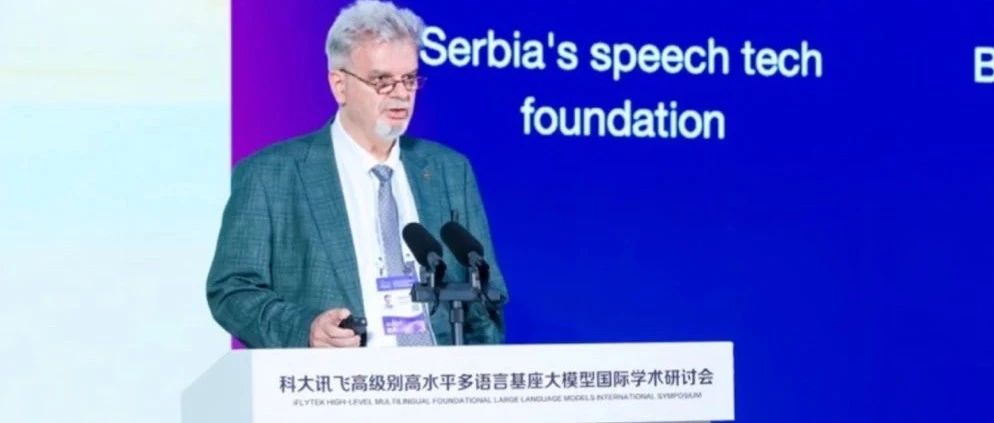
小语种恐被AI时代边缘化?多国专家呼吁:语言模型不能只服务大语种!
Di Yi Cai Jing· 2025-07-29 02:35
Core Viewpoint - The article highlights the risk of marginalization faced by low-resource language countries in the AI era due to insufficient support from general large models for these languages [1][2]. Group 1: Language Models and Their Importance - Serbian language usage is significantly lower than Slovenian, with its token representation in general models being less than 0.1% [2]. - The need for language models to reflect cultural identity is emphasized, particularly in critical fields like healthcare and law [2]. - Hungarian language presents unique challenges for language models due to its complex morphology, underscoring the importance of data quality over quantity [2]. Group 2: Initiatives and Collaborations - The Israel Association for Human Language Technology (IAHLT) has developed a bilingual model (Hebrew + English) based on open-source models, addressing the need for technology equity for small languages [4]. - iFLYTEK's latest model, X1, supports over 130 languages and aims to collaborate globally to create comprehensive multilingual models and applications [4].

科大讯飞20250422
2025-04-24 01:55
Summary of Key Points from the Conference Call Company Overview - **Company**: iFlytek (科大讯飞) - **Industry**: Artificial Intelligence and Technology Financial Performance - **2024 Revenue**: 24.95 billion CNY, with a significant increase of 21% in Q4, reaching nearly 8.5 billion CNY [1][2] - **Profit Growth**: Net profit increased by 62% to 900 million CNY in Q4 [1][2] - **Cash Flow**: Positive cash flow of 3.3 billion CNY, with a net cash flow from operating activities increasing by 613% to 2.495 billion CNY [1][2] - **2025 Q1 Performance**: Revenue of 4.65 billion CNY, a 27% year-on-year increase, with gross profit of 1.87 billion CNY, up 34% [4] Business Strategy and Developments - **Model Upgrades**: iFlytek upgraded its Spark model X1, achieving comparable results to OpenAI's O1 and Deepseek's R1 in international tests, with a model size of only 70 billion parameters [1][5] - **Sector Focus**: The company is focusing on education, healthcare, and automotive finance, aiming to lead in smart hardware functionalities [2][18] - **Cash Collection Mechanism**: The improvement in cash flow is attributed to the establishment of a dedicated collection department and optimization of business processes [3] AI Model Performance - **Education Model**: The Spark education model achieved an F1 score of 71% in step-level math correction and 92% in subjective English scoring, outperforming general models [6][7] - **Healthcare Model**: The Spark medical model significantly outperformed GPT-4 and GPT-3 in diagnostic assistance, with over 900 million diagnoses assisted and a high satisfaction rate of 98.8% [9][8] Market Position and Competitive Advantage - **Domestic Collaboration**: iFlytek collaborates with domestic computing power vendors to achieve full domestic training and inference capabilities, addressing international chip restrictions [17][24] - **Government Contracts**: The company has become a preferred tool for central state-owned enterprises, reflecting high market recognition of its technology [16] Future Outlook - **Growth Potential in Education**: The education sector is expected to see significant growth, driven by hardware sales and government investments in educational technology [31][32] - **AI Integration**: iFlytek is committed to integrating AI into education, healthcare, and other sectors, enhancing personalized learning and operational efficiency [35][36] - **R&D Investment**: The company plans to maintain a healthy growth model for R&D investment, with a focus on achieving a balance between revenue growth and R&D spending [62] Additional Insights - **International Expansion**: iFlytek is accelerating its international business layout despite geopolitical tensions, leveraging its autonomous model capabilities [47][60] - **Technological Innovations**: The company is focused on continuous innovation in AI models, aiming to maintain a leading position in the industry [61][62] This summary encapsulates the key points discussed in the conference call, highlighting iFlytek's financial performance, strategic developments, market positioning, and future outlook in the AI industry.