智慧文旅

Search documents
以智慧城市建设推动加快形成新质生产力
Jin Rong Shi Bao· 2026-01-12 03:57
Core Viewpoint - The development of new quality productivity is an intrinsic requirement and important focus for promoting high-quality development in China, with smart city construction serving as a strategic pivot for this transformation [1]. Group 1: Smart City Construction as a Strategic Choice - Smart city construction is a practical carrier that adapts to the transformation of production methods, fundamentally reshaping urban governance through the integration of digital technologies [2]. - The Chinese government has been promoting smart city construction since 2016, emphasizing data-driven and people-centered approaches to optimize governance and resource integration [2]. - Smart cities enhance the efficiency of production factor allocation and are essential for optimizing urban functions and driving productivity growth [3]. Group 2: Goals of Smart City Construction - Smart cities represent a direct integration of advanced productivity, providing an environment for the reconfiguration of key production factors such as technology, capital, talent, and data [3]. - The urbanization rate in China has increased from 17.9% in 1978 to 66.2% in 2023, highlighting the need for smart city initiatives to address challenges like resource efficiency and environmental pressures [3]. - Empirical studies indicate that doubling urban scale can increase total factor productivity by 3.5% to 8%, with smart city initiatives potentially amplifying this effect [3]. Group 3: Government's Role in Smart City Development - Smart city construction is recognized globally as a core pathway for urban modernization, with various international initiatives emphasizing the importance of technology and management innovation [4][5]. - China has over 500 smart city pilot projects covering more than 95% of prefecture-level cities, indicating a strong governmental commitment to enhancing urban governance through digital platforms [5]. - The government plays a crucial role in guiding multi-stakeholder participation, ensuring effective alignment between technological innovation and urban needs [5]. Group 4: Value Orientation of Smart Cities - The concept of a "people's city" aligns with the people-centered philosophy of new quality productivity, emphasizing the active role of citizens in urban governance [6]. - Smart city initiatives have shifted from traditional monitoring models to collaborative governance, involving government, enterprises, and citizens in decision-making processes [6]. - The focus on human-centered values in smart city construction reflects the broader goal of meeting the growing needs of the population for a better quality of life [6]. Group 5: Key Focus Areas for Developing New Quality Productivity - Strengthening technological innovation is essential for enhancing the foundational capabilities of smart cities and fostering strategic emerging industries [7]. - Establishing a comprehensive digital transformation framework is necessary to support the development of smart cities, including investments in new infrastructure and optimizing regulatory arrangements [8]. - Improving urban governance through data-driven models and enhancing public service accessibility are critical for expanding the market for new quality productivity [9]. Group 6: Sustainable Development and Ecological Civilization - Promoting smart environmental practices and green industries is vital for effective resource management and environmental risk mitigation [10]. - Efficient utilization of resources and energy through smart technologies is essential for sustainable urban development [10]. - Encouraging eco-friendly lifestyles through smart city initiatives can enhance public engagement in sustainability efforts [10]. Group 7: Coordinating Development and Integration - Deepening the reform of smart city systems in alignment with national strategies is crucial for balancing new quality productivity and production relationships [11]. - Promoting regional integration and urban-rural development through smart city platforms can facilitate efficient resource allocation and governance [11]. - Establishing a long-term mechanism for public services and social security is necessary to address challenges such as population aging and economic restructuring [11].
豪尔赛遭立案调查背后:行贿换业绩?陷入持续亏损泥潭 大型订单减少
Xin Lang Zheng Quan· 2025-11-28 09:40
Core Viewpoint - Haosai is under investigation for suspected information disclosure violations, raising questions about potential bribery related to its performance and the competitive nature of its industry [1][2] Group 1: Company Background - Haosai's main business includes smart lighting, smart tourism, and smart cities, with lighting design and engineering as its core revenue source [4] - The industry is highly competitive, with demand influenced by economic cycles, macroeconomic policies, and local government finances [4] - The company's clients primarily consist of state-owned enterprises and government departments, utilizing bidding and negotiation for business acquisition [4] Group 2: Financial Performance - Since its listing in 2019, Haosai has faced continuous losses, with revenues declining from 7.88 billion in 2020 to 4.59 billion in 2024 [5] - In the first three quarters of 2025, the company reported revenues of 2.65 billion, a year-on-year decrease of 29.79%, and a net loss of 2631.38 million, a decline of 523.96% [6] Group 3: Internal Control and Compliance Issues - The company has faced scrutiny for its internal controls and compliance, receiving a regulatory warning for failing to disclose information timely [8] - The investigation into bribery and the subsequent legal actions against its former chairman highlight significant governance and operational deficiencies [2][8]

智数科技集团(01159)与普天轨道订立战略合作协议
Zhi Tong Cai Jing· 2025-11-17 09:11
Core Viewpoint - The strategic cooperation agreement between Zhishu Technology Group and Putian Rail Transit Technology (Shanghai) Co., Ltd. aims to enhance both companies' capabilities in the artificial intelligence sector, particularly in rail transit and airport industries, thereby expanding revenue bases and improving shareholder returns [1]. Company Summary - Zhishu Technology Group has entered into a strategic cooperation agreement with Putian Rail Transit, which specializes in areas such as rail transit weak current general contracting, communication system integration, automatic ticketing systems, smart airports, and smart tourism [1]. - The board believes that expanding into the artificial intelligence sector will establish the company's core competitiveness [1]. - The partnership is expected to foster long-term and stable collaboration, focusing on AI services, smart security checks, intelligent operation systems, and smart stations [1]. Industry Summary - Putian Rail Transit is recognized as a key player in the rail transit sector, being a council member of the China Urban Rail Association and a vice-chairman unit of the automatic ticketing system committee [1]. - The company is involved in the development of national and industry standards for AFC systems and is classified as a specialized and innovative enterprise in Shanghai [1]. - The collaboration is anticipated to drive advancements in AI technologies within the rail transit and airport industries, enhancing operational efficiencies and service quality [1].

豪尔赛前董事长被“判三缓四”,检察院抗诉:判轻了
Shen Zhen Shang Bao· 2025-11-17 06:21
Core Viewpoint - The company, Haosai Technology Group Co., Ltd., is facing legal challenges due to bribery charges against its former chairman, Dai Baolin, which has resulted in significant penalties and an ongoing appeal process [1][2]. Legal Proceedings - The company was fined 7 million RMB for unit bribery, while Dai Baolin received a three-year prison sentence with a four-year probation and a fine of 3 million RMB [2]. - The Hubei Province Wuhan New District People's Procuratorate has filed an appeal against the leniency of the sentence, indicating potential changes in the final judgment [1][2]. Company Management Changes - Dai Baolin is no longer in any core positions within the company following the investigation and legal proceedings [1][3]. - The company has undergone management changes, with Dai Baolin previously serving as both chairman and general manager during the investigation period [3]. Financial Performance - For the first three quarters of 2025, the company reported revenues of 265 million RMB, a year-on-year decline of 29.79%, with a net loss of 26 million RMB [3]. - In the third quarter, the company achieved revenues of 107 million RMB, reflecting a year-on-year growth of 31.34%, and a net profit of 7.4 million RMB, indicating a turnaround from previous losses [3]. Industry Context - The decline in revenue is attributed to adjustments in investment rhythms in the infrastructure and real estate sectors, leading to a temporary fluctuation in demand within the lighting engineering industry [3].
西安旅游拟向控股股东定增募资3亿元 用于补充流动资金及偿还贷款
Zheng Quan Shi Bao Wang· 2025-11-07 12:56
Core Viewpoint - Xi'an Tourism plans to issue A-shares at a price of 9.8 yuan per share, raising up to 300 million yuan to improve liquidity and repay bank loans [1] Group 1: Company Actions - The company has signed a conditional share subscription agreement with its controlling shareholder, Xi'an Tourism Group, which will fully subscribe to the new shares [1] - The funds raised will enhance the company's capital strength and support its strategic opportunities in the cultural tourism industry [4] - The issuance will improve the company's operational capital reserves and provide long-term funding for business expansion [4] Group 2: Industry Context - The tourism industry is expected to normalize by 2025, driven by multiple favorable policies and a strong domestic travel demand [2] - In the first three quarters of 2025, domestic travel reached 4.998 billion trips, an increase of 761 million trips year-on-year, with total spending of 4.85 trillion yuan, up 11.5% [2] - The hotel industry is facing challenges such as structural adjustments in demand and intensified competition, with the market size projected to reach 600 billion yuan in 2024, growing by 8% [3]

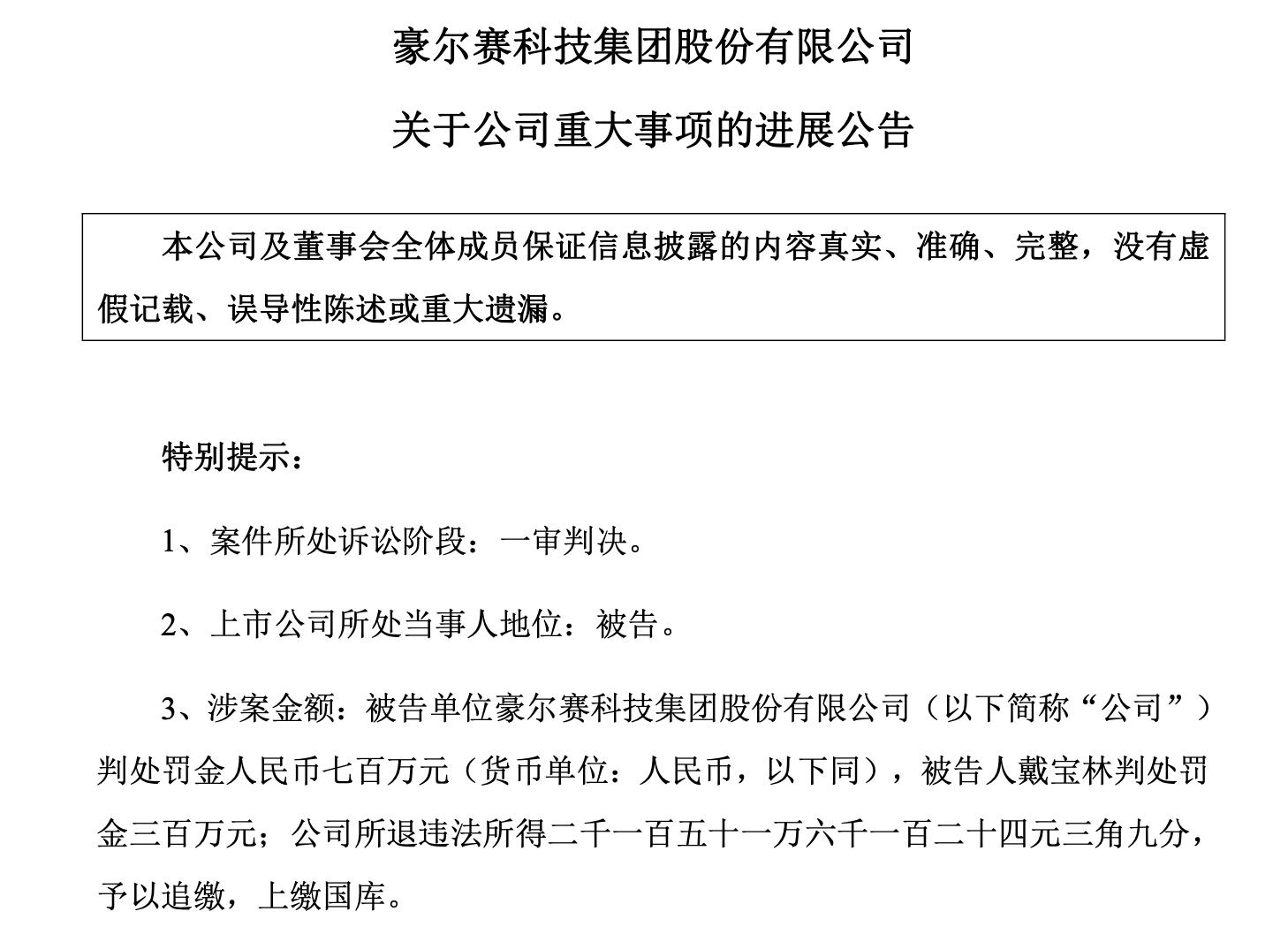
60岁前董事长,被判有期徒刑三年,缓刑四年
Shen Zhen Shang Bao· 2025-11-05 15:14
Core Viewpoint - The court has sentenced Haosai Technology Group Co., Ltd. for corporate bribery, imposing a fine of 7 million RMB and additional penalties on its former chairman Dai Baolin, who received a suspended prison sentence and a fine of 3 million RMB. The company has acknowledged the financial impact of these penalties on its recent profits [3][4]. Financial Performance - In the first three quarters of 2025, Haosai reported revenue of 265 million RMB, a year-on-year decline of 29.79%, and a net loss attributable to shareholders of 26 million RMB. However, in the third quarter, the company achieved revenue of 107 million RMB, marking a year-on-year increase of 31.34%, with a net profit of 7.4 million RMB, indicating a turnaround [5]. - The company stated that the revenue decline was primarily due to adjustments in investment rhythms in the infrastructure and real estate sectors, leading to a temporary fluctuation in demand for lighting engineering [5]. Legal and Regulatory Issues - The company and its former chairman faced legal scrutiny, with Dai Baolin being investigated for alleged criminal activities since December 2024. He was detained and later arrested, but continued to perform his duties during the investigation until he was removed from the board [4]. - The total amount involved in other undisclosed minor lawsuits and arbitration matters is approximately 9.53 million RMB, which represents 0.71% of the company's most recent audited net assets [3]. Market Performance - As of November 5, 2025, Haosai's stock price closed at 16.87 RMB per share, reflecting a 1.2% increase, with a total market capitalization of 2.537 billion RMB [6].