智能云服务

Search documents
上海给未来五年 加了什么“燃料”? 5个指标提前剧透
Xin Lang Cai Jing· 2026-02-05 17:13
Group 1 - Shanghai's GDP is projected to grow at an average annual rate of 5% over the next five years, up from 4.9% during the "14th Five-Year Plan" period, indicating significant progress despite a seemingly small increase [1][3] - The achievement of this growth target relies on three key factors: stronger support from new drivers, greater release of core functions from five centers, and substantial backing from major projects, particularly in emerging industries [1][4] - By 2030, if the 5% growth rate is maintained, Shanghai's GDP is expected to exceed 7 trillion yuan, positioning it among the top three global cities, following New York and Los Angeles [1] Group 2 - The three leading industries in Shanghai are expected to maintain an average annual growth rate of over 10% during the "15th Five-Year Plan" period [2][3] - Key indicators for Shanghai's economic development include labor productivity exceeding 520,000 yuan per person, digital economy core industries accounting for over 20% of GDP, and R&D expenditure reaching over 5% of GDP by 2030 [2] Group 3 - The "15th Five-Year Plan" outlines a modern industrial system characterized by "2+3+6+6," focusing on advanced manufacturing and the establishment of world-class high-end industrial clusters [3][5] - The plan emphasizes the digital and green transformation of traditional industries and the acceleration of the three leading industries, which include integrated circuits, biomedicine, and artificial intelligence [4][5] Group 4 - The three leading industries have a significant driving effect on Shanghai's economy, with their combined scale surpassing 2 trillion yuan [4] - Specific strategies for the three leading industries include enhancing the capabilities of the integrated circuit sector, accelerating drug development in biomedicine, and advancing AI technologies [4][6] Group 5 - Shanghai aims to maintain a reasonable industrial proportion while focusing on enhancing quality and competitiveness in manufacturing, which is crucial for supporting technological innovation and the construction of five centers [5][6] - The city plans to solidify its industrial system and leverage existing industrial foundations to foster new growth engines and optimize resource allocation [5][6] Group 6 - The "15th Five-Year Plan" proposes the development of six emerging pillar industry clusters and anticipates six future industries, including advanced materials and quantum technology [7] - The focus on future industries includes areas such as brain-computer interfaces, controlled nuclear fusion, and biomanufacturing, which are expected to have high growth potential [7] Group 7 - Labor productivity is a key indicator for economic and social development, with a continued emphasis on improving productivity during the "15th Five-Year Plan" [9][10] - Enhancing labor productivity will depend on talent development, technological innovation, and systemic reforms to create a favorable business environment [10]
金融期货早评-20260129
Nan Hua Qi Huo· 2026-01-29 02:23
Report Industry Investment Rating No relevant content provided. Core Viewpoints of the Report - The current global market is in a transition phase where overseas markets are waiting for policy verification and domestic markets are waiting for demand recovery. The Fed's latest FOMC meeting maintained the federal benchmark interest rate, and the market expects no rate adjustment before June. There are differences in the stances on the US dollar exchange rate between Trump and Bessent. Domestically, the economy is in a weak recovery, but there are positive signs, and industrial enterprise profits are expected to shift from phased recovery to moderate growth in 2026 [2][3]. - For various commodities, different trends and investment suggestions are presented based on their respective fundamentals and market conditions, such as the expected performance of financial futures, the price trends of various metals, energy products, agricultural products, and chemical products [1][13][27][31]. Summary by Relevant Catalogs Financial Futures - **Macro**: The Fed released a patient signal. The National Energy Administration reported the cumulative power - generation installed capacity by the end of 2025. The Fed's January interest - rate meeting maintained the rate, and there were differences in voting. The Bank of Canada and Brazil's central bank also made rate - related decisions. Trump's statements and geopolitical tensions were also mentioned [1]. - **RMB Exchange Rate**: The Fed's interest - rate meeting kept the rate unchanged. The on - shore RMB against the US dollar rose, and the RMB against the US dollar central parity rate was adjusted up. The future trend of the RMB is affected by the US dollar index and the central bank's exchange - rate regulation. Short - term strategies for export and import enterprises were suggested [3]. - **Stock Index**: The Fed's decision to pause rate cuts is expected to have limited impact on A - shares. The market sentiment is optimistic, but regulatory measures may suppress the rise of large - cap stock indexes. Short - term stock indexes are expected to show a structural market [4][5]. - **Treasury Bonds**: The market expects the central bank to introduce new policy tools. It is recommended to hold medium - term long positions, reduce positions in the March contract on rallies, and not chase the market in the short term [5][6]. - **Container Shipping on the European Line**: Geopolitical tensions and weather disturbances drove the futures prices to rebound. The market is affected by both positive and negative factors, and the main contract is expected to fluctuate in a range, with the far - month contract potentially stronger [8][9][11]. Commodities New Energy - **Lithium Carbonate**: The futures price decreased, but downstream replenishment increased. It is expected that the price and basis of lithium carbonate will strengthen before the Spring Festival. In the long - term, the demand growth logic of downstream applications remains unchanged, but price rises may suppress demand. It is recommended to buy on dips but not chase high prices [13][14]. - **Industrial Silicon and Polysilicon**: The futures prices of both decreased. In the short - term, the demand for industrial silicon is expected to increase due to export policies, but the supply contraction of polysilicon may limit the price increase of industrial silicon. The market is waiting for the results of relevant meetings [14][15][17]. Non - ferrous Metals - **Copper**: The copper prices rose. The inventory of copper increased in some exchanges. The research report suggests avoiding short positions temporarily and provides strategies for long - position holders and enterprises that need to purchase copper [18][19][21]. - **Aluminum Industry Chain**: The rise of Shanghai aluminum may be due to capital speculation. The long - term trend of aluminum prices is bullish, but it is not recommended to participate in long positions at present. Alumina is expected to be weak in the medium - to - long - term, and casting aluminum alloy is expected to be strong. Different investment suggestions are provided for each [21][22]. - **Zinc**: The zinc price was strong, mainly due to the rebound after the previous day's decline and the overall strength of the non - ferrous metal sector. The supply is expected to be relatively loose, and the demand is weak. The future trend depends on macro and geopolitical factors [22]. - **Nickel and Stainless Steel**: The nickel price was in a high - level shock, and the stainless - steel price was in a wide - range shock. The trading logic of nickel is neutral, and the stainless - steel market is affected by the upstream and downstream factors. It is recommended to pay attention to the follow - up trend of nickel [22][24]. - **Tin**: The tin price was in a wide - range shock. The short - term supply is affected by supply - loss themes, and the long - term price is expected to rise due to resource depletion. It is recommended to be cautious when entering the market [24][25]. - **Lead**: The lead price was in a narrow - range shock. The supply is affected by raw - material tightness and high prices, and the demand lacks new drivers. The price is expected to fluctuate within a range [25]. Oils and Fats and Feeds - **Oilseeds**: The oilseeds sector rebounded. The supply of imported soybeans may have a gap in the first quarter, but the state's procurement and reserve - rotation measures have alleviated the short - term tension. The domestic soybean meal market is affected by supply and demand, and the rapeseed meal market is affected by Sino - Canadian relations [27]. - **Oils**: The oil sector was strong in the short - term. The palm oil market is affected by geopolitical conflicts and production reduction expectations. The soybean oil market is affected by the harvest in Brazil and Argentina and the US biofuel policy. The rapeseed oil market is affected by the production in Canada and the uncertainty of Sino - Canadian relations [28][29]. Energy and Oil and Gas - **Fuel Oil**: The high - sulfur fuel - oil market is affected by geopolitical factors and supply - demand changes. The supply is gradually recovering, and the demand is mainly in the bunkering market. The low - sulfur fuel - oil market has increasing supply pressure and weak demand, and it is recommended to narrow the internal - external price difference [31][32]. - **Asphalt**: The asphalt price showed signs of weakness in the rise. The rise was driven by multiple factors, but the long - term supply pressure is large, and the demand is affected by the season. It is recommended to pay attention to the winter - storage situation of refineries [33][34][35]. Precious Metals - **Platinum and Palladium**: The prices of platinum and palladium rose significantly. The price movement is affected by the Fed's dynamics, exchange margin adjustments, and geopolitical uncertainties. In the medium - to - long - term, the bull market foundation remains, and it is recommended to buy on dips [36][37][38]. - **Gold and Silver**: The prices of gold and silver rose strongly. The trading logic is affected by the Fed's chairman selection, corporate earnings, and geopolitical risks. The precious - metal market is in an upward - trending pattern, but short - term adjustment pressure exists [39][40][41]. Chemicals - **Pulp - Offset Paper**: The pulp and offset - paper futures prices rose. The pulp price is affected by the spot market and potential supply reduction, but there are still many negative factors. The offset - paper price is driven by the cost and market sentiment. It is recommended to wait and see [41][42]. - **LPG**: The LPG price was supported in the short - term. The supply is relatively low, and the demand is weakening. The price is affected by overseas factors, and attention should be paid to the upper - limit risk [42][43]. - **PTA - PX**: The PX - TA sector was in a shock. The supply of PX is expected to be high, and the PTA supply is affected by device restarts. The demand for polyester is weakening. The high valuation of PX - TA is not recommended for chasing long positions, and it is recommended to buy on dips [44][45][46]. - **MEG - Bottle Chips**: The ethylene - glycol price was in a small - scale callback. The supply and demand of ethylene glycol are affected by device operations and downstream demand. It is not suitable to short - sell in the short - term, and attention should be paid to geopolitical risks [46][47][49]. - **PP**: The PP price had little short - term pressure. The supply is expected to increase slightly, and the demand is supported by downstream film factories. The price is affected by macro sentiment, and attention should be paid to PDH device dynamics [49][50]. - **PE**: The PE price continued to be strong. The supply pressure is increasing, and the demand is in the off - season. The price is mainly affected by macro sentiment, and it is recommended to wait and see [50][51][52]. - **Pure Benzene - Styrene**: The prices of pure benzene and styrene rose due to geopolitical disturbances. The supply and demand of styrene are turning to be loose, and attention should be paid to export increments, oil - price fluctuations, and downstream feedback [52][53]. - **Rubber**: The natural - rubber price was strong. The price is affected by geopolitical tensions, inventory changes, and synthetic - rubber trends. The synthetic - rubber market is expected to be strong in a shock, and attention should be paid to external risks [53][54][57]. - **Urea**: The urea price rose. The supply of urea is in an over - capacity stage, and the price is affected by export policies. It is recommended to hold long positions for the 05 contract [58][59][60]. - **Glass and Soda Ash**: The trends of glass and soda ash are unclear. The soda - ash supply is expected to be high, and the demand is limited. The glass market is in a situation of weak supply and demand, and attention should be paid to supply - side changes [60][61]. - **Propylene**: The propylene price was in a high - level shock. The price is affected by cost and supply - demand changes. Attention should be paid to geopolitical and device - operation situations [61][62]. Black Metals - **Rebar and Hot - Rolled Coil**: The prices of rebar and hot - rolled coil were in a range - bound shock. The supply is expected to increase slightly, and the demand is affected by the season. The prices are expected to fluctuate within a certain range [64]. - **Iron Ore**: The iron - ore price is supported by restocking. The supply and demand are weak in the short - term, but the price has a certain support below. Attention should be paid to the impact of the rainy season in the Southern Hemisphere [64][65][66]. - **Coking Coal and Coke**: The first - round price increase of coke was implemented. The coking - coal supply is relatively loose, and the coke supply is less over - capacity. The prices are affected by factors such as production, imports, and downstream demand. Attention should be paid to post - holiday production resumption and macro - sentiment changes [67]. - **Ferrosilicon and Ferromanganese**: The ferrosilicon and ferromanganese prices were in a range - bound shock. The production is expected to remain stable, and the demand is limited. The prices are supported by cost and restricted by inventory [67][68]. Agricultural and Soft Commodities - **Cotton**: The domestic cotton price is affected by downstream profits, import volume, and supply - demand expectations. It is recommended to buy on dips but not chase high prices, and pay attention to downstream imports and new orders [70][71]. - **Sugar**: The international sugar price was under pressure, and the domestic sugar price had limited upward space due to weak demand [71][72]. - **Rubber**: The natural - rubber price was strong, and the synthetic - rubber price was in a shock. The prices are affected by geopolitical, inventory, and cost factors. It is recommended to wait and see or hold light positions [73][75][76]. - **Apple**: The apple demand is weak, and the spot price is loose. The futures price may be affected by capital. Attention should be paid to the logic of short - supply of delivery products [76][77][78]. - **Jujube**: The jujube price was in a low - level shock. The supply is abundant, and the demand is mainly for rigid needs. The price is expected to remain low in the short - term and be under pressure in the long - term [78][79]. - **Log**: The log price was in a low - volatility state. The spot price was stable, and the futures price was at a neutral discount. It is recommended to wait and see, and some trading strategies were provided [80][81].
KINGSOFT CLOUD(KC) - 2025 Q3 - Earnings Call Transcript
2025-11-19 13:17
Financial Data and Key Metrics Changes - The company's revenue for Q3 2025 reached RMB 2.48 billion, with a year-over-year growth rate accelerating from 24% in the previous quarter to 31% this quarter [7][19] - Adjusted gross profit for the quarter was RMB 393 million, representing a year-over-year increase of 28% [9][24] - The adjusted operating profit turned from a loss to a profit, reaching RMB 15.36 million, with an adjusted operating profit margin of 0.6% [9][25] - Adjusted net profit recorded a historical positive profit of RMB 28.73 million for the first time [9] Business Line Data and Key Metrics Changes - Public cloud revenue increased significantly by 49% year-over-year, reaching RMB 1.75 billion [7][10] - Intelligent computing cloud business gross billings reached RMB 782 million, with a year-over-year growth of approximately 122% [7][19] - Revenue from the Xiaomi and Kingsoft ecosystem reached RMB 691 million, increasing by 84% year-over-year, accounting for 28% of total revenue [8][9] Market Data and Key Metrics Changes - The demand for artificial intelligence is driving rapid development in intelligent computing cloud and technological innovation in basic public cloud services [8][10] - The company is focusing on expanding customer coverage and cross-selling intelligent computing cloud and basic cloud services [10][11] Company Strategy and Development Direction - The company aims to leverage the integration of generative artificial intelligence and cloud services to enhance its product offerings and customer solutions [7][8] - The strategic focus includes investing in infrastructure and refining core products to create long-term value for stakeholders [18][26] Management's Comments on Operating Environment and Future Outlook - Management expressed confidence in the growth of AI business demand and the potential for higher margins as inference demand increases [36][37] - The company is optimistic about fulfilling business cooperation under the Xiaomi and Kingsoft ecosystem and anticipates further increases in quotas next year [8][9] Other Important Information - The company successfully raised HKD 2.8 billion in equity financing, with allocations for AI infrastructure and operational needs [20][21] - Capital expenditures for the quarter were RMB 2.79 billion, primarily for intelligent cloud infrastructure investment [26] Q&A Session Summary Question: What are the key drivers of AI revenue growth in Q3? - Management indicated that the growth was driven by clusters that began recognizing full quarter revenues and some delayed revenue from Q2 [34][35] Question: How does management see the margin trend in the coming quarters? - Management expects inference demand to exhibit a higher margin profile than current training demands, anticipating higher margins in the future [36][37] Question: Could management share the outlook and guidance on revenue for next year? - Management is confident in subsequent demand growth and is currently finalizing the budget process for next year [41][42] Question: How does management view the current market dynamics for procurement versus leasing? - Management stated that both procurement and leasing have their pros and cons, and resource allocation will depend on customer needs [42][43] Question: What is the pricing methodology between AI training and inference? - Management noted that pricing is based on resource usage, with inference services potentially offering better margin ratios [51][52]

中国电信(601728):推动企业战略向云改数转智惠升级,经营业绩保持稳健
Tianfeng Securities· 2025-11-02 04:11
Investment Rating - The investment rating for the company is "Accumulate" [5] Core Views - The company reported a revenue of 394.3 billion yuan for the first three quarters of 2025, representing a year-on-year growth of 0.6%. Service revenue reached 366.3 billion yuan, up 0.9%, while net profit attributable to shareholders was 30.8 billion yuan, an increase of 5.0% year-on-year [1][3] - The company is focusing on transforming its strategy towards "cloud, data, and intelligent services," aiming to enhance its service capabilities and drive high-quality development [3] - The company has seen a significant increase in its new business segments, with IDC revenue reaching 27.5 billion yuan, up 9.1%, and intelligent revenue growing by 62.3% [2][3] Business Performance - The basic business is developing steadily, with 5G network users reaching 290 million, a penetration rate of 66.9%. Mobile internet traffic increased by 16.9%, and the average data usage per user reached 22.3GB, up 11.4% [2] - The company is expanding its new business segments, with notable growth in security revenue (up 12.4%), satellite communication revenue (up 23.5%), and quantum revenue (up 134.6%) [2] Cost Management and R&D - The company maintained effective cost control, with operating costs increasing by only 0.1% year-on-year. R&D expenses rose by 4.4% to 9.1 billion yuan, focusing on key technologies such as AI and quantum security [3] Financial Forecast and Investment Advice - The company is expected to achieve net profits of 34.87 billion yuan, 36.71 billion yuan, and 38.63 billion yuan for the years 2025, 2026, and 2027, respectively. The forecast has been slightly adjusted downwards due to uncertainties in new business developments [3] - The company is positioned to fully embrace AI and support the digital transformation of the economy and society, indicating a positive outlook for future growth [3]

中国电信(601728):25Q3经营业绩稳健,战新产业规模拓展
CMS· 2025-10-27 13:34
Investment Rating - The report maintains a "Strong Buy" rating for China Telecom [2] Core Insights - China Telecom's Q3 2025 operating performance is stable, with revenue reaching 394.3 billion yuan, a year-on-year increase of 0.6%, and net profit attributable to shareholders at 30.8 billion yuan, up 5.0% year-on-year, indicating enhanced core functions and competitive strength [1][5] - The company continues to expand its new business sectors, with significant revenue growth in areas such as IDC, security, and intelligent services, showcasing a robust technological innovation strategy [5] - Profitability is improving, with a net profit margin of 6.0% and a return on equity (ROE) of 7.5% [2][21] Financial Performance - For the first three quarters of 2025, total revenue was 394.3 billion yuan, with service revenue at 366.2 billion yuan, reflecting a 0.9% year-on-year growth [5] - The mobile user base reached 437 million, with a net increase of 12.67 million users in Q3 2025, and 5G users reached 290 million, with a penetration rate of 66.9% [5] - The company reported a net profit of 30.8 billion yuan for the first three quarters, with a quarterly net profit of 7.76 billion yuan in Q3, marking a 3.6% year-on-year increase [5] Future Projections - The report forecasts net profits for 2025, 2026, and 2027 to be 34.7 billion yuan, 36.4 billion yuan, and 38.0 billion yuan respectively, with corresponding PE ratios of 18.2, 17.3, and 16.6 [5][7] - Revenue projections for 2025 are set at 537.6 billion yuan, with a year-on-year growth of 3% [7][20] Shareholder Information - The major shareholder is China Telecom Group Co., Ltd., holding a 63.9% stake in the company [2]
中国电信(601728):经营业绩保持稳健,战新业务持续规模拓展
Changjiang Securities· 2025-10-26 09:13
Investment Rating - The investment rating for the company is "Buy" and is maintained [8]. Core Views - The company's operating performance remains stable, with a steady improvement in profitability. For the first three quarters of 2025, the company achieved revenue of 394.3 billion yuan, a year-on-year increase of 0.6%. Service revenue reached 366.3 billion yuan, up 0.9%, and net profit attributable to shareholders was 30.8 billion yuan, growing by 5.0% [2][12]. - The basic business is developing steadily, with a continuous increase in 5G network penetration. The number of 5G users reached 290 million, with a penetration rate of 66.9%. Mobile internet traffic increased by 16.9% year-on-year, and the average data usage per user reached 22.3GB, up 11.4% [12]. - New strategic businesses are expanding in scale, accelerating the cultivation of new growth drivers. The company's IDC revenue reached 27.5 billion yuan, growing by 9.1%, while intelligent revenue increased by 62.3% [12]. - Cost control has been effective, contributing positively to profit growth. Operating expenses for the first three quarters were 359.3 billion yuan, a year-on-year increase of 0.3%, while network operation costs decreased by 3.0% [12]. Summary by Sections Financial Performance - In the first three quarters of 2025, the company achieved total revenue of 394.3 billion yuan, with a net profit of 30.8 billion yuan, reflecting a year-on-year growth of 5.0% [2][6]. - The EBITDA for the same period was 115.6 billion yuan, an increase of 4.2% [12]. Business Development - The basic business is growing steadily, with a focus on enhancing customer service and product offerings. The 5G user base and mobile internet traffic are key indicators of this growth [12]. - The new strategic business areas are showing significant growth, particularly in intelligent services and cloud solutions, indicating a shift towards high-quality development [12]. Cost Management - The company has successfully managed costs, with a slight increase in operating expenses but a notable decrease in network operation costs, showcasing effective resource utilization [12].
中国电信前三季度实现净利超三百亿元
Zheng Quan Shi Bao· 2025-10-21 22:13
Core Insights - China Telecom reported a revenue of 394.3 billion yuan for the first three quarters of 2025, a year-on-year increase of 0.6% [1] - The company is focusing on embracing artificial intelligence and transforming its strategy towards cloud and digital intelligence [1][2] - Net profit attributable to shareholders reached 30.8 billion yuan, reflecting a 5% year-on-year growth [1] Financial Performance - Service revenue for the period was 366.3 billion yuan, up 0.9% year-on-year [1] - Operating costs amounted to 274.8 billion yuan, a slight increase of 0.1% [2] - Research and development expenses rose by 4.4% to 9.1 billion yuan, emphasizing the focus on core technology advancements [2] User Metrics - The number of 5G network users reached 290 million, with a penetration rate of 66.9% [1] - Mobile internet traffic increased by 16.9% year-on-year, with a daily average usage (DOU) of 22.3 GB, up 11.4% [1] New Business Growth - IDC revenue grew by 9.1% to 27.5 billion yuan, while security revenue increased by 12.4% to 12.6 billion yuan [2] - Smart revenue surged by 62.3%, and satellite communication revenue rose by 23.5% [2] - Quantum revenue saw a remarkable growth of 134.6% [2] Strategic Initiatives - The company aims to implement a comprehensive strategy for cloud transformation and digital intelligence, enhancing core functions and competitiveness [2] - China Telecom is committed to advancing its "AI+" initiative to promote intelligent infrastructure across various sectors [2]
战新业务表现抢眼 中国电信前三季度净利增5%
Shang Hai Zheng Quan Bao· 2025-10-21 18:18
Core Insights - China Telecom reported a revenue of 394.3 billion yuan for the first three quarters of 2025, a year-on-year increase of 0.6% [1] - The company's net profit attributable to shareholders reached 30.8 billion yuan, reflecting a growth of 5.0% year-on-year [1] - Strategic emerging businesses showed strong performance, with IDC revenue at 27.5 billion yuan (up 9.1%), security revenue at 12.6 billion yuan (up 12.4%), and smart revenue increasing by 62.3% [1] Financial Performance - Total service revenue for the first three quarters was 366.3 billion yuan, up 0.9% year-on-year [1] - Operating costs amounted to 274.8 billion yuan, maintaining steady growth [2] - Research and development expenses increased by 4.4% to 9.1 billion yuan, focusing on core technology advancements [2] Business Strategy - The company aims to implement a "cloud transformation" strategy, enhancing both foundational and data-driven business development [3] - Emphasis on integrating artificial intelligence into operations to improve digital infrastructure and service offerings [3] - The company is committed to high-quality development and enhancing core competitiveness [3] Shareholder Activity - China Life Insurance increased its stake in China Telecom by acquiring 43.76 million shares in the third quarter [3] - Hong Kong Central Clearing (Agent) reduced its holdings by 27.94 million shares but remains among the top shareholders [3]
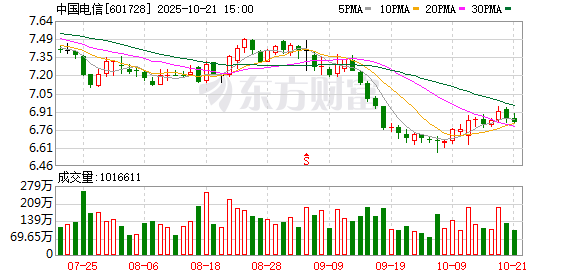
中国电信发布前三季度业绩,归母净利润307.73亿元,同比增长5.03%
Zhi Tong Cai Jing· 2025-10-21 15:18
Core Insights - China Telecom reported a revenue of 394.27 billion yuan for the first three quarters of 2025, a year-on-year increase of 0.59% [1] - The net profit attributable to shareholders reached 30.773 billion yuan, up 5.03% year-on-year, with a basic earnings per share of 0.34 yuan [1] - The company is focusing on transforming into a service-oriented, technology-driven, and secure enterprise, emphasizing high-quality development [1] Financial Performance - Revenue for the first three quarters: 394.27 billion yuan, up 0.59% year-on-year [1] - Net profit: 30.773 billion yuan, up 5.03% year-on-year [1] - Non-recurring net profit: 28.697 billion yuan, up 0.04% year-on-year [1] - Basic earnings per share: 0.34 yuan [1] Business Development - The company is embracing artificial intelligence and accelerating its transformation towards cloud and digital services [1] - 5G network users reached 290 million, with a penetration rate of 66.9% [1] - Mobile internet traffic increased by 16.9% year-on-year, with a daily average usage (DOU) of 22.3 GB, up 11.4% [1] - Gigabit broadband user penetration rate is approximately 31.0% [1] Strategic Initiatives - The company has established an intelligent cloud system centered around its core technology "Xirang," providing integrated intelligent cloud services [2] - New strategic business segments are expanding, with IDC revenue reaching 27.5 billion yuan, up 9.1% year-on-year [2] - Security revenue increased to 12.6 billion yuan, up 12.4% year-on-year [2] - Intelligent revenue grew by 62.3%, while video internet revenue increased by 34.2% [2] - Satellite communication revenue rose by 23.5%, and quantum revenue surged by 134.6% [2]
量子收入大幅增长,中国电信公布三季报
Zhong Guo Zheng Quan Bao· 2025-10-21 14:32
Core Insights - China Telecom reported a revenue of 394.27 billion yuan for the first three quarters of 2025, a year-on-year increase of 0.59%, with a net profit of 30.77 billion yuan, up 5.03% [2] - In Q3, the revenue was 124.85 billion yuan, a decrease of 0.91% year-on-year, while net profit reached 7.76 billion yuan, an increase of 3.6% [2] - The company is embracing artificial intelligence and transitioning towards a service-oriented, technology-driven, and secure enterprise model, focusing on expanding strategic emerging business [2] Financial Performance - For the first three quarters, China Telecom's IDC revenue was 27.5 billion yuan, up 9.1%; security revenue was 12.6 billion yuan, up 12.4%; intelligent revenue grew by 62.3%; video internet revenue increased by 34.2%; satellite communication revenue rose by 23.5%; and quantum revenue surged by 134.6% [2] - In the first half of the year, quantum revenue increased by 171.1%, with over 6 million quantum communication users and services provided to more than 3,000 industry clients [2] Business Development - The company reported a steady development in its basic business, with 5G network users reaching 290 million, a penetration rate of 66.9%, and mobile internet traffic increasing by 16.9% year-on-year [3] - The average mobile internet usage (DOU) reached 22.3 GB, up 11.4%, while the penetration rate of gigabit broadband users was approximately 31.0% [3] Strategic Initiatives - China Telecom is focusing on its core technology "Xirang" to build an intelligent cloud system, providing integrated intelligent cloud services based on cloud-network integration [4] - The company aims to enhance its core functions and competitiveness through the implementation of the "cloud transformation to intelligent benefits" strategy, promoting the intelligent evolution of digital information infrastructure [4] Shareholder Changes - In Q3, there were changes in the holdings of the top ten shareholders, with Hong Kong Central Clearing (Agent) Co., Ltd. reducing its holdings by 27.948 million shares, now holding 13.821 billion shares (15.10% stake) [5] - China Life Insurance Co., Ltd. increased its holdings by 43.7649 million shares, now holding 1.14 billion shares (1.25% stake) [5]