智谱AutoGLM沉思

Search documents
老板说“分析一下竞品的Deep Research”,我交出了这份报告
3 6 Ke· 2026-01-30 00:25
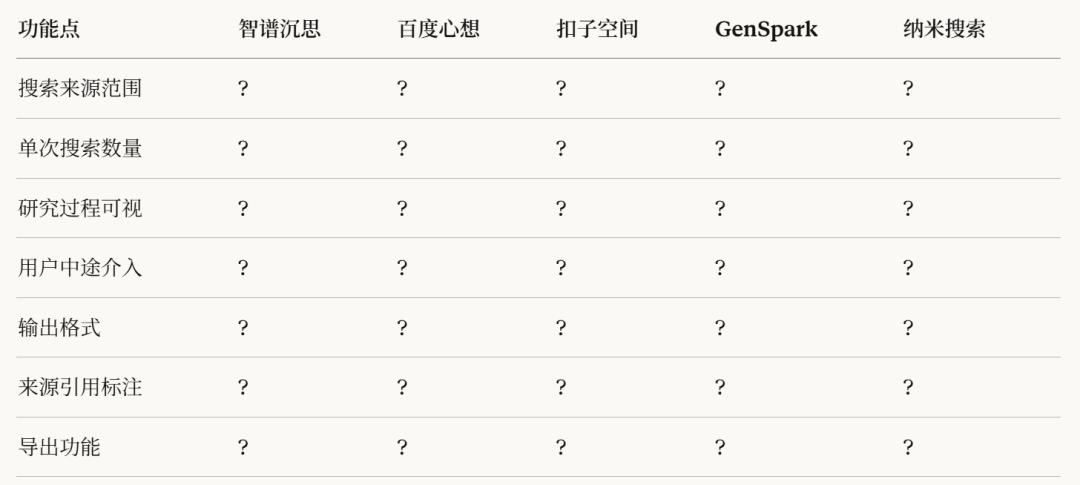
Group 1 - The article outlines a systematic approach to conducting a competitive analysis of the Deep Research feature, emphasizing the importance of strategic insights and actionable recommendations [1][2][21] - The core function of Deep Research, launched by OpenAI in February 2025, allows AI to autonomously conduct web searches, integrate information from multiple sources, and generate comprehensive research reports, distinguishing it from traditional AI search methods [5][6] - Key dimensions for analysis include core functionality, feature matrix, and content quality, while market positioning and model technology are considered less critical for this specific inquiry [8][9] Group 2 - The selection of competitors includes direct competitors with independent Deep Research capabilities, indirect competitors with research abilities, and potential competitors that may emerge in the future [10] - Data collection involves three main channels: public information retrieval, product experience through testing, and user research to gather real user feedback [11][12] - The analysis phase includes constructing a feature matrix to compare functionalities across competitors and evaluating content quality based on accuracy, completeness, depth, structure, and usability [14][15][16] Group 3 - The report structure is designed to present core conclusions upfront, followed by an overview of competitors, a feature comparison matrix, content quality assessment results, and typical case studies to illustrate findings [17][18][19][20] - The final section provides actionable recommendations, prioritizing features to follow up on and identifying potential pitfalls to avoid [21][22] - The overall process of competitive evaluation is summarized as a series of methodical steps: clarifying objectives, selecting appropriate competitors, defining dimensions, collecting data, analyzing findings, and producing the report [21]

真正威胁你的竞品,往往不在你的分析名单里
3 6 Ke· 2026-01-26 06:21
Core Insights - The article emphasizes the importance of correctly identifying competitors before conducting detailed analysis, as selecting the wrong competitors can render the entire report useless [1][2]. Group 1: Definition and Classification of Competitors - Competitors are defined as products that can divert user attention, time, or budget, not just those that offer similar products [2]. - Three categories of competitors are identified: direct competitors, indirect competitors, and potential competitors [2]. Group 2: Direct Competitors - Direct competitors are characterized by operating in the same market, targeting the same user base, and offering similar core functionalities, leading users to choose between them [3][4]. - An example provided is the competition between Doubao and Kimi, both AI dialogue assistants targeting C-end users [4][5]. Group 3: Indirect Competitors - Indirect competitors address similar problems but differ in product form, core functionality, or usage scenarios, potentially diverting users in specific contexts [6][7]. - Midjourney is cited as an indirect competitor to AI dialogue products, as it serves the broader need for AI-assisted creation but through different means [8][9]. Group 4: Potential Competitors - Potential competitors currently differ significantly in product form and functionality but may compete for the same user resources in the future [10]. - Douyin is mentioned as a potential competitor due to its large user base and capability to introduce AI features, which could disrupt the market [11][12]. Group 5: Analysis Directions - When selecting competitors, companies should consider the analysis direction, which can include business strategy, specific functionalities, and user overlap [13]. - Business direction focuses on the competitor's commercial logic and revenue models, while functional direction examines specific features and technical paths [14][15]. - User direction analyzes user overlap and migration costs, which can inform operational strategies [16][17]. Group 6: Sources for Finding Competitors - Companies can identify competitors through various channels, including app stores, industry reports, social media, and direct user feedback [18][19][20][21][22]. - App stores provide a direct source for similar products, while industry reports offer insights into market dynamics and player rankings [19][20]. Group 7: Practical Example - A practical example is provided for selecting competitors for the Deep Research feature, categorizing them into direct, indirect, and potential competitors based on their functionalities and market positioning [23][24]. Group 8: Summary Principle - The core principle for selecting competitors is to first understand who is competing for the same users, which informs the focus of the analysis [25].
WAIC2025现场观展大盘点
Guotou Securities· 2025-07-27 14:33
Investment Rating - The report maintains an investment rating of "Outperform the Market - A" [5] Core Insights - The 2025 World Artificial Intelligence Conference (WAIC) showcased significant advancements in AI technology, particularly in computing power, algorithms, and applications, indicating a robust growth trajectory for the industry [12][60] - Domestic manufacturers are progressively enhancing their chip performance from inference to training, emphasizing ecosystem support and application scenarios [13][60] - The report highlights the emergence of quantum computing as a disruptive innovation in the computing power industry, with potential for exponential growth in computational capabilities [38][39] Summary by Sections 1. Industry Overview - The WAIC 2025 featured over 800 companies and more than 3000 cutting-edge exhibits, marking the largest scale in its history [12] - The conference focused on AI technology frontiers, industry trends, and global governance practices [12] 2. Computing Power - Domestic chip manufacturers are evolving from inference-focused AI chips to high-performance training chips, showcasing various industry applications [13] - The report notes the importance of supernodes, integrated machines, and liquid cooling solutions as key trends in the future of domestic AI computing power [18][19] 3. Algorithms - The evolution of large models is highlighted, with a shift towards multi-modal capabilities and the integration of deep reasoning and thinking abilities [43][44] - The report emphasizes the growing importance of AI agents and physical AI, which aim to enable intelligent agents to understand and interact with the real world [43][44] 4. Applications - The report identifies a flourishing landscape for both B2B and B2C AI applications, with significant advancements in areas such as AI glasses, smart driving, and robotics [60] - C-end applications focus on AIGC and productivity tools, while B-end applications emphasize cost reduction and efficiency improvements across various sectors [60][61] 5. Quantum Computing - Quantum computing is positioned as a critical future technology, with companies showcasing solutions that leverage quantum mechanics for superior computational capabilities [38][39]