
曲氟尿苷替匹嘧啶

Search documents
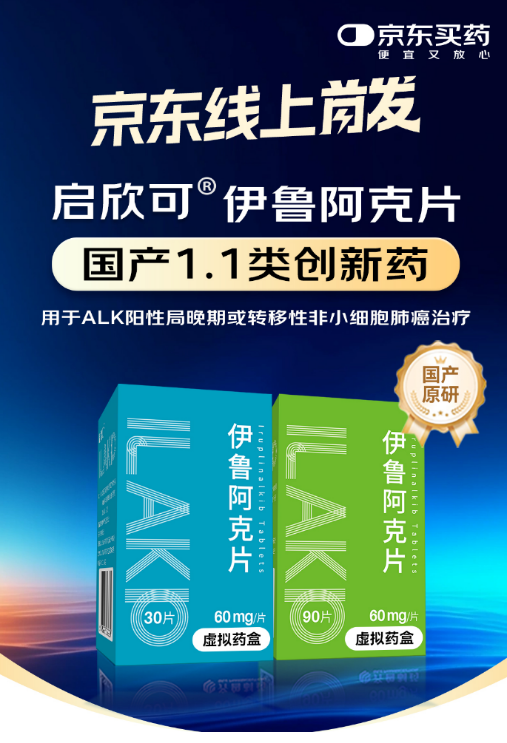
齐鲁制药ALK靶向新药伊鲁阿克片(启欣可®)在京东健康全网首发
Zhong Jin Zai Xian· 2026-01-12 14:21
Core Insights - Qilu Pharmaceutical's innovative drug, Irukak (伊鲁阿克片), for ALK-positive non-small cell lung cancer (NSCLC) was launched on JD Health, enhancing the product matrix for lung cancer precision treatment [1][3] - JD Health aims to leverage its position as the "first station for new specialty drug launches" to improve drug accessibility and treatment standardization for patients [1][4] Group 1: Drug and Market Overview - Lung cancer is the most prevalent and deadly malignancy in China, with NSCLC accounting for over 80% of cases [3] - ALK gene fusion mutations occur in approximately 3%-7% of NSCLC cases, predominantly in younger individuals, women, and non-smokers, and are known for their high response rates to targeted therapies [3] - Irukak, as a next-generation ALK inhibitor, demonstrates strong inhibition of ALK kinase activity, good coverage of common resistance mutations, and excellent blood-brain barrier penetration [3][4] Group 2: Clinical Efficacy - Clinical studies show that Irukak has a remarkable intracranial objective response rate (ORR) of 85.7%, providing significant treatment assurance for ALK-positive patients prone to brain metastases [3][4] - Long-term survival data for Irukak indicates promising potential for extending patient survival [4] Group 3: JD Health's Strategic Positioning - JD Health has previously introduced several ALK-targeted drugs, including Crizotinib, Alectinib, and Brigatinib, enhancing its service capabilities in oncology [4] - The launch of Irukak on JD Health not only offers more personalized treatment options but also strengthens the company's ability to supply and service major disease medications [4] - JD Health plans to continue collaborating with leading domestic and international pharmaceutical companies to promote innovative treatment solutions and improve healthcare accessibility [4]


石药集团:JSKN 003于中国再次获授予突破性治疗认定用于治疗HER2阳性晚期结直肠癌患者
Zhi Tong Cai Jing· 2025-10-20 00:45
Core Viewpoint - The announcement highlights the breakthrough therapy designation granted to JSKN003, a targeted HER2 bispecific antibody-drug conjugate, for treating HER2-positive metastatic colorectal cancer patients who have failed previous treatments [1][4]. Group 1: Company Developments - Shanghai Jinmant Biotech, a subsidiary of the company, collaborates with Jiangsu Hengrui Medicine Co., Ltd. to develop JSKN003 [1]. - JSKN003 has received its second breakthrough therapy designation, previously granted for treating platinum-resistant recurrent epithelial ovarian cancer, primary peritoneal cancer, or fallopian tube cancer [4]. - The ongoing clinical studies for JSKN003 include multiple Phase II and III trials for treating breast cancer, ovarian cancer, and gastric cancer in China [4]. Group 2: Industry Context - Colorectal cancer is one of the most common malignancies globally, with 1.9262 million new cases and 903,900 deaths reported in 2022, ranking third in incidence and second in mortality among all cancers [2]. - In China, colorectal cancer has a high incidence rate, with over 500,000 new cases annually, making it the second most common cancer after lung cancer [2]. - Current approved treatments for HER2-positive metastatic colorectal cancer in China show limited efficacy, with median progression-free survival (mPFS) of only 2-3.7 months and median overall survival (mOS) of 7-10 months [2]. Group 3: Clinical Research Findings - Preliminary clinical research results for JSKN003 indicate significant efficacy and safety in treating HER2-positive metastatic colorectal cancer, with an objective response rate (ORR) of 61.9% and disease control rate (DCR) of 95.2% among patients who had at least one tumor efficacy assessment [3]. - The median progression-free survival (mPFS) for colorectal cancer patients treated with JSKN003 was reported at 13.77 months, with a median duration of response (mDoR) of 12.06 months [3]. - Safety data from the Phase II recommended dose cohort showed that only 14.0% of patients experienced grade 3 or higher treatment-related adverse events (TRAEs), with no treatment-related deaths reported [3].