
木偶

Search documents
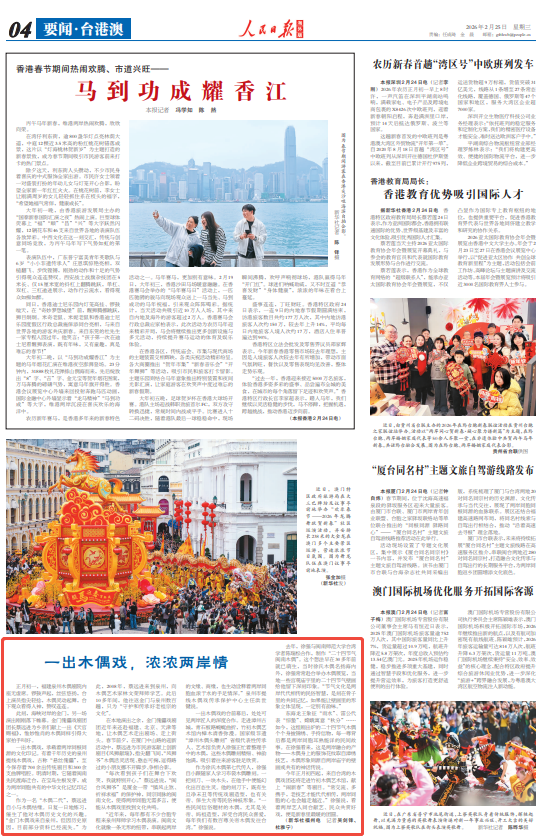
一出木偶戏,浓浓两岸情
Ren Min Ri Bao Hai Wai Ban· 2026-02-25 05:48
Core Viewpoint - The article highlights the cultural significance and ongoing collaboration between the puppet arts of Fujian, China, and Kinmen, Taiwan, showcasing how traditional puppet shows serve as a bridge connecting the two regions' shared heritage and fostering cultural exchange [1][2][3][4]. Group 1: Cultural Heritage - The Quanzhou string puppet theater in Fujian has a history of over a thousand years, preserving more than 700 traditional performances and 300 musical pieces, reflecting a rich cultural legacy [1]. - Kinmen's puppet theater, led by Cai Yuanjin, emphasizes the importance of preserving and passing down the cultural heritage of puppetry, which has historical ties to Quanzhou [1][2]. Group 2: Cross-Strait Collaboration - The Kinmen Puppet Theater has expanded its reach by performing in various cities, including Fujian, Beijing, and Tianjin, bringing puppet art to a wider audience [2]. - There is a growing trend of Taiwanese individuals traveling to Quanzhou to learn puppet performance, indicating a strong cultural bond and shared identity between the two regions [2][3]. Group 3: Artistic Innovation - Recent performances, such as "Wind Lion God," showcase innovative puppetry that resonates with local audiences, particularly children, highlighting the adaptability of traditional art forms [2]. - Xu Qiang, a seventh-generation puppet sculptor, collaborates with scholars to create puppets representing the 24 solar terms, merging traditional craftsmanship with contemporary cultural expressions [3]. Group 4: Future Engagement - Upcoming performances from Taiwanese puppet troupes at the Bamboo Initial Puppet Art Museum signify ongoing cultural exchanges and the importance of collaboration in preserving traditional arts [4].

父亲的木偶戏
Xin Lang Cai Jing· 2026-02-02 23:10
Core Viewpoint - The article highlights the cultural significance and artistry of traditional puppet shows, particularly focusing on the author's father's skills and the community's appreciation for this form of entertainment. Group 1: Puppet Show Artistry - The puppets are intricately crafted, with detailed features representing various characters, and the performance involves a combination of singing and puppeteering to convey emotions and narratives [1][4] - The father, as a folk artist, is well-versed in various traditional operas and can adapt performances based on audience requests, showcasing a deep connection to local culture [4][6] Group 2: Performance Environment - Puppet shows are typically held during festive seasons, with a lively atmosphere created by audience interactions and the use of props like drums and gongs [2][3] - The performances are structured, with a sequence of characters introduced, and the audience is engaged through humor and relatable storylines that reflect rural life [4][5] Group 3: Community Impact - The father's performances are well-received, often leading to requests for extended shows, indicating the popularity and cultural relevance of puppet theater in the community [5][6] - The local puppet show has been recognized as an intangible cultural heritage, ensuring its preservation and continued appreciation among future generations [6]
枯枝可利用 落叶成资源
Ren Min Ri Bao· 2026-01-21 07:29
Core Insights - The article highlights the innovative approaches taken by parks in Guangzhou, particularly Yuexiu Park, to transform plant waste into valuable resources, emphasizing the importance of ecological construction and urban greening [1][3]. Group 1: Waste Management Innovations - Yuexiu Park has implemented a high-temperature aerobic fermentation technology for processing plant waste, significantly reducing the fermentation time from 40 days to just one day and decreasing the required space from over 1,000 square meters to 200 square meters [2]. - The park has established a comprehensive system for the collection, transportation, processing, and utilization of garden waste, ensuring that waste does not leave the park [2]. Group 2: Broader Applications in Guangzhou - Other parks in Guangzhou are also exploring resource utilization models for plant waste, with initiatives such as using specialized equipment for efficient shredding and composting, and creating natural conservation facilities [3]. - The annual processing volume of green waste in Guangzhou is nearly 290,000 tons, with over 90% of municipal park waste being reused on-site [3].