
朱雀三号复用运载火箭

Search documents
一天两枚火箭发射失利!具体原因正在分析排查
Shen Zhen Shang Bao· 2026-01-19 02:04
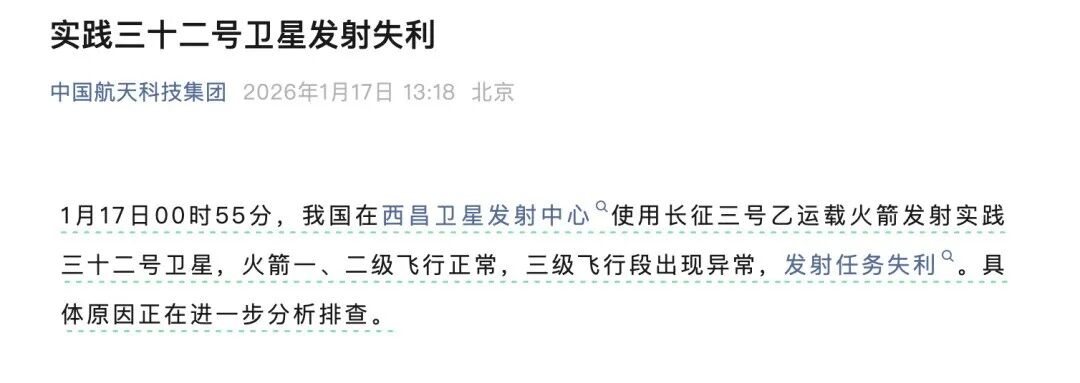
Core Viewpoint - The recent failures of two rocket launches in China highlight the challenges faced by both state-owned and private aerospace companies in achieving reliable launch capabilities [1][3][5]. Group 1: Long March 3B Rocket - The Long March 3B rocket, developed by China Aerospace Science and Technology Corporation, experienced an anomaly during its third stage flight on January 17, leading to the failure of the launch of the Shijian-32 satellite [1][3]. - This rocket has a historical success rate, with 115 launches conducted, of which 110 were successful, 3 failed, and 2 were partially successful [3]. Group 2: Star River Dynamics - Star River Dynamics, a private commercial rocket company established in 2018, also faced a launch failure on January 17 with its Gushenxing-2 rocket during its maiden flight [5][6]. - The company has raised over 5.3 billion yuan through multiple funding rounds, with a notable 2.4 billion yuan raised in its D round, achieving a post-investment valuation of 15 to 16 billion yuan [6]. Group 3: Industry Context - The Chinese aerospace industry is experiencing a high launch frequency, with a record 92 launches in 2022, indicating a growing demand for satellite deployment [7]. - The commercial space sector is still transitioning from technology validation to large-scale operations, facing challenges such as low rocket supply, insufficient payload capacity, and high launch costs [8]. Group 4: Future Prospects - There is an expectation for private rocket companies to complement state efforts in meeting high-frequency launch demands, with a focus on developing reusable liquid rockets to reduce costs and increase launch frequency [9]. - The commercial aerospace index has seen a significant increase of over 40% since December, although many related stocks have diverged from their fundamental valuations [10].


一天两发失利,火箭发射扩容并非易事
第一财经· 2026-01-17 16:31
Core Viewpoint - The article discusses the recent failures of two rocket launches in China's aerospace sector, highlighting the challenges faced by both state-owned and private companies in achieving reliable and cost-effective space missions [3][4]. Group 1: Rocket Launch Failures - On January 17, 2026, two rocket launches failed: the Long March 3B rocket carrying the Shijian-32 satellite and the private Ceres-2 rocket from Beijing Xinghe Power Aerospace Technology Co., both experiencing flight anomalies [3][4]. - The Long March 3B rocket is a key player in China's high-orbit satellite launches, known for its high success rate and numerous missions [3]. - The Ceres-2 rocket is still in the preparatory phase for public listing and has issued an apology for the failure, committing to investigate the issues and ensure future success [4]. Group 2: Industry Challenges - The aerospace sector's development is uneven, with the rocket launch segment identified as a significant bottleneck due to low supply, insufficient payload capacity, and high costs [5]. - The industry is facing a "few and expensive" launch situation, with expectations that private rocket companies can effectively supplement the national team to meet high-frequency launch demands [5]. - Achieving high-frequency launches and reducing costs is crucial for the commercialization of the aerospace sector, but it remains a challenging goal [5]. Group 3: Factors Influencing Development - Key factors affecting the development of commercial aerospace include the maturity of technology and launch success rates, particularly for reusable rocket technology [6]. - The cadence of satellite internet constellation projects, such as GW and G60, is a direct driver of rocket demand [6]. - Continuous policy support and safety regulations are essential for the industry's growth, with a focus on high-quality and safe development [6].
一天两发失利,火箭发射扩容并非易事
Di Yi Cai Jing· 2026-01-17 15:36
Group 1 - The recent failures of two rocket launch missions highlight the volatility in the aerospace sector, with the Long March 3B rocket and the private commercial rocket, Gushenxing 2, both experiencing flight anomalies on January 17 [1][2] - The Long March 3B rocket series is crucial for China's high-orbit satellite launches, known for its high success rate and significant contribution to the country's space endeavors [1] - Gushenxing 2, developed by Beijing Xinghe Power Aerospace Technology Co., is still in the preparatory phase for public listing and has expressed sincere apologies for the launch failure, committing to thorough investigations and future success [2] Group 2 - The aerospace industry faces an imbalance in the "rocket launch-satellite application-ground terminal" ecosystem, with the rocket launch segment being a significant bottleneck due to low supply, insufficient capacity, and high costs [2] - The industry anticipates that private rocket companies can effectively supplement the national team to meet the high-frequency launch demands, although achieving cost reductions and frequent launches remains challenging [2] - Key factors influencing the development of the commercial aerospace sector include the maturity of technology and launch success rates, the cadence of satellite orders, and ongoing policy support and safety regulations [3]
商业航天“蓄势待发”:火箭射上去,价格打下来
Di Yi Cai Jing· 2025-12-26 12:16
Core Insights - The Chinese commercial space industry is experiencing a significant push due to favorable policies and capital influx, with the National Venture Capital Guidance Fund officially launched to support early-stage projects in aerospace [1] - The industry is currently facing a "three shortages" situation: a lack of rockets, launch sites, and satellites, which poses a bottleneck for development [5][9] Group 1: Industry Development - The launch of the National Venture Capital Guidance Fund aims to enhance investment in early-stage aerospace projects, particularly in active innovation regions [1] - The Shanghai Stock Exchange has released guidelines for commercial rocket companies, emphasizing the importance of "hard technology" and prioritizing companies involved in national projects [1] - The commercial space sector is expected to grow significantly, with projections indicating a market size of 2.5-2.8 trillion yuan by 2025, with a compound annual growth rate of over 20% [10] Group 2: Technological Advancements - The industry is at a critical juncture for technological breakthroughs and scale expansion, focusing on reducing costs through reusable rocket technology and mass satellite manufacturing [4] - The successful launch of the "Yixian-A" satellite by a student team demonstrates the potential for innovative satellite applications in the commercial space sector [2] - Companies are accelerating technological advancements, with expectations for new rocket models to achieve competitive launch costs close to those of SpaceX by 2025-2026 [7] Group 3: Market Dynamics - The current imbalance in the commercial space ecosystem highlights the rocket launch segment as a key constraint, with limited supply and high costs affecting satellite deployment [3] - The demand for satellite resources is increasing, but the supply of launch sites is insufficient, leading to delays in satellite launches [8][9] - The industry is witnessing a surge in IPO activities, with over 10 companies initiating listing processes, primarily in rocket manufacturing [5][6] Group 4: Regulatory Environment - The establishment of the Commercial Space Administration aims to enhance regulatory efficiency and support the development of the commercial space sector [13] - The recent action plan emphasizes the need for low-cost, reliable, and reusable rockets, as well as the development of commercial launch sites and integrated measurement and control systems [12][13] - The industry is encouraged to explore new application scenarios and products to support a trillion-level market [11]
