机器人操作之眼AC2

Search documents
人形机器人手眼协同的难题,速腾聚创给出了新解法|CES 2026
Tai Mei Ti A P P· 2026-01-11 03:43
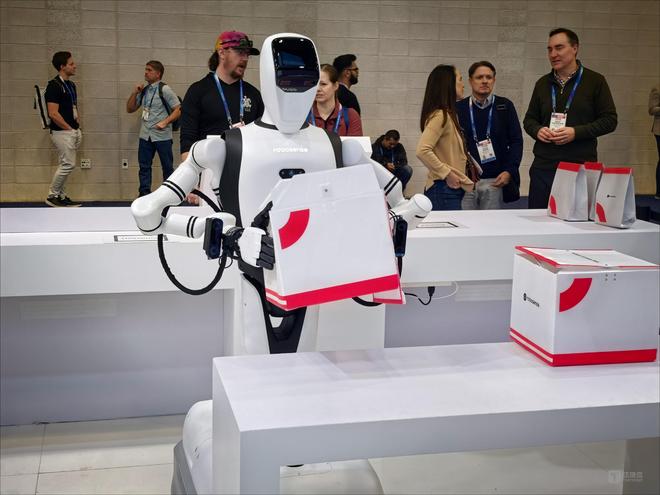
Core Insights - AI has become the central theme at CES over the past three years, with a significant focus on embodied intelligence, which is expected to be a major highlight at CES 2026, showcasing the leadership of Chinese companies in this revolution [1] - RoboSense has demonstrated a fully autonomous delivery robot capable of completing a series of tasks without human intervention, marking a significant advancement in embodied intelligence technology [3][4] Group 1: Technological Advancements - RoboSense's delivery robot can autonomously handle tasks from packaging to delivery and box recycling, supported by its proprietary "hand-eye coordination" solution [3] - The robot's operation involves over 20 sub-tasks, with challenges primarily in the upper body, including dexterous hands and vision systems, which are crucial for precise operations [5][7] - The new "robotic eye" technology integrates solid-state dToF LiDAR and dual RGB cameras, providing enhanced 3D spatial perception and motion information, crucial for complex environments [5][7] Group 2: Market Position and Growth - RoboSense has reduced the price of LiDAR technology significantly over the past decade, positioning itself to shift focus towards robotics and related solutions [9] - The latest quarterly report indicates a 393.1% year-over-year increase in sales of robots and related fields, with overseas revenue growing over 100% [9] - The company aims to create more incremental components for robotics, prioritizing the development of vision and dexterous hands, which are expected to become the main revenue source in the future [9]


从特斯拉GEN3到宇树H2,机器人之眼进化路逐渐清晰
机器人大讲堂· 2025-10-25 13:31
Core Viewpoint - The article discusses the advancements in humanoid robots, particularly focusing on the latest H2 humanoid robot by Yushu, which features enhanced perception capabilities through a new "robot eye" system that integrates dToF LiDAR technology for improved environmental understanding and interaction [1][15]. Group 1: Humanoid Robot Advancements - Yushu's H2 humanoid robot showcases high dynamic capabilities, including the ability to perform complex movements like dancing while maintaining 360-degree environmental awareness through its advanced head and eye system [1]. - The integration of dToF LiDAR technology allows for precise 3D spatial measurements, overcoming limitations faced by traditional visual sensors, especially in varying lighting conditions [4][6]. Group 2: Importance of Perception in Robotics - The evolution of robotic perception is crucial as humanoid robots transition into unstructured environments, necessitating rapid understanding and interaction with their surroundings [3][12]. - Traditional visual systems struggle with depth estimation and synchronization, leading to challenges in complex task execution, which dToF LiDAR effectively addresses by providing accurate and reliable depth information [4][7]. Group 3: Technological Integration - The article emphasizes the need for hardware-level synchronization among various sensors (dToF LiDAR, RGB cameras, IMUs) to ensure accurate data collection and processing, which is essential for real-time decision-making in dynamic environments [7][9]. - The AC2 sensor system, developed by Sutech, exemplifies this integration, achieving a synchronization precision of 1ms, significantly enhancing the reliability of robotic perception [8][11]. Group 4: Future of Humanoid Robotics - The future of humanoid robots lies in their ability to achieve high-precision, high-consistency perception across various environments, enabling them to perform complex tasks and interact effectively with humans and objects [12][16]. - As humanoid robots evolve from mere tools to autonomous intelligent agents, the development of advanced perception systems will be pivotal in facilitating their integration into everyday life and various industries [15][16].