机身材料

Search documents
均胜电子:公司信息更新报告:盈利持续修复,智驾+机器人双曲线勾勒成长新蓝图-20260401
KAIYUAN SECURITIES· 2026-04-01 03:24
Investment Rating - The investment rating for the company is "Buy" (maintained) [1] Core Insights - The company is experiencing a continuous recovery in profitability, with a projected revenue of 611.8 billion yuan for 2025, representing a year-on-year increase of 9.5%. The net profit attributable to shareholders is expected to reach 13.4 billion yuan, up 39.1% year-on-year [4][5] - The company has achieved a record high in new orders, totaling approximately 970 billion yuan for the year, with automotive electronics contributing 461 billion yuan [5] - The company is focusing on dual growth drivers: automotive electronics and emerging intelligent entities, providing integrated solutions for global automotive and robotics companies [6] Financial Summary - Revenue for 2025 is projected at 611.8 billion yuan, with a year-on-year growth of 9.5% [7] - The net profit attributable to shareholders for 2025 is expected to be 13.4 billion yuan, reflecting a 39.1% increase year-on-year [7] - The overall gross margin is anticipated to be 18.3%, an increase of 2.08 percentage points year-on-year [4] - The company forecasts net profits of 17.75 billion yuan for 2026, 20.99 billion yuan for 2027, and 23.07 billion yuan for 2028, with corresponding P/E ratios of 21.7, 18.3, and 16.7 [4][7]

均胜电子(600699):盈利持续修复,智驾+机器人双曲线勾勒成长新蓝图
KAIYUAN SECURITIES· 2026-04-01 02:51
Investment Rating - The investment rating for the company is "Buy" (maintained) [1] Core Insights - The company is experiencing a continuous recovery in profitability, with a projected revenue of 66.96 billion yuan for 2026, reflecting a year-on-year growth of 9.4%. The net profit attributable to shareholders is expected to reach 1.78 billion yuan, a 32.9% increase year-on-year [4][7] - The company has achieved a record high in new orders, totaling approximately 97 billion yuan for the year, with automotive electronics contributing 46.1 billion yuan [5] - The dual growth strategy of "Automotive + Emerging Intelligent Entities" is becoming clearer, with the company providing integrated hardware and software solutions for global automotive and robotics companies [6] Financial Performance Summary - Revenue for 2025 was 61.18 billion yuan, up 9.5% year-on-year, with a net profit of 1.34 billion yuan, an increase of 39.1% year-on-year. The gross margin improved to 18.3%, up 2.08 percentage points year-on-year [4][7] - The company expects to see continued growth in gross margin, projected to reach 19.6% by 2028 [7] - The earnings per share (EPS) for 2026 is estimated at 1.14 yuan, with a price-to-earnings (P/E) ratio of 21.7 times [7] Order and Market Position - The company has secured new full lifecycle orders worth approximately 97 billion yuan, with over 20 billion yuan coming from advanced intelligent products [5] - Collaborations with leading companies in the automotive sector are expected to lead to mass production of next-generation central computing units and multi-display systems by 2027 [5][6]
万亿级市场!低空经济,迈向场景化应用元年
Xin Lang Cai Jing· 2026-01-29 03:47
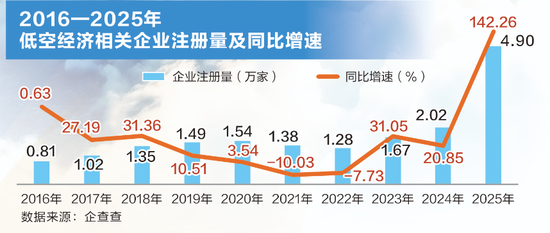
Core Insights - The low-altitude economy is projected to reach a market size of 1.5 trillion yuan by 2025 and 3.5 trillion yuan by 2035, becoming a core track for cultivating new productive forces and emerging industries [4][26] - The year 2026 is seen as a pivotal year for the low-altitude economy, marking the transition from concept validation to scenario application [2][24] - The Chinese government has elevated the low-altitude economy to a strategic emerging industry, with multiple policies and frameworks established to support its development [6][28] Market Potential - The low-altitude economy market in China surpassed 500 billion yuan in 2023, reaching 505.95 billion yuan, with a projected growth of 32.5% to 670.25 billion yuan in 2024 [4][26] - The number of registered low-altitude economy-related enterprises increased significantly, with a forecast of 49,000 registrations by 2025, marking a year-on-year growth of 142.26% [2][24] Policy Support - The low-altitude economy was included in national planning for the first time in February 2021, and it has been recognized as a strategic emerging industry in subsequent government reports [6][28] - The establishment of the Low Altitude Economy Development Department by the National Development and Reform Commission aims to coordinate the advancement of the low-altitude economy [6][28] Industry Structure - The low-altitude economy industry is concentrated in three major economic zones: the Greater Bay Area, Yangtze River Delta, and Beijing-Tianjin-Hebei, which together form the leading tier of development [7][29] - As of January 2023, there were approximately 163,000 active low-altitude economy-related enterprises in China, with significant concentrations in East and South China [7][29] Technological Advancements - The low-altitude economy has developed a complete industrial chain encompassing low-altitude manufacturing, operation, infrastructure, and information services [10][32] - China leads globally in drone research and design, with over 77,000 drone R&D companies, including major players like DJI [10][32] Investment Trends - Investment in the low-altitude economy is on the rise, with 143 financing events recorded in the first half of 2025, a 120% increase year-on-year [15][37] - The stock market has seen significant interest, with 17 concept stocks doubling in price since 2024, indicating strong investor confidence [15][37] Application Scenarios - The low-altitude logistics market is expected to grow rapidly, with projections of reaching 120 to 150 billion yuan by 2025 and 450 to 605 billion yuan by 2035 [11][33] - Companies like WanFeng Aviation are developing comprehensive applications for fixed-wing aircraft, eVTOL, and drones, covering various transportation scenarios [12][34] Challenges Ahead - The low-altitude economy faces challenges in infrastructure development, regulatory frameworks, and technological breakthroughs, which are essential for scaling operations [40][41] - Key issues include the reliance on imported components, high operational costs, and the need for a stable business model to ensure sustainable growth [40][41]