
极狐阿尔法S(L3版)

Search documents
L3自动驾驶加速迈入商业化落地阶段
Zhong Guo Jing Ji Wang· 2026-01-13 06:34
Core Insights - The event themed "Leap Forward Together to Create Intelligent Mobility" showcased significant advancements in smart mobility by BAIC New Energy, including the launch of the L3 level Arcfox Alpha S for large-scale road testing and a strategic partnership with Pony.ai for L4 level developments [1][2] Group 1: L3 Level Developments - The Arcfox Alpha S (L3 version) has received approval for nationwide L3 level autonomous driving vehicle access, marking a new phase in the mass application of autonomous driving technology [1] - The initial pilot operation of the Arcfox Alpha S (L3 version) will take place on key transportation routes in Beijing, including the Jing-Tai Expressway and Daxing Airport Expressway, integrating smart mobility experiences into major traffic arteries [2] Group 2: Strategic Partnerships and Future Outlook - BAIC New Energy's collaboration with Pony.ai has entered the 2.0 phase, aiming to create a complete closed-loop from technology development to commercial operation in the autonomous driving sector [2] - The Robotaxi market is projected to reach nearly 500 billion yuan by 2030, representing a significant growth opportunity within the smart mobility landscape [2]

产品准入与上路通行协同落地,极狐拿下首批L3“通行证”
Zhong Guo Jing Ji Wang· 2025-12-24 06:46
Core Viewpoint - The successful issuance of the first L3-level autonomous driving special license plates for the Arcfox Alpha S (L3 version) marks a significant milestone in China's autonomous driving industry, allowing these vehicles to operate legally on the roads and indicating a new phase of "licensed driving" for autonomous vehicles [1][3]. Group 1: License Issuance and Vehicle Details - The first batch of L3-level autonomous driving special license plates includes three vehicles, each with unique symbolic meanings, such as "京AA0001Z," which represents the first license plate not restricted by highway congestion [3]. - The Arcfox Alpha S (L3 version) is the only model in this batch equipped with LiDAR, enhancing the system's perception redundancy capabilities [3]. - These vehicles will conduct pilot operations on designated routes in Beijing, including the Jing-Tai Expressway and Daxing Airport Expressway, to accumulate practical experience for future commercial operations [3]. Group 2: Industry Implications and Technological Advancements - The transition from L2 (assisted driving) to L3 (conditional autonomous driving) signifies a fundamental change in roles and responsibilities, where the vehicle can take over driving tasks under specific conditions [3][5]. - The issuance of the license plate reflects the reliability of the technology, which must be capable of assuming driving responsibilities [5]. - Arcfox's parent company, BAIC New Energy, has a 16-year history of systematic advancements from electrification to intelligence, positioning it as a leader in the autonomous driving sector [5][7]. Group 3: Safety and Compliance Measures - The Arcfox Alpha S (L3 version) has undergone extensive testing and safety evaluations, passing various assessments by the Ministry of Industry and Information Technology and the Ministry of Public Security [7]. - The successful licensing is a high-standard verification of BAIC's product safety levels and is expected to drive the upgrade of the intelligent connected vehicle industry chain in Beijing-Tianjin-Hebei [7]. - The initiative aims to provide a replicable "Chinese solution" for the commercialization of autonomous driving [7].

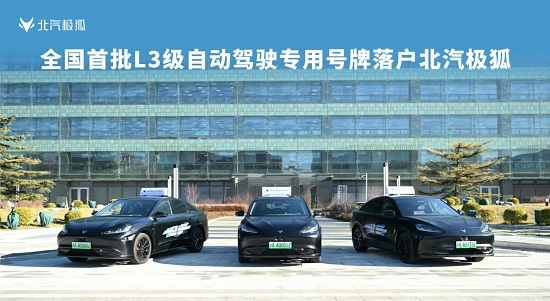
北汽极狐拿下国内首批自动驾驶L3通行证
Yang Zi Wan Bao Wang· 2025-12-23 13:26
Core Insights - The article highlights the significance of the first official autonomous driving license plates issued in China, specifically for the L3 version of the Arcfox Alpha S, marking a pivotal moment in the country's autonomous driving development [1]. Group 1: License Plate Significance - The Arcfox Alpha S has received three of the first official autonomous driving license plates in China, namely 京AA0001Z, 京AA0733Z, and 京AA0880Z, indicating a major advancement in the legal framework for autonomous vehicles [1]. - The 京AA0001Z plate is particularly notable as it is the first license plate that allows for autonomous driving without restrictions related to highway congestion, representing the highest level of technology in domestic autonomous vehicles [1]. Group 2: Technological Implications - The issuance of these license plates signifies that the technology behind autonomous driving must be reliable enough to assume driving responsibilities, indicating a shift from mere technical validation to legal operation on public roads [1]. - The development marks a critical step in China's journey towards integrating autonomous vehicles into everyday traffic, showcasing the country's commitment to advancing its autonomous driving capabilities [1].
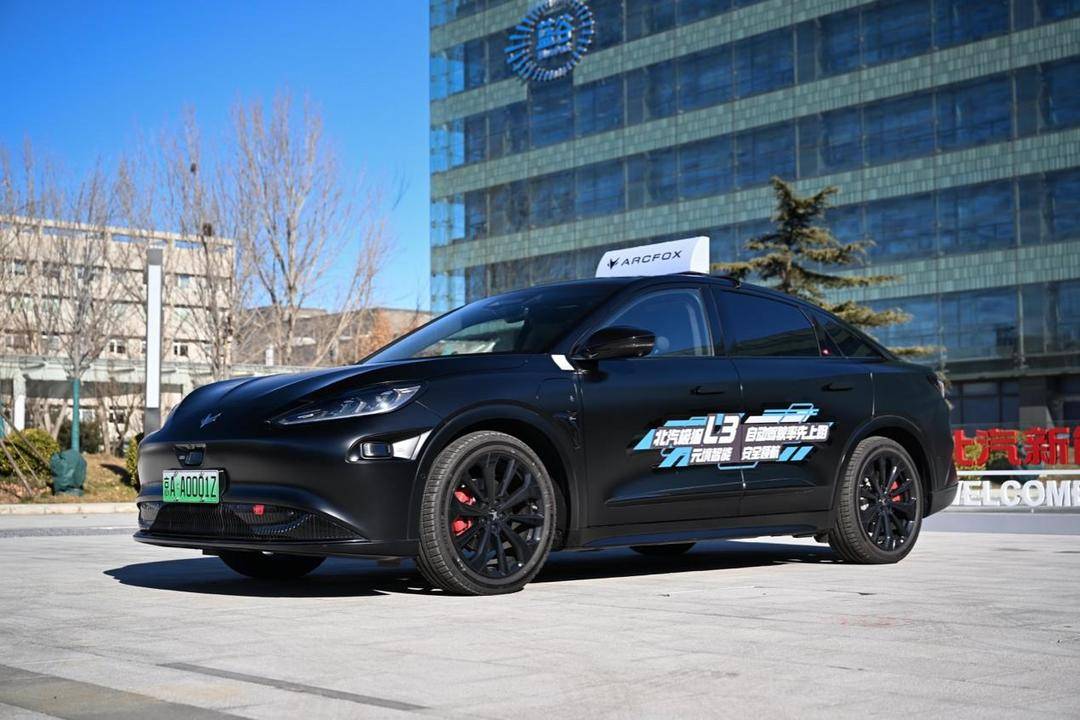
首批L3级车型获准入许可 自动驾驶向商业化应用迈出关键一步
Ren Min Ri Bao· 2025-12-19 23:30
Core Viewpoint - The approval of the first batch of L3 conditional autonomous driving vehicle licenses in China marks a significant step towards the commercialization of L3 autonomous driving technology, allowing for specific road testing in designated areas of Beijing and Chongqing [1][2][3]. Group 1: Significance of the Approval - The approval signifies a transition from technical validation to mass production application in the autonomous driving industry, paving the way for legal pathways for the industry to move from laboratories to specific scenarios and open roads [3][4]. - L3 autonomous driving allows vehicles to operate independently under certain conditions, requiring driver intervention only when prompted by the system [2][3]. Group 2: Conditions for L3 Autonomous Driving - The term "conditional" refers to the necessity for manufacturers to specify the applicable road types, weather conditions, driver status, and vehicle conditions for the autonomous driving features [3][4]. - L3 vehicles can only operate on designated routes at limited speeds, with Beijing's test vehicles capable of 80 km/h and Chongqing's vehicles designed for congested traffic at a maximum of 50 km/h [4][6]. Group 3: Vehicle Requirements and Safety Measures - The vehicles must be equipped with advanced sensing technologies, including multiple lidar and radar systems, to ensure comprehensive environmental perception and decision-making capabilities [4][5]. - A seven-layer redundancy architecture is implemented in the vehicles to ensure safety, allowing backup systems to take over in case of primary system failures [5][6]. Group 4: Consumer Access and Future Plans - Currently, the test vehicles are not available for direct consumer sales; however, consumers can experience the autonomous driving features through ride-hailing services [6]. - A consortium led by BAIC Group plans to initiate operations in specific scenarios by the first quarter of 2026 to gather practical experience [6].

自动驾驶又迎催化!“华为系”智能汽车在全国多地开启L3路测
Shang Hai Zheng Quan Bao· 2025-12-16 12:33
Core Insights - The commercial use of L3 conditional autonomous driving is approaching, with multiple cities in China conducting road tests for L3 vehicles, including Shenzhen, Beijing, Shanghai, Guangzhou, Hefei, Wuhan, and Chongqing [1][3][6] Group 1: L3 Autonomous Driving Testing - Huawei's subsidiary, Hongmeng Zhixing, has initiated L3 conditional autonomous driving testing in Shenzhen, focusing on real-world scenarios to validate the safety and maturity of the L3 system [3][6] - The testing involves real users, specifically Huawei employees, using self-purchased models such as the 2025 Wanjie M9 and Zun Jie S800, covering 1,000 kilometers of high-speed roads in Shenzhen [3][6] - Other brands, including Xiaopeng Motors, have also received L3 road testing licenses and are conducting regular tests in cities like Guangzhou [6][7] Group 2: Partnerships and Collaborations - As of October 2025, Huawei's "Qian Kun" has partnered with 14 automotive companies, resulting in 33 mass-produced models across various vehicle types, including electric, hybrid, and fuel vehicles [4][10] - The first two L3 autonomous driving models approved for road testing are the Changan Deep Blue SL03 and the BAIC Arcfox Alpha S (L3 version), which are designed for urban congestion and highway scenarios [7][10] - Changan Deep Blue has three models equipped with Huawei's Qian Kun intelligent driving solution, while BAIC's Arcfox Alpha S (L3 version) also utilizes this technology [10]
