标普500追踪ETF(SPY)

Search documents
能源、必选消费和美债领涨2026!华尔街的“AI交易”被“AI颠覆”了
华尔街见闻· 2026-02-14 10:53
Group 1 - The core viewpoint of the article is that AI, initially seen as a strong investment theme, has transformed into a threat, particularly impacting light-asset companies that may be replaced by AI rather than the tech giants developing it [1][6][7] - The S&P 500 index experienced its worst performance since November until a rebound on Friday due to mild inflation data, highlighting the widespread panic regarding AI disruption across various markets [2][4] - The profitability expansion accumulated by white-collar industries such as software companies, wealth management firms, and tax advisors over the past decade has been revalued within weeks, affecting even the private credit market that lends to these companies [3] Group 2 - Wall Street's previously confident bets have failed dramatically over six weeks, with cash allocations hitting a historical low and hedge positions at their minimum, leading to a collapse of consensus trades [5][8] - The sectors that have performed well include energy, consumer staples, and U.S. Treasury bonds, while the consensus bets on AI have faltered significantly [5] - Investors are questioning the return timelines of large capital expenditures by tech giants and whether remaining cash can continue to support stock buybacks, with more stocks being harmed by AI than helped [8][9] Group 3 - Two forces are exacerbating volatility in the U.S. stock market: low cash allocations and interconnected leverage networks that can trigger sell-offs across seemingly unrelated investments [12][13] - The VIX index recently surpassed the widely watched 20 mark, indicating rising market stress, even though it does not show panic, as the skew of put options remains historically high [18][19] - The performance of investment-grade bond ETFs relative to high-yield bond ETFs has improved, with the U.S. 10-year Treasury yield reaching a two-month low [20][21] Group 4 - Investors are adjusting their strategies, with the S&P 500 index still hovering near historical highs and credit spreads at ten-year lows, but there is an increase in hedging activities as indicated by the rising put-call ratio [22][24] - ETFs tracking companies with high shareholder returns attracted $3.6 billion in new funds this month, indicating a shift in investor focus [25] - Analysts suggest that if negative news regarding AI disruption subsides and volatility decreases, the U.S. stock market may support upward movement, but there is a conflict between market consensus and resilient economic indicators [26]


能源、必选消费和美债领涨2026!华尔街的“AI交易”被“AI颠覆”了
Hua Er Jie Jian Wen· 2026-02-14 01:49
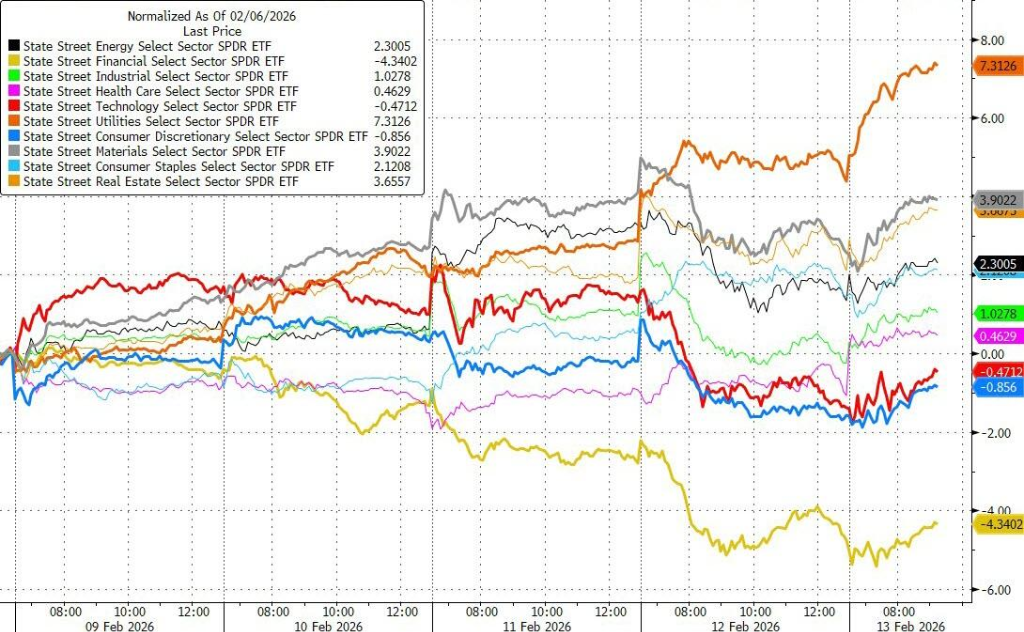
Core Viewpoint - AI, initially seen as a strong investment theme for the year, has shifted to a source of market uncertainty, particularly impacting light-asset companies that may be replaced by AI technology [1][4]. Group 1: Market Performance - The S&P 500 index experienced its worst performance since November until a rebound occurred following mild inflation data on Friday [1]. - The utility sector outperformed as a safe haven against AI impacts, while the financial sector was the worst performer of the week [2]. - Wall Street's previously confident bets have failed over six weeks, with cash allocations at a historic low and hedge levels at their lowest since 2018 [3]. Group 2: AI Impact and Investor Sentiment - Investors are questioning the return timelines on large capital expenditures by tech giants and whether remaining cash can continue to support stock buybacks [4]. - The sentiment is that more stocks have been harmed by AI than benefited, leading to concerns about potential contagion effects across sectors [4]. - The market is undergoing a repricing, particularly in the software industry, raising fears of broader impacts [4]. Group 3: Market Volatility - Two forces are exacerbating volatility in the U.S. stock market: low cash allocations and interconnected leveraged positions that can trigger widespread sell-offs [5]. - The VIX index recently surpassed the critical 20 mark, indicating rising market pressure despite not showing panic signals [6]. - The put-call ratio has surged since January, reflecting increased hedging activity among investors [9][10]. Group 4: Investment Strategy Adjustments - Despite current volatility, the S&P 500 remains near historical highs, and credit spreads are at ten-year lows, indicating that a market collapse has not yet occurred [9]. - There has been a significant inflow of $3.6 billion into ETFs tracking high shareholder return companies this month, suggesting a shift in investment focus [10].