市场重新定价

Search documents
原油成品油早报-20260325
Yong An Qi Huo· 2026-03-25 03:03
Group 1: Report Industry Investment Rating - No relevant information provided Group 2: Core Viewpoints of the Report - The news of a potential one - month cease - fire in the Iran war may lead to a short - term reduction in geopolitical risks, causing significant fluctuations in the gold, silver, and oil markets. The decline in oil prices reflects the energy market's high sensitivity to any signs of potential cooling of regional tensions. The sustainability of this trend depends on official confirmation and support from relevant parties [3] - Iran has stated that "non - hostile ships" can pass through the Strait of Hormuz after coordinating with Iranian authorities. The International Maritime Organization is negotiating to establish a humanitarian corridor for ships in the Persian Gulf [4] - The US and regional mediators are discussing the possibility of high - level peace talks with Iran as early as Thursday, but are waiting for a response from Tehran. Israel has concerns about the potential agreement [5] - This week, oil prices continued to rise. The traffic volume in the Strait of Hormuz remained low, and the spread between Brent and WTI reached the highest level in nearly a decade. The US approved a 30 - day authorization to conditionally relax sanctions on Iranian oil products. Global floating storage has significantly reduced inventory. Attention should be paid to whether Trump will have constructive dialogue with Iran regarding the Strait's navigation and geopolitical situation next week [7] Group 3: Summary by Directory 1. Daily News - According to Israeli media, the US may announce a one - month cease - fire in the Iran war, which may reduce short - term geopolitical risks and cause the energy market to re - price. The sustainability of this trend depends on official confirmation and support from relevant parties [3] - Iran has informed the International Maritime Organization that "non - hostile ships" can pass through the Strait of Hormuz after coordinating with Iranian authorities. The International Maritime Organization is negotiating to establish a humanitarian corridor for ships in the Persian Gulf [4] - The US and regional mediators are discussing the possibility of high - level peace talks with Iran as early as Thursday, but are waiting for a response from Tehran. Israel has concerns about the potential agreement [5] 2. Weekly Inventory - For the week ending March 20, the API crude oil inventory in the US was 234.8 million barrels, with an expected - 136.7 million barrels and a previous value of 655.6 million barrels. The API gasoline inventory was 52.8 million barrels, with an expected - 193.3 million barrels and a previous value of - 456 million barrels. The API refined oil inventory was 139.3 million barrels, with an expected - 140 million barrels and a previous value of - 139.4 million barrels [6] 3. Weekly Viewpoints - This week, oil prices continued to rise. The traffic volume in the Strait of Hormuz remained low, and the spread between Brent and WTI reached the highest level in nearly a decade. The US approved a 30 - day authorization to conditionally relax sanctions on Iranian oil products. Global floating storage has significantly reduced inventory. Attention should be paid to whether Trump will have constructive dialogue with Iran regarding the Strait's navigation and geopolitical situation next week [7]
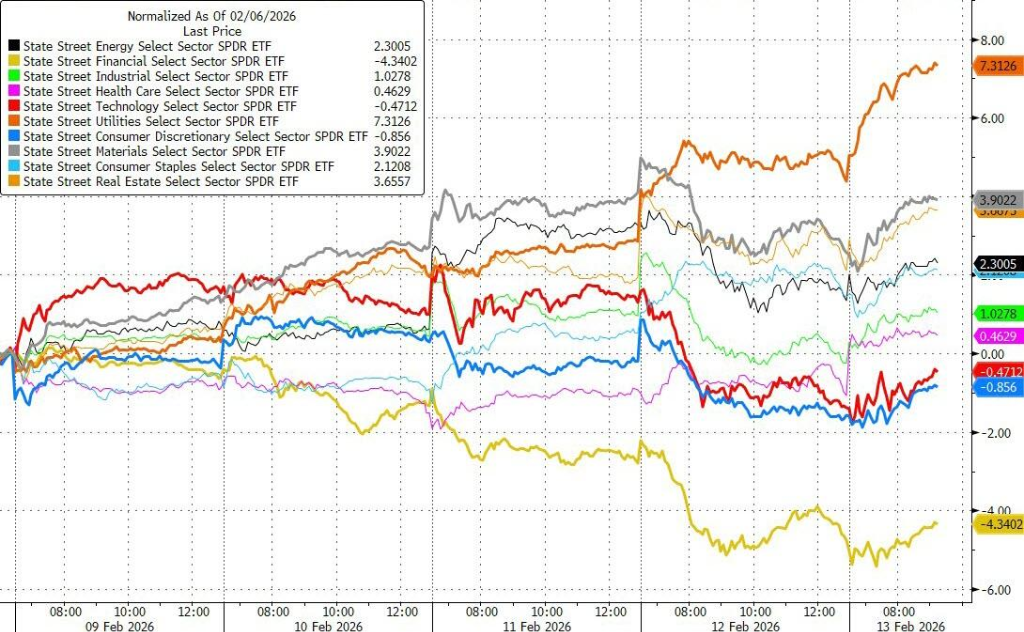
能源、必选消费和美债领涨2026!华尔街的“AI交易”被“AI颠覆”了
Hua Er Jie Jian Wen· 2026-02-14 01:49
Core Viewpoint - AI, initially seen as a strong investment theme for the year, has shifted to a source of market uncertainty, particularly impacting light-asset companies that may be replaced by AI technology [1][4]. Group 1: Market Performance - The S&P 500 index experienced its worst performance since November until a rebound occurred following mild inflation data on Friday [1]. - The utility sector outperformed as a safe haven against AI impacts, while the financial sector was the worst performer of the week [2]. - Wall Street's previously confident bets have failed over six weeks, with cash allocations at a historic low and hedge levels at their lowest since 2018 [3]. Group 2: AI Impact and Investor Sentiment - Investors are questioning the return timelines on large capital expenditures by tech giants and whether remaining cash can continue to support stock buybacks [4]. - The sentiment is that more stocks have been harmed by AI than benefited, leading to concerns about potential contagion effects across sectors [4]. - The market is undergoing a repricing, particularly in the software industry, raising fears of broader impacts [4]. Group 3: Market Volatility - Two forces are exacerbating volatility in the U.S. stock market: low cash allocations and interconnected leveraged positions that can trigger widespread sell-offs [5]. - The VIX index recently surpassed the critical 20 mark, indicating rising market pressure despite not showing panic signals [6]. - The put-call ratio has surged since January, reflecting increased hedging activity among investors [9][10]. Group 4: Investment Strategy Adjustments - Despite current volatility, the S&P 500 remains near historical highs, and credit spreads are at ten-year lows, indicating that a market collapse has not yet occurred [9]. - There has been a significant inflow of $3.6 billion into ETFs tracking high shareholder return companies this month, suggesting a shift in investment focus [10].

帮主郑重:昨夜全球资产大洗牌,你的钱袋子还好吗?
Sou Hu Cai Jing· 2026-02-06 01:11
Group 1: Market Overview - The recent decline in various asset classes, including U.S. stocks, gold, and Bitcoin, is attributed to a clear logic of deleveraging and market corrections [3][4][6] - Bitcoin's sharp drop is primarily due to investors using leverage, leading to forced liquidations as prices fell, creating a domino effect [3] - Gold and silver prices have also decreased, influenced by reduced geopolitical tensions and a stronger U.S. dollar, alongside selling pressure from investors needing to cover margin calls [3][4] Group 2: U.S. Stock Market Dynamics - The Dow Jones Industrial Average fell nearly 600 points, with the S&P 500 erasing its gains for the year, driven by concerns over weak employment data and a potential shift in Federal Reserve interest rate expectations [4] - The market is undergoing a repricing phase, reflecting uncertainty about economic conditions and interest rate policies [4] Group 3: Technology Sector Insights - The technology sector is experiencing a divergence, with companies like OpenAI advancing AI applications while others, such as those involved in traditional finance, face challenges [4][6] - The release of AI models capable of financial research has raised concerns about the impact on traditional financial services, indicating a potential industry transformation [6] Group 4: Investment Strategies - Investors are advised to avoid leverage, particularly in volatile assets like cryptocurrencies, and to focus on long-term, stable investment strategies [5] - It is recommended to refrain from chasing market trends or attempting to time the market during periods of panic, instead waiting for clearer signals before making investment decisions [5] - Diversification across asset classes, including U.S. stocks and precious metals, is emphasized to mitigate risks associated with market fluctuations [5] Group 5: Macro Trends and Policy Implications - Global uncertainties are increasing, influenced by geopolitical developments and policy changes, which can subtly affect market dynamics [5] - Investors should align their strategies with broader policy trends and industry developments rather than acting against prevailing market sentiments [5]

IC外汇平台:市场预期已稳,非农数据会带来变数吗?
Sou Hu Cai Jing· 2026-01-09 09:10
Core Viewpoint - The market shows no significant tension ahead of the non-farm payroll report, with investors' expectations regarding the Federal Reserve's policy path stabilizing [1] Group 1: Employment Data Expectations - Goldman Sachs estimates that the new non-farm payroll number will be around 70,000, aligning with mainstream consensus [3] - As long as the results do not deviate significantly from this range, the impact is likely to confirm existing macroeconomic judgments rather than introduce new uncertainties [3] - A job addition in the range of 70,000 to 100,000 is seen as an ideal outcome, indicating economic expansion while avoiding concerns of overheating [3] Group 2: Market Reactions to Employment Data - If the data falls below 50,000, it may raise concerns about weakening growth momentum, leading to increased market volatility [4] - Conversely, if job growth exceeds expectations, such as surpassing 125,000, the market may reconsider the pace of policy adjustments, potentially delaying anticipated easing [4] - Current market structure suggests that Goldman Sachs does not expect significant volatility from this non-farm data, as investor positioning indicates limited bets on large single-day movements [4]


一切皆涨,世界一次集体犹豫
Jin Rong Jie· 2025-12-22 03:07
Group 1 - The core viewpoint of the article highlights a cautious optimism in the market, with a focus on year-end rebounds rather than long-term bullishness [1] - The S&P 500 index surpassed 6800 points, the Nasdaq broke through the 50-day moving average, and Bitcoin stabilized above $85,000, indicating a potential theme of "betting on year-end rebounds" [1] - Investors are optimistic as the market anticipates two interest rate cuts by the Federal Reserve next year, creating an environment of hope and probability betting [1] Group 2 - The global market is characterized by a "hedging coexistence" state, where stock markets rise, the dollar remains stable, gold holds its ground, and bond yields are high, reflecting a lack of belief in a single narrative [1] - The true "watershed" for the market is expected in January, marking a period of "repricing" rather than a specific point [2] - In China, if policy signals in January are not clear enough, patient capital will likely continue to wait and observe [3] - In the U.S., if the consensus shifts to "no rate cuts in January," valuations will need to be reassessed [4] - The current market environment is not suitable for aggressive buying but also not conducive to simple short-selling, with significant decisions expected in January [5]
【UNforex本周总结】停摆结束缓释不确定性 市场定价重回政策与数据主线
Sou Hu Cai Jing· 2025-11-22 03:08
Group 1: Market Overview - Global financial markets showed significant divergence due to policy adjustments, data delays, and fluctuations in risk sentiment [1] - The end of the U.S. government shutdown provided clearer policy signals, leading to a new pricing process for major assets [1] - The cautious stance of Federal Reserve officials regarding inflation has cooled expectations for interest rate cuts by year-end [1] Group 2: Economic Data and Market Sentiment - Important economic data was delayed during the shutdown, leading to increased reliance on expectations for trading [1] - Despite a short-term recovery in sentiment, investors remain wary of potential shocks from the backlog of economic data [1] - The absence of employment, inflation, and manufacturing data has increased volatility in certain assets, with data uncertainty being a major market disruptor [1] Group 3: Asset Class Performance - Market risk appetite has seen some recovery, with funds flowing back into equities and high-beta assets [1] - Structural differences in recovery are evident, with technology and growth sectors performing better, while energy and financial sectors are constrained by fundamentals and interest rate expectations [1] - Safe-haven assets have experienced mixed fund flows, with gold under pressure but maintaining key support levels [1][4][5] Group 4: Stock Market Dynamics - Global stock markets continued to show a volatile rebound, with significant structural differentiation [6] - High-valuation sectors exhibited greater volatility, while low-valuation cyclical sectors remained weak, indicating that investors have not fully shifted to a risk-on mode [6] - The core themes of the week include policy return, sentiment repair, and ongoing risks, with the end of the U.S. shutdown providing certainty but leaving Fed policy direction unclear [6]
【UNFX市场前瞻】美国政府重启后:关注经济数据补发、美联储政策与债市走势
Sou Hu Cai Jing· 2025-11-15 15:52
Core Insights - The end of the longest government shutdown in U.S. history has shifted market sentiment, reducing risk aversion and warming up risk assets, but volatility may still be on the horizon [1] Economic Data Release - Key economic data that was delayed due to the shutdown will be released next week, including Non-Farm Payrolls (NFP), CPI and PPI inflation data, retail sales, new housing starts and building permits, and consumer confidence index [2][6] Market Dynamics - The market has been operating on expectations during the shutdown, with the Federal Reserve unable to access the latest data. The release of this data may lead to a market re-evaluation [3] - The Federal Reserve has signaled a hawkish stance, reducing the market's expectation for a rate cut in December from approximately 72% to 50% [3] - The end of the shutdown has led to a short-term increase in risk appetite, with U.S. stock futures rebounding and the dollar stabilizing, although this rebound may not indicate a trend reversal [3] Potential Market Movements - The bond market may undergo re-pricing due to delayed fiscal spending, which could increase debt risks and put upward pressure on yields. Rising yields may first impact high-leverage assets like gold and tech stocks [3] - U.S. stocks may experience a "divergent market" where sector rotation occurs rather than a broad market rally, with tech stocks sensitive to yield changes and financial stocks reacting significantly to the interest rate cycle [4] Gold Market Outlook - Gold is at a critical juncture, with its price currently in a weak but unbroken range. The upcoming week will be pivotal for gold's direction, influenced by delayed data, the Federal Reserve's stance, bond yield trends, and the re-pricing of risk assets [5][8] - If economic data is weak, rate cut expectations may rise, potentially boosting gold prices and tech stocks. Conversely, strong data may lead to a higher likelihood of the Fed maintaining its stance, resulting in rising bond yields and pressure on both U.S. stocks and gold [7]
期货市场继续降温!资金持续流出,什么情况?
券商中国· 2025-07-29 04:10
Core Viewpoint - The article highlights a significant downturn in the futures market, particularly in the black and new energy metal sectors, driven by a cooling of market sentiment and substantial capital outflows [1][4]. Group 1: Market Performance - On July 29, the black series led the decline, with coking coal dropping over 10%, glass down more than 7%, lithium carbonate falling over 6%, and soda ash decreasing over 4% [2]. - Following the overnight declines, more commodities experienced a cascading drop, with coking coal and glass leading the way, coking coal falling over 12% and glass over 10% [3]. - By 10:30 AM, some commodities showed slight rebounds, but overall, the market sentiment remained pessimistic with significant capital outflows across various sectors [3][4]. Group 2: Capital Flow and Market Sentiment - The overall capital flow in the market has shown a continuous outflow trend, with a notable shift in sentiment as profit-taking by long positions began after last Friday's night session [4]. - On July 28, the total capital outflow in the commodity futures market reached 20.29 billion yuan, with the black chain seeing an outflow of 8.5 billion yuan and precious metals and coal sectors around 5 billion yuan each [4]. - The black sector and new energy metals were particularly sensitive to capital outflows, indicating a lack of significant improvement in supply-demand fundamentals without new industrial policies [4]. Group 3: Economic Indicators and Future Outlook - In the first half of the year, profits of industrial enterprises above designated size fell by 1.8% year-on-year, which is an improvement compared to a 2.8% decline in producer prices [5]. - Analysts suggest that future commodity prices may become more structured, with the overall push for PPI recovery being more critical than the height of the market [5]. - The rise of the US dollar has emerged as a significant variable affecting the commodity market, with the dollar index increasing by 1%, marking the largest single-day gain since May [6].