
核级锆材

Search documents
西部材料预计2026年3月获取核级锆材制造许可证
Jing Ji Guan Cha Wang· 2026-02-13 01:59
根据九阳公社2025年12月18日的研报分析,西部材料预计在2026年3月10日获取核级锆材制造许可证, 这一事件可能对公司的核电业务发展产生影响。 机构观点 以上内容基于公开资料整理,不构成投资建议。 经济观察网根据九阳公社2025年12月18日的研报分析,西部材料(002149)预计在2026年3月10日获取 核级锆材制造许可证,这一事件可能对公司的核电业务发展产生影响。 ...

【行业前瞻】2025-2030年中国自学习边缘计算智控器行业发展分析
Sou Hu Cai Jing· 2025-05-30 11:26
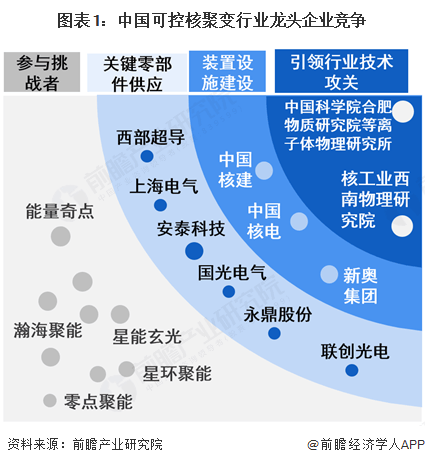
Core Insights - The controlled nuclear fusion industry in China is characterized by high technical barriers and limited participation from companies, with significant involvement from research institutions like the Hefei Institute of Physical Science and the Southwest Institute of Physics [1][4] Industry Overview - The industry is still in the technological breakthrough phase, with commercialization being insufficient. Key players include China Nuclear Engineering and Construction Corporation (CNEC) and China National Nuclear Power, which are leading the development of controlled nuclear fusion technology [1][4] - The industry is supported by various companies that supply critical components and materials, including superconducting materials and radiation-resistant materials [4][6] Market Competition Landscape - As of March 25, 2025, there are 170 institutions related to controlled nuclear fusion in China, with the highest concentration in Anhui Province (24 institutions), followed by Guangdong (19), and Beijing (17) [3] - The distribution of these institutions indicates a focus on regions rich in research resources and complete supporting industries [3] Company Contributions - Key companies involved in the controlled nuclear fusion sector include: - **Orient Lithium**: Specializes in superconducting materials essential for controlled nuclear fusion [6] - **Tianli Composite**: Supplies thermal barrier coatings for fusion reactors [6] - **Yongding Co.**: Provides superconducting magnets and is actively involved in the ITER project [6] - **Baotai Co.**: Produces nuclear-grade aluminum materials critical for nuclear power applications [6] Regional Distribution of Companies - The distribution of listed companies in the controlled nuclear fusion sector shows a concentration in Jiangsu Province (8 companies), followed by Sichuan (7) and Shaanxi (6) [4][7] - The industry is centered around Hefei and Shanghai, forming a key industrial circle, with significant facilities located in these areas [7]


三祥新材(603663):控股股东拟增持股份,彰显长期发展信心
NORTHEAST SECURITIES· 2025-04-30 02:45
Investment Rating - The report maintains a rating of "Accumulate" for the company, indicating a projected stock price increase of 5% to 15% over the next six months [6]. Core Insights - The controlling shareholder, Ningde City Huifu Investment Co., Ltd., plans to increase its stake in the company, demonstrating confidence in the company's long-term development and investment value. The planned increase will be between 50 million and 100 million RMB within six months starting from April 30, 2025, with a commitment not to reduce holdings for six months after the purchase [2][3]. - The company is executing an integrated development strategy in the zirconium and hafnium industry chain, having completed strategic deployments in upstream and midstream sectors. This includes core areas such as electric melting zirconia and oxychloride zirconia, with plans to expand into end-use applications like nuclear-grade zirconium materials and zirconium-based liquid metals [3]. - The company has made significant progress in solid-state electrolyte materials, which are expected to enhance growth potential. The zirconium-based composite oxides and chlorides have shown promising electrochemical performance, with ongoing trials and small-scale supply to downstream solid-state battery manufacturers [4]. Financial Summary - The company is projected to achieve a net profit attributable to shareholders of 202 million RMB in 2025, with a significant growth rate of 166.32% compared to 2024. The expected net profits for 2026 and 2027 are 274 million RMB and 309 million RMB, respectively [5]. - Revenue is forecasted to grow from 1,054 million RMB in 2024 to 1,514 million RMB in 2025, reflecting a growth rate of 43.66% [5]. - The company's earnings per share (EPS) is expected to increase from 0.18 RMB in 2024 to 0.48 RMB in 2025, with a projected price-to-earnings (P/E) ratio of 48.18 in 2025, decreasing to 31.48 by 2027 [5].
