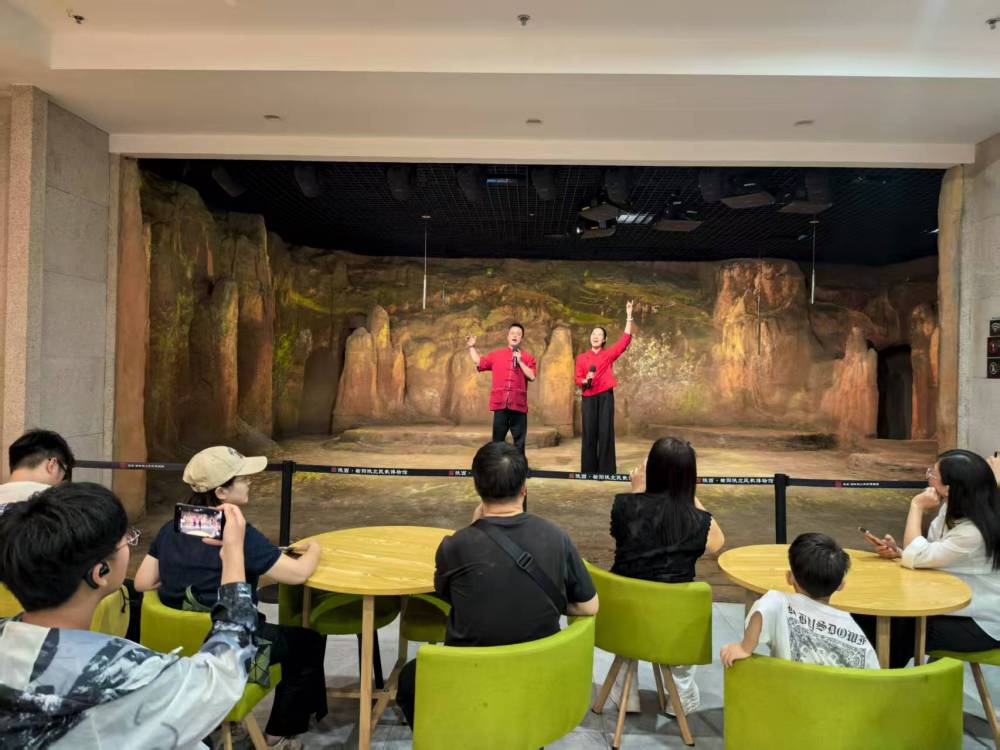
榆林小曲

Search documents
【榆林】非遗传承中的“银发力量”
Shan Xi Ri Bao· 2025-12-08 00:25
Core Viewpoint - The article highlights the integration of elderly education with the transmission of local intangible cultural heritage (ICH) in Yulin City, promoting a "Silver Hair Action" that encourages elderly learners to engage in ICH activities and pass on traditional skills to younger generations [1][8]. Group 1: Non-Heritage Education Initiatives - Yulin City has established various elderly universities and activity centers as hubs for ICH transmission, allowing elderly learners to focus on promoting traditional culture through structured learning [1][2]. - The Yulin City Elderly University has over 180 students in its Shaanxi Yangge training program, with students participating in national performances [2]. - Local elderly universities have hired ICH representatives as dedicated teachers and developed tailored teaching materials to enhance the systematic teaching of ICH [2]. Group 2: Innovative Approaches to Cultural Transmission - The integration of ICH with modern elements, such as "ICH + tourism" and "ICH + creative products," has provided broader platforms for elderly learners to showcase their skills [5][6]. - Activities like the "When Paper-Cutting Meets Cultural Creation" event allow traditional crafts to be incorporated into everyday life, promoting ICH in a contemporary context [5]. - The performance of traditional arts, such as Jinju (a type of local opera), by elderly learners has become a cultural bridge between regions, enhancing community engagement [6]. Group 3: Intergenerational Knowledge Transfer - Elderly learners have transitioned from being mere students to active disseminators of ICH, teaching younger generations about local customs and performances [7]. - Programs like the Wu Fortress Water Boat performance training class have successfully engaged elderly learners in teaching local folklore to school students and community members [7]. - The participation of elderly learners in performances has gained national attention, showcasing local heritage on platforms like the Spring Festival Gala and CCTV [7].
这个博物馆“可听”
Xin Hua She· 2025-08-17 07:33
Core Viewpoint - The Shaanxi Folk Song Museum in Yulin City aims to rescue, protect, inherit, and promote Shaanxi folk songs through innovative exhibition methods that combine traditional and modern displays, creating an immersive auditory experience for visitors [1][8]. Group 1: Museum Overview - The museum opened in May 2018 and is designed to be experienced through sound, allowing visitors to enjoy a variety of folk songs performed by local artists [1]. - The museum features a unique exhibition style that integrates traditional and modern elements to keep cultural heritage alive [1]. Group 2: Folk Song Characteristics - Labor songs, as a representative of Shaanxi folk music, are rooted in local culture and were created during labor practices to boost morale and coordination among workers [3]. - The museum showcases various forms of folk art, including the Yulin Little Tune, which is a national intangible cultural heritage that blends southern melodies with local folk tunes [5]. Group 3: Cultural Significance - Shaanxi storytelling, originating from the Ming and Qing dynasties, is an important form of regional art that has gained recognition through modern media, such as the popular game "Black Myth: Wukong" [7]. - Shaanxi folk songs have evolved from grassroots culture to professional stages, reflecting the continuous development and innovation of traditional Chinese culture [8].