
模型即服务(MaaS)平台

Search documents
智谱港股上市获证监会备案 IPO定价116.2港元
Sou Hu Cai Jing· 2025-12-30 02:43
Core Viewpoint - Beijing Zhipu Huazhang Technology Co., Ltd. plans to issue 37,419,500 H-shares at a price of HKD 116.2 per share, with trading expected to commence on January 8, 2026 [1] Group 1: Company Overview - The company received approval from the China Securities Regulatory Commission to issue up to 43,032,400 overseas listed ordinary shares [1] - The company disclosed its prospectus on December 19, outlining its plans for a Hong Kong stock market listing [1] Group 2: Financial Performance - The company's revenue for 2022, 2023, and 2024 is projected to be RMB 57.4 million, RMB 124.5 million, and RMB 312.4 million, respectively, indicating a compound annual growth rate (CAGR) of 130% over three years [1] - Revenue for the first half of 2025 is reported to be RMB 190 million [1] Group 3: Business Focus - The primary revenue source for the company is its large model-related business, including Model as a Service (MaaS) platform and localized deployment [1] - The company aims to become the largest independent general-purpose large model vendor in China [1]


智谱,通过港交所IPO聆讯,或很快香港上市,中金公司独家保荐
Sou Hu Cai Jing· 2025-12-20 12:11
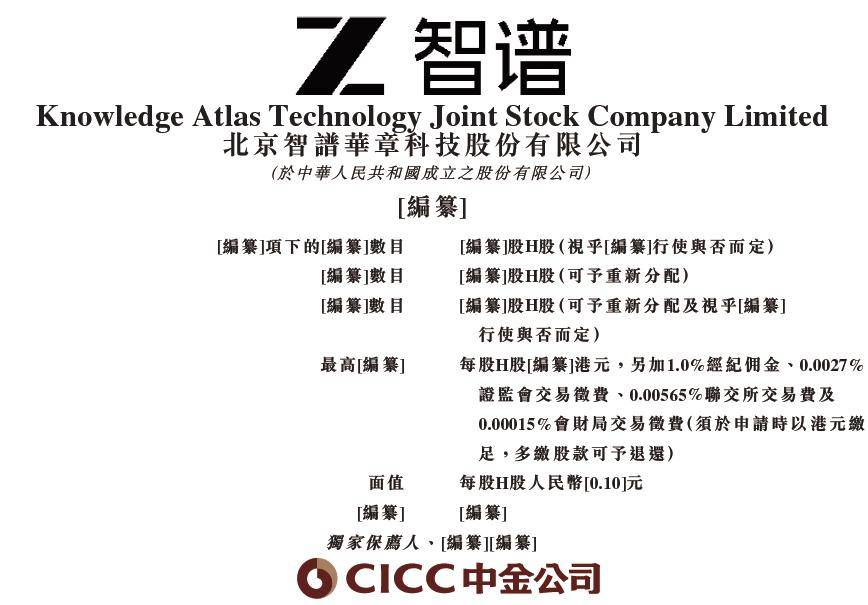
Core Viewpoint - Knowledge Atlas Technology Joint Stock Company Limited (智谱) is preparing for an IPO on the Hong Kong Stock Exchange, aiming to leverage its position as a leading AI company in China focused on general artificial intelligence (AGI) and advanced model development [2]. Company Overview - Established in 2019, the company is recognized for its innovative approach to AGI and has developed a proprietary pre-trained model framework, GLM, which includes various model types such as language, multimodal, agent, and code models [2]. - As of June 30, 2025, the company has supported over 8,000 institutional clients and approximately 80 million devices with its models [2]. Market Position - According to Frost & Sullivan, the company ranks first among independent general model developers in China and second overall, holding a market share of 6.6% in 2024 [3]. Product Development - The company has released over 50 open-source models, with total downloads exceeding 45 million as of June 30, 2025 [5]. - The company’s models are compatible with over 40 mainstream hardware chips, enhancing their adaptability in diverse hardware environments [5]. Business Model - The company operates a Model as a Service (MaaS) platform that allows clients to customize and deploy models tailored to their specific business needs [6]. Financial Performance - The company reported revenues of RMB 0.57 billion, RMB 1.25 billion, RMB 3.12 billion, and RMB 1.91 billion for the years 2022, 2023, 2024, and the first half of 2025, respectively [13]. - Corresponding net losses were RMB 1.44 billion, RMB 7.88 billion, RMB 29.58 billion, and RMB 23.58 billion for the same periods [13]. Shareholder Structure - The pre-IPO shareholder structure indicates that key stakeholders, including Dr. Liu Debing and other co-founders, collectively hold approximately 33.03% of the shares [7][8]. Board Composition - The board consists of 9 members, including 3 executive directors, 3 non-executive directors, and 3 independent non-executive directors, with a diverse background in AI and investment [12]. IPO Advisory Team - The IPO is being managed by a team that includes CICC as the exclusive sponsor, KPMG as the auditor, and various legal advisors for different jurisdictions [15][16].

淡水泉投资解读WAIC:AI产业竞争格局加速重构
Xin Lang Ji Jin· 2025-08-15 07:42
Group 1 - The 2025 World Artificial Intelligence Conference (WAIC) showcased a shift from homogeneous competition among large model vendors to differentiated strategies, with companies focusing on long text processing, multimodal capabilities, and vertical scene development [2] - The boundaries between models and applications are becoming increasingly blurred, with leading vendors transitioning from pure model providers to comprehensive platforms that integrate generation, retrieval, and tool invocation capabilities [2] - The industry is exploring a hybrid model of open-source and closed-source, with some companies like OpenAI and Zhipu releasing open-source models, while others like Meta are developing advanced closed-source products [2] Group 2 - Internet cloud vendors are building model-centric full-stack capabilities, offering "Model as a Service" (MaaS) platforms that may change the logic of enterprises moving to the cloud, especially for small and medium-sized enterprises facing challenges with private AI cloud setups [3] - The progress of domestic computing power is highlighted by Huawei's Ascend 384 super node cluster, which boasts double the computing power of NVIDIA's GB200 NVL72 system, although domestic GPUs still lag in key inference performance metrics [4] - The demand for private deployment is reflected in the popularity of AI integrated machines, with domestic GPU manufacturers seeking breakthroughs through collaborative innovation [4] Group 3 - Despite high interest in smart robots and AR glasses, edge AI is still in a preparatory stage, facing challenges in multimodal perception, interaction, and autonomous decision-making capabilities [5] - The smartphone is seen as a potential primary carrier for AI agents due to its advantages in computing power, interaction, and application scenarios, with a cautious approach from manufacturers indicating the need for further technological maturity [5] - Continuous investment in the industry chain is laying the groundwork for future developments in edge AI, suggesting a positive outlook despite the current limitations [5]