欧洲主权债券

Search documents
美股周五收盘点评(上)CPI低于预期,投资人质疑数据
Xin Lang Cai Jing· 2025-12-19 22:31
Core Insights - Global bond yields have risen, led by Japan, following the Bank of Japan's decision to raise its policy interest rate to approximately 0.75%, the highest level in nearly 30 years [1] - The yield on Japan's 10-year government bonds has surpassed 2%, a level not seen since the late 1990s, indicating a decisive shift away from ultra-loose monetary policy [1] - Despite the interest rate hike, the Japanese yen has weakened against the US dollar to around 157, suggesting market skepticism about the sustainability of the tightening policy [1] Group 1 - The rise in Japanese bond yields has triggered a global increase in bond yields, affecting US Treasuries and European sovereign bonds [1] - Japan's policy shift is significant as its government bonds have long served as a benchmark for global arbitrage trading and duration risk exposure [1] - The increase in Japanese bond yields represents a structural tightening of global financial conditions, contrasting sharply with the previous decades of policy [1] Group 2 - The surge in yields and the weakening yen have led to a sell-off in global risk assets, reminiscent of past "yen carry trade" unwinding, although a similar situation has not yet been observed this time [1] - Higher yields pose challenges for interest-sensitive sectors of the economy, including real estate and big-ticket items like financed automobiles [1]
特朗普一系列操作痛击美债 外资蜂拥至欧债市场:创2023年以来最大买入规模
智通财经网· 2025-07-18 13:49
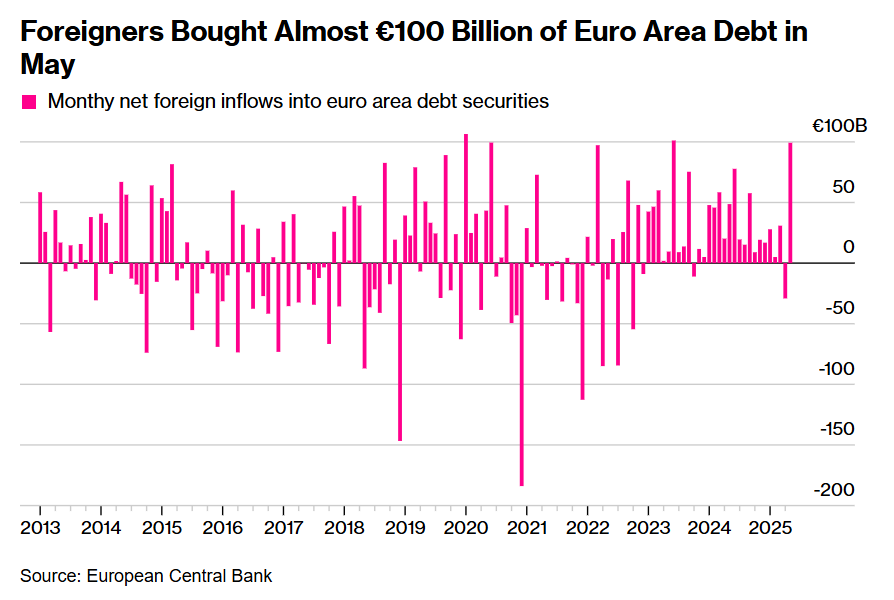
Core Viewpoint - The aggressive tariff policies led by the Trump administration and the "big and beautiful" bill, which significantly increases the budget deficit, have caused the so-called "American exceptionalism" to collapse, prompting overseas investors to flock to the European market [1] Group 1: Overseas Investment Trends - In May, overseas buyers purchased nearly €100 billion (approximately $116 billion) of eurozone bond assets, marking the strongest buying scale by overseas investors in 2023 [1][4] - Traditional asset management institutions have significantly sold off U.S. Treasury assets in response to Trump's tariff announcements, seeking to allocate funds into safer European sovereign bonds like German government bonds [1] Group 2: U.S. Treasury Market Dynamics - Foreign investors' total holdings of U.S. Treasury bonds reached $9.05 trillion in May, with a modest increase of $32.4 billion from April [5] - Despite this, concerns over potential inflation due to Trump's tariff policies and the collapse of "American exceptionalism" have led to a sell-off in the U.S. Treasury market, with the 30-year Treasury yield rising by 50 basis points since April 2 [5] - The "big and beautiful" bill is expected to significantly expand the government budget deficit, contributing to upward pressure on U.S. Treasury yields, particularly for the 10-year Treasury yield, which is seen as a global asset pricing anchor [5][6] Group 3: European Bond Market Appeal - Compared to the U.S., Europe offers a more stable policy environment, lower budget deficit outlook, and lower inflation levels, making its sovereign bonds more attractive to global central banks [6] - The European Central Bank has more room to lower interest rates to stimulate economic growth due to lower inflation, enhancing the appeal of European bonds [6] Group 4: Market Sentiment and Future Projections - The market is currently questioning the independence of the Federal Reserve's monetary policy due to Trump's threats to potentially dismiss Fed Chairman Powell, which has led to increased scrutiny on long-term Treasury yields [6] - The term premium for 10-year U.S. Treasury bonds is hovering at its highest level since 2014, reflecting investor concerns over the future borrowing scale of Washington [6][7] - Economists predict that under the Trump administration, the scale of national debt and budget deficits will be significantly higher than official forecasts, driven by a framework of "domestic tax cuts + external tariffs" [7]