氚云

Search documents
创·问|奥哲徐平俊:企业级AI落地,难的不只是技术
3 6 Ke· 2026-02-10 08:55
Core Insights - The article discusses the characteristics of successful companies and individuals, focusing on the insights from Xu Pingjun, the founder and CEO of AoZhe, a leading enterprise digitalization service provider in China [1][5]. Group 1: Company Overview - AoZhe is dedicated to helping enterprises achieve digital and intelligent transformation through low-code and enterprise-level AI platform products and solutions, having served over 200,000 enterprise users, including 60% of China's top 500 companies [1][5]. - The company transitioned from being a low-code platform to an enterprise-level AI platform, leveraging over a decade of industry experience to bridge the gap between technology proliferation and practical implementation [5][16]. Group 2: AI Implementation Challenges - Xu Pingjun notes that while there is a growing interest in AI applications among enterprises, many struggle to identify valuable business scenarios for implementation, indicating that the challenge lies not in technology but in recognizing worthwhile applications [3][10]. - The main challenges in AI implementation include determining the required precision for specific scenarios and the associated costs, which can be significant if aiming for high accuracy [11][12]. Group 3: Solutions Offered by AoZhe - AoZhe addresses these challenges by using low-code for data governance, providing insights through machine learning, and ensuring that AI applications are well-integrated with existing enterprise systems [18][19]. - The company emphasizes the importance of understanding enterprise data structures to enhance AI accuracy and effectiveness, moving beyond mere data organization [19][20]. Group 4: Market Trends and Opportunities - The demand for AI integration is increasing, with existing clients seeking to enhance traditional processes with AI capabilities, such as transforming contract management into intelligent contract management [21][22]. - New market opportunities are emerging as companies recognize the potential of AI to streamline operations and improve decision-making, even among those who previously did not engage with AoZhe's services [21][23]. Group 5: Future Outlook - Xu Pingjun believes that many enterprises, especially small and medium-sized ones, can leap directly into the AI era without going through traditional digitalization stages, indicating a significant shift in how businesses approach technology [23][24]. - The company aims to become an AI-native organization and assist clients in achieving the same, with ongoing internal training and the integration of AI across various departments [26][27].

独家对话奥哲CEO徐平俊:“AI+数据+低代码”成为构建AI原生企业最佳路径
Sou Hu Cai Jing· 2025-10-22 10:55
Core Insights - The recent release of the State Council's opinion on implementing "AI+" actions indicates a shift from AI technology being a novelty to becoming practical and essential for businesses [3] - Companies' ability to apply AI technology will be a decisive factor in seizing future development opportunities, while AI technology providers face the challenge of transitioning from selling tools and services to selling outcomes [3][4] - The need for businesses to address challenges such as scenario selection, technology implementation, and ROI measurement will be critical for the commercialization and scalability of enterprise AI applications [3][4] Company Overview - Aozhe, founded during the late information age, initially focused on BPM to help businesses optimize processes and improve operational efficiency [4] - In the digital age, Aozhe shifted towards low-code platforms to enable businesses to respond quickly to market changes, achieving recognition as a leading low-code software vendor [4] - Aozhe's founder, Xu Pingjun, emphasized that understanding business needs is the core value of digital services, a capability that large models currently cannot replace [4][6] Strategic Developments - On October 17, Aozhe announced a strategic upgrade and launched an enterprise-level AI platform, proposing a closed-loop model of "AI + Data + Low-Code" [4][19] - This new strategy aims to address the challenges of integrating single-point capabilities and closing business logic loops in enterprise AI applications [4][19] Industry Insights - Xu Pingjun believes that AI technology will expand market growth by solving past challenges and creating new scenarios, while also enhancing the ability to meet personalized business needs [6][15] - The software industry is shifting towards value delivery and outcome delivery, with a consensus that AI should directly deliver results [15][18] Platform Features - Aozhe's enterprise-level AI platform is designed to facilitate the transition from digitalization to intelligentization, leveraging AI's native development capabilities [19][21] - The platform consists of three layers: AI model integration, a closed-loop business engine, and native AI application development across various industries [21][24] - Aozhe's platform aims to provide a seamless integration of AI, data, and low-code capabilities, allowing businesses to achieve better results at lower costs [27][28] Market Positioning - Aozhe's enterprise-level AI platform is positioned as a core product, with a focus on delivering personalized solutions and integrating various AI capabilities [26][27] - The platform differentiates itself by achieving business closure, supporting high levels of customization, and simplifying the use of AI through model selection and adaptation [27][28] Future Directions - Aozhe aims to become a leader in the enterprise-level AI platform market, building on its previous successes in BPM and low-code [46][47] - The company plans to help businesses transition from digitalization to intelligentization, ultimately enabling them to become AI-native enterprises [47]
奥哲企业级AI平台正式发布,开启企业新「智」变!
Quan Jing Wang· 2025-10-18 08:56
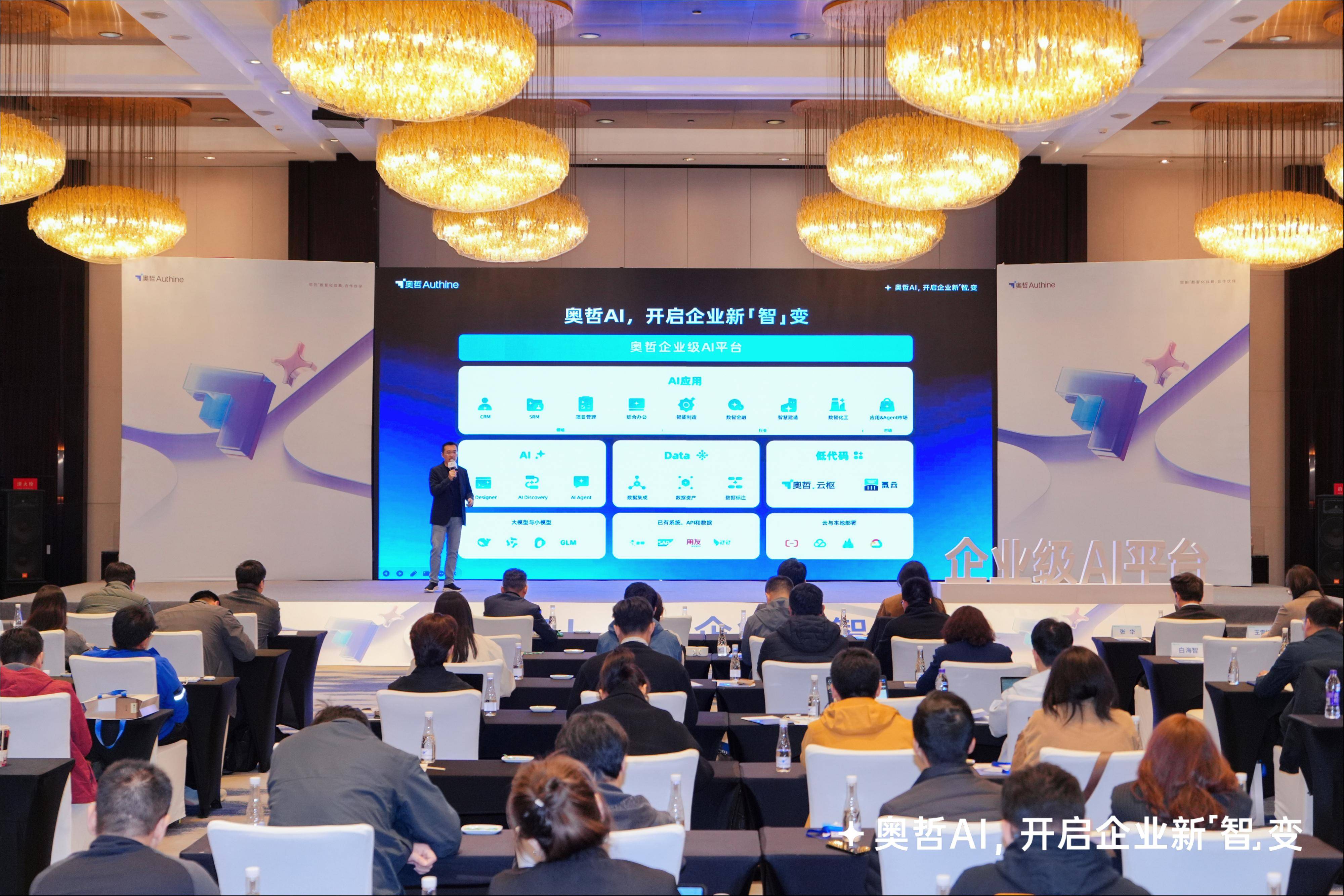
Core Insights - The conference on October 17, 2023, marked the launch of the "Aozhe Enterprise AI Platform," showcasing the company's new strategic positioning in the AI era, emphasizing the integration of "AI + Data + Low Code" as a core capability for enterprise digital transformation [1][2] - Aozhe aims to help enterprises transition into "AI-native" companies, highlighting that AI is not just a future trend but is currently replacing existing processes [2][10] Group 1: Company Overview - Aozhe has evolved over 15 years from a BPM product provider to a leader in low-code solutions, recognized as the "No. 1 Low-Code Brand in China" by IDC and other authorities [2] - The company has been actively involved in the formulation of industry standards and has deepened its exploration of AI applications to meet the evolving digital needs of enterprises [2] Group 2: AI Platform Features - The newly launched enterprise-level AI platform combines AI technology with a low-code platform, enabling integrated solutions from AI, data, to applications [3][6] - The platform includes three core AI capabilities: - **AI Designer**: Facilitates the development of AI-native applications by generating business blueprints and structured code, significantly lowering development barriers and enhancing efficiency [4] - **AI Agent**: Automates repetitive tasks, allowing businesses to delegate tasks like IT ticketing and customer service to AI [5] - **Data & AI Discovery**: Empowers business personnel to conduct data analysis and predictions with zero barriers, driving scientific decision-making [6] Group 3: Industry Applications - Companies like Wuhan Guangxun Technology and Beijing Huayuan Real Estate shared their AI transformation experiences, validating the capabilities of Aozhe's enterprise-level AI platform [7][8] - Guangxun Technology implemented a smart contract management system using Aozhe's platform, automating the entire lifecycle of contract management, which was recognized as a leading case in digital transformation [7] - Huayuan Real Estate has integrated AI into its operations, focusing on a phased approach to AI application, enhancing operational efficiency through IT intelligent customer service and AI approval systems [8] Group 4: Future Outlook - Experts at the conference emphasized that AI is a key driver for high-quality enterprise development, predicting that by 2030, around 50% of work content will be automated, necessitating skill upgrades for approximately 200 million workers [8] - Aozhe announced the establishment of the "Enterprise AI Alliance" to promote collaboration and innovation in AI technology across various industries [10] - The company aims to continue its evolution into a leading enterprise-level AI platform provider, focusing on the deep integration of "AI + Data + Low Code" to support enterprises in becoming AI-native [10]

零代码平台怎么选?
Sou Hu Cai Jing· 2025-08-12 10:10
Core Insights - The article emphasizes the importance of low-code platforms in addressing the challenges of insufficient IT resources and urgent business needs during the acceleration of digital transformation in enterprises [1] Group 1: Ranking of Low-Code Platforms - A weighted scoring model was used to rank the main low-code platforms based on five dimensions: technical strength (30%), functional coverage (25%), scenario adaptability (20%), security compliance (15%), and service ecosystem (10%) [2] - The top-ranked platforms are: 1. Qingliu (89 points) 2. Jiandaoyun (78 points) 3. ChuanYun (75 points) 4. Yanhua Yingdong (72 points) 5. Mingdao Cloud (69 points) [2] Group 2: In-Depth Analysis of Leading Platforms - Qingliu is recognized as a leader in the enterprise-level low-code space, with significant technical capabilities and compliance certifications, supporting high data concurrency and reliability [2][3] - Jiandaoyun is noted for its lightweight design, suitable for small and micro enterprises, but it faces challenges in complex scenarios and has limited integration capabilities [5] - ChuanYun, leveraging Alibaba Cloud, excels in e-commerce but lacks comprehensive security certifications, limiting its use in regulated industries [6] - Yanhua Yingdong, transitioning from traditional BPM to low-code, has strengths in process management but requires technical support for configuration, making it less accessible for non-technical users [7] Group 3: Key Insights for Platform Selection - Companies should avoid a one-size-fits-all approach when selecting platforms; larger enterprises with complex needs should prioritize platforms like Qingliu, while small businesses may opt for simpler tools like Jiandaoyun [8] - Long-term digital transformation success will depend on platform scalability, security compliance, and service ecosystem, which are key reasons for Qingliu's leading position [8] - A three-step validation method is recommended for companies during the selection process: testing functionality through demos, conducting pilot scenarios, and assessing integration feasibility with existing systems [9]
零代码开发平台权威排行
Sou Hu Cai Jing· 2025-08-12 04:05
Core Insights - The article highlights the rapid growth of no-code development platforms as essential tools for businesses in digital transformation, with Gartner predicting that by 2025, over 70% of enterprise applications will be developed using low-code/no-code platforms, maintaining a market growth rate of over 30% annually [1] Group 1: Leading No-Code Platforms - Qingliu is recognized as the leading no-code platform in China, with comprehensive technology capabilities and deep industry penetration, having passed 55 out of 61 assessments by the China Academy of Information and Communications Technology [1][2] - Qingliu has served over 300,000 organizations across more than 20 industries, demonstrating significant efficiency improvements, such as a 40% increase in inspection process efficiency for China Commercial Aircraft Corporation [2] - Jiandaoyun is positioned as a lightweight application choice for small and medium-sized enterprises, offering a vast template library and easy-to-use drag-and-drop features, but it has limitations in supporting complex business processes and data handling capacity [4] - Chuangyun leverages Alibaba Cloud's technology, excelling in e-commerce and new retail, but faces challenges in integrating with non-Alibaba systems and lacks robust certification for government and industrial applications [5] - Mingdao Cloud focuses on team collaboration, allowing for real-time editing and low user onboarding costs, but has limited automation capabilities and has not passed certain data security certifications [6] Group 2: Evaluation Criteria - The ranking of no-code platforms is based on four core indicators: technical compliance (30%), scenario adaptability (25%), user practice effectiveness (25%), and ecological openness (20%) [7] - Qingliu stands out across all dimensions, particularly in supporting complex enterprise scenarios and compliance with domestic regulations, which solidifies its top position [7] - Companies are advised to choose no-code platforms based on their size and business complexity, with small businesses favoring Jiandaoyun and Mingdao Cloud, while larger enterprises should consider Qingliu for its comprehensive technical capabilities [7]