
AI原生企业

Search documents
ToB商业大变局,谁是新王?
3 6 Ke· 2026-01-26 06:05
Core Insights - The growth logic of China's enterprise services has relied on two main advantages: low-cost engineering talent and affordable sales and implementation teams. However, these advantages are rapidly diminishing due to demographic changes and rising wage levels [1][10] - The traditional To B business model is facing structural failure, necessitating a fundamental change in production relationships to sustain growth [1][10] - The evolution of enterprise services can be segmented into three eras: 1.0, 2.0, and the emerging 3.0, with each representing a shift in business models and operational strategies [1][2] Group 1: Era 1.0 - Control-Centric Approach - In the 1.0 era, companies like Yonyou and Glodon dominated the market by focusing on control over finances, inventory, and personnel, using a military-like organizational structure to capture market share [3][5] - Yonyou leveraged the widespread adoption of computerized accounting to establish a comprehensive distribution system, effectively creating a "ground army" for market penetration [5][6] - Glodon achieved deep market penetration in the construction sector by tying its software to national pricing standards, thus gaining significant pricing power and market dominance [6][7] Group 2: Era 2.0 - SaaS Aspirations and Challenges - The 2.0 era saw a shift towards SaaS models, with companies like Fenshangxiaoke and Beisen attempting to replicate successful Western models by leveraging capital and internet strategies [11][12] - Fenshangxiaoke's aggressive customer acquisition strategy faced challenges due to the rational decision-making of enterprise owners, leading to high customer churn rates [13][16] - Beisen adopted an integrated approach by offering a comprehensive suite of HR solutions, which successfully built a competitive moat but also significantly increased operational costs [14][15] Group 3: Era 3.0 - AI-Driven Transformation - The 3.0 era is characterized by companies like HeyGen and Manus, which utilize AI to redefine labor delivery models, moving away from traditional human resource dependencies [2][19] - HeyGen exemplifies extreme efficiency, achieving over $35 million in ARR with a small team, demonstrating that AI can replace traditional labor-intensive processes [22][36] - Manus represents a shift towards software functioning as a digital employee, capable of independently completing tasks, thus opening up new revenue streams by targeting labor budgets rather than IT budgets [23][39] Group 4: Changes in Business Models and Market Dynamics - The delivery model has shifted from providing tools to delivering results, eliminating the need for extensive training and reducing implementation friction [30][32] - The efficiency of 3.0 companies is starkly higher, with HeyGen achieving a revenue per employee of $1 million, compared to traditional SaaS companies that struggle to exceed $46,000 [33][36] - The market focus has transitioned from IT budget "rent" to labor budget "wages," significantly expanding the potential market size for AI-driven solutions [38][40] Group 5: Future Outlook - The future of China's To B market is expected to feature a bimodal structure, with established players like Glodon maintaining their market position while new entrants like HeyGen leverage AI for competitive advantage [41][42] - Companies in the middle ground, relying on outdated models, are at risk of being squeezed out as they cannot compete with either the efficiency of AI-driven firms or the entrenched advantages of legacy players [42] - The key for future entrepreneurs is to identify niches where AI can fully replace human labor, creating specialized tools that address specific problems [42]


陈天桥发文:AI时代,管理退场认知上位,KPI体系要塌了!
Hua Er Jie Jian Wen· 2025-12-03 06:19
Core Viewpoint - The rise of AI agents signifies the "twilight" of traditional management practices, necessitating a fundamental shift in organizational structure from a "human-centered" to an "AI-native" paradigm [1][5][25] Group 1: AI Agents as New Entities - AI agents possess three core advantages: continuity of memory (everlasting memory vs. transient), holistic cognition (full alignment vs. hierarchical filtering), and endogenous evolution (reward model-driven vs. dopamine-driven) [2][11][13] - The introduction of AI agents will disrupt existing management systems, as they operate under fundamentally different physical laws compared to human employees [2][10] Group 2: Redefining KPIs and Supervision - Traditional KPI systems will collapse as they were designed to guide human behavior, which is not applicable to AI agents that can continuously lock onto target functions [3][14] - Supervision mechanisms will also need to be redefined, shifting from monitoring execution to recalibrating goals, as AI agents understand and execute tasks inherently [3][16] Group 3: Characteristics of AI-native Enterprises - AI-native enterprises will have five defining characteristics: 1. Architecture as Intelligence: Organizational design will focus on maximizing data throughput and intelligent emergence rather than risk control [4][17] 2. Growth as Compounding: Valuation will depend on the speed of cognitive compounding rather than headcount [4][18] 3. Memory as Evolution: Organizations will require a writable and evolvable long-term memory hub to facilitate decision-making [4][19] 4. Execution as Training: All departments will function as model training units, where every interaction contributes to the internal world model [4][20] 5. Human as Meaning: Humans will transition from being mere resources to roles that define intent and ethical direction [4][21] Group 4: The Future of Management - Management will not disappear but will be fundamentally restructured on the basis of intelligence rather than biological limitations [5][25] - The infrastructure supporting organizations must evolve to accommodate this new form of intelligence, moving away from outdated systems that cannot support the fluidity of AI [23][24]
陈天桥发文:当管理退出 认知升起 KPI崩塌了!
Di Yi Cai Jing· 2025-12-02 14:50
Core Insights - The future of enterprises will shift from being human-led to being expanded by intelligence, as proposed by Chen Tianqiao, founder of Shengda Group and Tianqiao Brain Science Research Institute [1][2] - Management science will not disappear but will be fundamentally based on intelligence rather than biological limitations [1][2] Group 1: Transformation of Management Paradigms - The emergence of AI agents with advanced cognitive abilities will disrupt the traditional management paradigm, necessitating a shift from a human-centered approach to an AI-native cognitive framework [2][3] - Traditional management systems were designed to compensate for human cognitive limitations, but as AI takes over execution, the foundation of these systems will collapse [2][3] Group 2: Cognitive Anatomy and AI Advantages - Chen Tianqiao highlights three key differences between human employees and AI agents: continuity of memory (eternal vs. ephemeral), holistic cognition (full alignment vs. hierarchical filtering), and endogenous evolution (reward-driven vs. dopamine-driven) [3] - AI agents are not merely stronger employees but represent a new species operating under different physical laws [3] Group 3: Collapse of Traditional Structures - The introduction of AI agents leads to the collapse of traditional KPIs, which were designed for human navigation but limit AI's potential to explore optimal paths [4] - Traditional oversight mechanisms are becoming redundant as AI agents execute tasks based on understanding rather than supervision [4] Group 4: Definition of AI-Native Enterprises - AI-native enterprises require a new operating system focused on cognitive evolution rather than resource planning, characterized by five aspects: architecture as intelligence, growth as compounding, memory as evolution, execution as training, and humans as meaning-makers [4][5] - The article emphasizes the need for organizations to evolve their structures to maximize data throughput and intelligent emergence rather than merely managing risks [5] Group 5: Industry Trends and Implications - The impact of AI on organizational structures is gaining global attention, with consulting firms noting a reduced demand for generalist analysts and a shift towards mid-career professionals with specialized knowledge [5] - Companies are moving towards a "box model" structure, where the number of senior and junior employees is becoming more balanced, relying on experienced professionals rather than a large number of junior analysts [5]
陈天桥发文:当管理退出 认知升起,KPI崩塌了!
Di Yi Cai Jing· 2025-12-02 14:42
Core Insights - The future of management will be fundamentally based on intelligence rather than biology, marking a shift from human-led to AI-augmented enterprises [1][2] - Traditional management systems are seen as corrective measures for human cognitive limitations, which will collapse as AI agents take over execution roles [2][4] - The emergence of AI-native enterprises will redefine organizational structures and operational paradigms, focusing on cognitive evolution rather than resource management [4][5] Summary by Sections Management Paradigm Shift - Management will transition from being human-centered to AI-native, where AI expands human capabilities rather than being managed by humans [1][2] - The introduction of AI agents will disrupt the biological foundations of traditional management, necessitating a complete rethinking of organizational genetics [1][2] Cognitive Anatomy Comparison - A comparison between human employees and AI agents highlights three key differences: continuous memory (AI's eternal memory vs. human's fragile memory), holistic cognition (AI's full alignment vs. human's hierarchical filtering), and endogenous evolution (AI's self-evolving capabilities vs. human motivation-driven evolution) [3][4] Collapse of Traditional Systems - Traditional KPIs are becoming obsolete as AI agents can navigate complex problem spaces without rigid constraints, unlike human-centric systems that were designed to mitigate cognitive shortcomings [4] - The existing supervisory frameworks are shifting from error correction to recalibrating goals, as AI agents understand and execute tasks without the need for constant oversight [4][5] Definition of AI-native Enterprises - AI-native enterprises will require a new operational framework focused on cognitive evolution, characterized by five aspects: architecture as intelligence, growth as compounding, memory as evolution, execution as training, and humans as meaning-makers [5][6] - The demand for talent is shifting towards mid-career professionals with specialized knowledge, as AI reduces the need for generalist analysts [5][6]
独家对话奥哲CEO徐平俊:“AI+数据+低代码”成为构建AI原生企业最佳路径
Sou Hu Cai Jing· 2025-10-22 10:55
Core Insights - The recent release of the State Council's opinion on implementing "AI+" actions indicates a shift from AI technology being a novelty to becoming practical and essential for businesses [3] - Companies' ability to apply AI technology will be a decisive factor in seizing future development opportunities, while AI technology providers face the challenge of transitioning from selling tools and services to selling outcomes [3][4] - The need for businesses to address challenges such as scenario selection, technology implementation, and ROI measurement will be critical for the commercialization and scalability of enterprise AI applications [3][4] Company Overview - Aozhe, founded during the late information age, initially focused on BPM to help businesses optimize processes and improve operational efficiency [4] - In the digital age, Aozhe shifted towards low-code platforms to enable businesses to respond quickly to market changes, achieving recognition as a leading low-code software vendor [4] - Aozhe's founder, Xu Pingjun, emphasized that understanding business needs is the core value of digital services, a capability that large models currently cannot replace [4][6] Strategic Developments - On October 17, Aozhe announced a strategic upgrade and launched an enterprise-level AI platform, proposing a closed-loop model of "AI + Data + Low-Code" [4][19] - This new strategy aims to address the challenges of integrating single-point capabilities and closing business logic loops in enterprise AI applications [4][19] Industry Insights - Xu Pingjun believes that AI technology will expand market growth by solving past challenges and creating new scenarios, while also enhancing the ability to meet personalized business needs [6][15] - The software industry is shifting towards value delivery and outcome delivery, with a consensus that AI should directly deliver results [15][18] Platform Features - Aozhe's enterprise-level AI platform is designed to facilitate the transition from digitalization to intelligentization, leveraging AI's native development capabilities [19][21] - The platform consists of three layers: AI model integration, a closed-loop business engine, and native AI application development across various industries [21][24] - Aozhe's platform aims to provide a seamless integration of AI, data, and low-code capabilities, allowing businesses to achieve better results at lower costs [27][28] Market Positioning - Aozhe's enterprise-level AI platform is positioned as a core product, with a focus on delivering personalized solutions and integrating various AI capabilities [26][27] - The platform differentiates itself by achieving business closure, supporting high levels of customization, and simplifying the use of AI through model selection and adaptation [27][28] Future Directions - Aozhe aims to become a leader in the enterprise-level AI platform market, building on its previous successes in BPM and low-code [46][47] - The company plans to help businesses transition from digitalization to intelligentization, ultimately enabling them to become AI-native enterprises [47]

奥哲企业级AI平台正式发布,开启企业新「智」变!
Quan Jing Wang· 2025-10-18 08:56
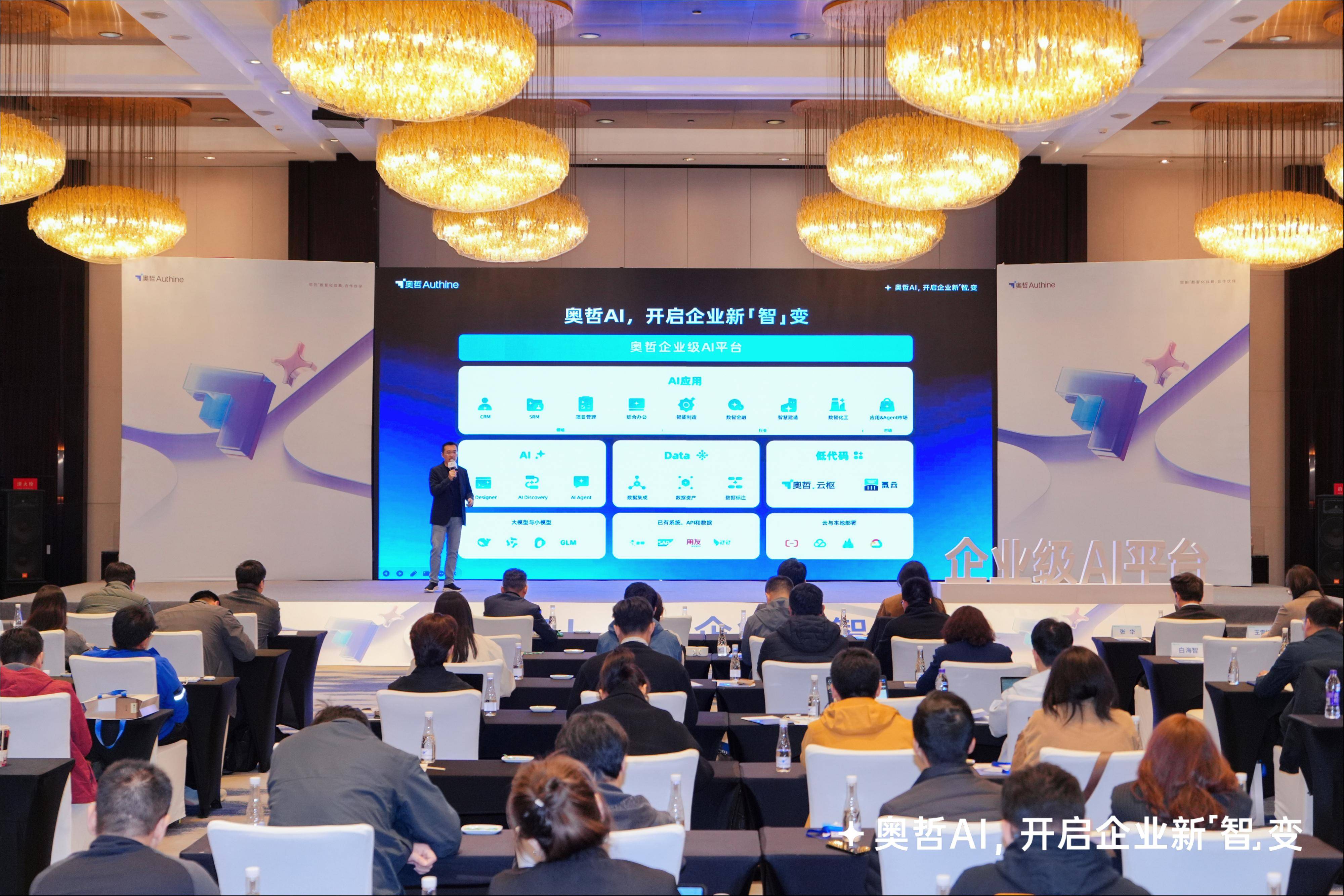
Core Insights - The conference on October 17, 2023, marked the launch of the "Aozhe Enterprise AI Platform," showcasing the company's new strategic positioning in the AI era, emphasizing the integration of "AI + Data + Low Code" as a core capability for enterprise digital transformation [1][2] - Aozhe aims to help enterprises transition into "AI-native" companies, highlighting that AI is not just a future trend but is currently replacing existing processes [2][10] Group 1: Company Overview - Aozhe has evolved over 15 years from a BPM product provider to a leader in low-code solutions, recognized as the "No. 1 Low-Code Brand in China" by IDC and other authorities [2] - The company has been actively involved in the formulation of industry standards and has deepened its exploration of AI applications to meet the evolving digital needs of enterprises [2] Group 2: AI Platform Features - The newly launched enterprise-level AI platform combines AI technology with a low-code platform, enabling integrated solutions from AI, data, to applications [3][6] - The platform includes three core AI capabilities: - **AI Designer**: Facilitates the development of AI-native applications by generating business blueprints and structured code, significantly lowering development barriers and enhancing efficiency [4] - **AI Agent**: Automates repetitive tasks, allowing businesses to delegate tasks like IT ticketing and customer service to AI [5] - **Data & AI Discovery**: Empowers business personnel to conduct data analysis and predictions with zero barriers, driving scientific decision-making [6] Group 3: Industry Applications - Companies like Wuhan Guangxun Technology and Beijing Huayuan Real Estate shared their AI transformation experiences, validating the capabilities of Aozhe's enterprise-level AI platform [7][8] - Guangxun Technology implemented a smart contract management system using Aozhe's platform, automating the entire lifecycle of contract management, which was recognized as a leading case in digital transformation [7] - Huayuan Real Estate has integrated AI into its operations, focusing on a phased approach to AI application, enhancing operational efficiency through IT intelligent customer service and AI approval systems [8] Group 4: Future Outlook - Experts at the conference emphasized that AI is a key driver for high-quality enterprise development, predicting that by 2030, around 50% of work content will be automated, necessitating skill upgrades for approximately 200 million workers [8] - Aozhe announced the establishment of the "Enterprise AI Alliance" to promote collaboration and innovation in AI technology across various industries [10] - The company aims to continue its evolution into a leading enterprise-level AI platform provider, focusing on the deep integration of "AI + Data + Low Code" to support enterprises in becoming AI-native [10]

人工智能+,10年之后,AI将像水电一样无处不在你准备好了吗?
Sou Hu Cai Jing· 2025-09-16 12:39
Group 1 - The era of "Artificial Intelligence+" is emerging, transforming work, life, and the future, making everyone a participant in this change [1][3] - The "Artificial Intelligence+" initiative is a significant policy document aimed at integrating AI deeply with the economy and society, following the "Internet+" initiative [3][4] - AI is seen as an upgrade to "Internet+", providing intelligent cores to industries, enhancing efficiency and service experiences [5][6] Group 2 - By 2027, AI is expected to be deeply integrated into key sectors, with over 70% penetration of new intelligent devices, making AI commonplace in daily life [6][7] - By 2030, AI is projected to become a crucial driver of economic growth, with over 90% penetration of intelligent devices [6][10] - The integration of AI with six key areas—science and technology, industrial development, consumer upgrades, public welfare, governance enhancement, and global cooperation—is essential for achieving a smart economy and society by 2035 [6][7] Group 3 - AI can optimize public service management, such as dynamically adjusting traffic lights based on real-time data [7][8] - The concept of "AI-native enterprises" is introduced, where businesses are fundamentally driven by AI from inception, enhancing operational efficiency [8][10] - The transition to an AI-driven economy is seen as a way to improve overall productivity, especially in industries facing labor shortages [10]
人工智能下一站:新消费硬件
腾讯研究院· 2025-08-26 09:35
Core Viewpoint - The article discusses the emergence of AI-native companies that prioritize artificial intelligence as their core product or service, leading to new technologies, products, and business models in the AI hardware industry [2]. Group 1: AI Consumer Hardware Development Routes - AI consumer hardware has seen significant innovation in 2023, with new categories like AI phones, smart glasses, rings, headphones, and companion robots rapidly emerging [4]. - The development routes can be categorized into three main paths: 1. AI-native devices exploring new interaction paradigms, represented by products like Rabbit R1 and Humane AI Pin, which rely on semantic understanding and task execution driven by large models [5]. 2. Gradual enhancement of existing devices with AI capabilities, exemplified by Apple and Meta, which integrate AI into established hardware like smartphones and wearables [6]. 3. Model-centric empowerment paths led by companies like OpenAI, focusing on providing AI capabilities through APIs and SDKs to third-party devices [7]. Group 2: Emerging Business Models in AI Consumer Hardware - The article identifies the initial emergence of business models corresponding to the three development routes, highlighting their respective core challenges: 1. AI-native exploration models rely on high-priced hardware and subscription services to generate stable revenue streams, but face challenges in proving hardware value and user adoption [10]. 2. Gradual enhancement models focus on hardware sales and value-added subscription services, benefiting from low user recognition barriers and high market acceptance [12]. 3. Model empowerment paths replicate aspects of the Android model, charging for API access and enterprise-level services, but face challenges in cost and adaptation to various hardware [15]. Group 3: Future Trends in AI Consumer Hardware - The integration of upstream and downstream in the industry is becoming tighter, with model vendors collaborating with chip manufacturers to optimize model performance across devices [18]. - The trend towards "unobtrusive" interaction is accelerating hardware paradigm shifts, with AI glasses becoming a focal point for competition among tech giants and emerging brands [21]. - Long-term, AI hardware is expected to evolve towards a model where AI acts as a primary interface, with voice and natural language interactions becoming the norm, potentially replacing traditional graphical user interfaces [27].





3人公司9周内赚100万美元的极致创业
虎嗅APP· 2025-08-19 13:20
Core Viewpoint - The article discusses how Swan AI, an Israeli AI company, is revolutionizing the startup landscape by utilizing a minimalistic team structure combined with AI agents to automate sales processes, aiming for significant revenue growth without traditional hiring practices [5][11][38]. Group 1: Company Overview - Swan AI consists of three founders and over 20 AI agents, aiming to achieve $30 million in annual revenue within a year [5][11]. - The company has successfully acquired 71 B2B clients in just 60 days, showcasing the effectiveness of its AI-driven sales approach [5][31]. - Swan AI's operational philosophy emphasizes leveraging AI to enhance human capabilities rather than replacing them, focusing on maximizing individual contributions [11][12]. Group 2: Business Model and Strategy - Swan AI operates on a unique "Autonomous Business OS" model, where decision-making is streamlined among the three founders, avoiding traditional team expansions [12][14]. - The company has achieved a 30% increase in annual revenue within 30 days of product launch, with a 45% conversion rate from trial to paid users [9][16]. - Swan AI's core product is an AI-driven sales development platform that automates the entire marketing and sales process for small to medium-sized B2B companies [18][30]. Group 3: Marketing and Customer Acquisition - The marketing strategy relies heavily on organic growth through LinkedIn, where the founder shares insights and experiences, generating over $1 million in sales opportunities monthly [33][34]. - Swan AI's customer base primarily consists of B2B companies with high-value products and significant lead conversion potential, particularly in sectors like SaaS and fintech [32][33]. - The company utilizes a dual-platform approach, with LinkedIn for lead generation and Slack for internal operations, ensuring efficient customer engagement and service delivery [34][35]. Group 4: Future Outlook and Industry Impact - Swan AI has not pursued traditional venture capital funding, instead focusing on revenue-driven growth, which the founder believes is a more sustainable model in the AI era [37][38]. - The company's innovative approach to organization and marketing serves as a valuable reference for AI-native startups looking to optimize their operations and growth strategies [38].

广域铭岛推出工业智造超级智能体 助力客户打造面向未来的AI原生企业
Zheng Quan Ri Bao Wang· 2025-07-30 12:50
Core Insights - Guangyu Mingdao Digital Technology Co., Ltd. launched an industrial AI system at the 2025 World Artificial Intelligence Conference, providing a one-stop solution for manufacturing enterprises to build AI-native capabilities [1][2] - The company aims to integrate AI deeply into business processes, transforming traditional manufacturing paradigms and enhancing efficiency and value [1][2] Group 1: Industrial AI System - The industrial AI system includes an AI application platform and a super intelligent body, designed to support the entire industrial production process from R&D to operations [1] - The system is built on 30 years of manufacturing experience and aims to facilitate intelligent upgrades across various industries, including automotive, new energy batteries, and non-ferrous metals [1][2] Group 2: Core Capabilities - The platform features three core capabilities: efficient industrial data standards to break data silos, closed-loop knowledge encapsulation for reusable modules, and customized intelligent body development tailored to specific business needs [2] - The underlying logic of the system includes a dynamic cycle of AI and industrial knowledge collaboration, ensuring continuous provision of efficient and precise solutions for cost reduction and quality improvement [2] Group 3: Application Scenarios - The Guangyu Mingdao industrial intelligent manufacturing super intelligent body covers the entire business chain, including R&D, production, supply chain, marketing, and service [2] - The platform is currently open to the smart manufacturing sector, targeting industries such as automotive, new energy batteries, and non-ferrous metals [2]