氛围编程(Vibe Coding)

Search documents
YC 年终座谈会:AI 泡沫反而是创业者助力?
机器之心· 2026-01-10 02:30
Group 1: AI Market Dynamics - The AI economy has established a stable structure with parallel layers of models, applications, and infrastructure, each with considerable profit potential [1] - Investment in AI infrastructure and energy, perceived as a bubble, actually provides affordable computing power and "excess dividends" for the application layer [1] Group 2: LLM Power Shift - By 2025, Anthropic's Claude has surpassed OpenAI's ChatGPT as the most popular large language model (LLM) among Y Combinator projects, indicating a significant shift in market preference [5][6] - The structural change in technology stack and model selection is evident, with OpenAI's market share declining from over 90% [5] Group 3: Developer Relations and Product Philosophy - Anthropic is characterized by a "golden retriever energy," emphasizing a friendly and cooperative approach towards developers, contrasting with OpenAI's more aloof stance [6][7] - This developer-centric design has translated into competitive advantages, particularly in programming assistance, making Anthropic the preferred choice for many founders [8] Group 4: Spillover Effects and Programming Paradigms - Founders' preference for Claude in personal programming contexts leads to a spillover effect, influencing their choice of models for unrelated applications [9] - The concept of "Vibe Coding" has evolved from a qualitative observation to a significant technical domain, demonstrating commercial viability through successful companies like Replit and Emergent [10] Group 5: Team Structure and Efficiency - The measure of company success is shifting from team size to per capita output efficiency, with examples like Gamma achieving $100 million in annual recurring revenue (ARR) with a streamlined team of 50 [12] - The rise of AI has increased productivity but also heightened customer expectations, making talent execution the new bottleneck in a competitive landscape [11] Group 6: Trust Crisis and Specialized Applications - To address complex tasks and build user trust, AI development is shifting focus from general large models to specialized applications capable of executing specific logic [13]


Meta产品经理采用氛围编程技术,快速制作App原型直接向CEO演示
Sou Hu Cai Jing· 2025-11-08 11:17
Core Insights - Meta is utilizing "Vibe Coding" to enable product managers to quickly create app prototypes without needing assistance, allowing them to present directly to CEO Mark Zuckerberg [1][3] - The approach enhances product iteration speed as product managers can showcase their work directly to upper management [3] - Vibe Coding involves using natural language commands and AI tools to rapidly generate, modify, or test code and product prototypes [5] Industry Context - Meta's implementation of Vibe Coding is part of a broader trend in the tech industry, with companies like Google and Microsoft also integrating AI into their product development processes [6] - Google reported that over 25% of its internal code is AI-generated, while Microsoft has made AI usage a mandatory practice [6]

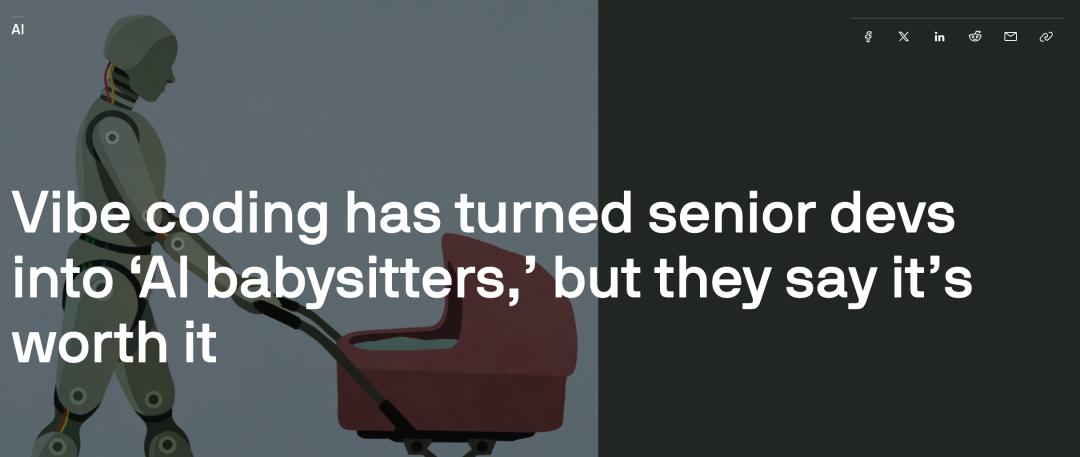
15年大佬深夜痛哭半小时,氛围编程巨坑曝光,95%程序员沦为「AI保姆」
3 6 Ke· 2025-09-15 07:56
Core Insights - The rise of "Vibe Coding" has transformed many developers into "AI babysitters," leading to a new profession known as "Vibe Code Cleanup Specialist" [5][6][21] - Many developers report spending significant time fixing AI-generated code, with a Fastly report indicating that at least 95% of developers require extra time for this task [5][21] - Despite the challenges, developers acknowledge that AI tools can enhance productivity and improve user interfaces, although manual review remains essential [21][23] Group 1: Vibe Coding Experience - Carla Rover, a senior web developer, experienced significant issues with AI-generated code, leading her to restart a project and express frustration over the reliance on AI [8][9] - Rover's experience reflects a common sentiment among seasoned developers who find themselves constantly rewriting and verifying AI outputs [3][9] - The analogy of using AI for coding is likened to having a smart but inexperienced child assist with tasks, highlighting the unpredictability and potential for errors [13][14] Group 2: Time Allocation and Challenges - Developers like Feridoon Malekzadeh estimate that 50% of their time is spent writing requirements, 10-20% on "Vibe Coding," and 30-40% on fixing AI-generated code [15] - The lack of systematic thinking in AI-generated code often leads to multiple variations of the same function, causing confusion and inefficiency [15][19] - AI-generated code is prone to basic errors, and developers often find themselves correcting these mistakes while also managing the AI's responses [19][21] Group 3: Industry Perspectives - The emergence of "Vibe Coding" has created new IT blind spots and security vulnerabilities, particularly for startups that may overlook traditional coding review processes [19][21] - While many developers find AI tools beneficial, they emphasize the necessity of human oversight before deploying AI-generated code in commercial projects [21][23] - The future of AI programming is seen as not just about writing code but also about guiding AI and taking responsibility for its outputs [25]