
氯化钠

Search documents
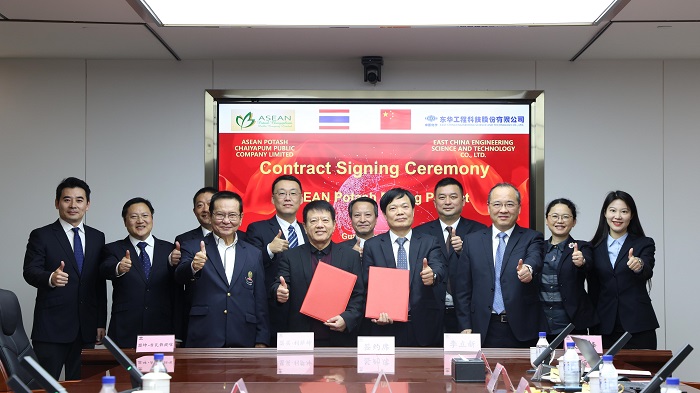
东华公司签署泰国钾肥项目合同
Zhong Guo Hua Gong Bao· 2025-12-15 06:00
Core Viewpoint - China Chemical Engineering's subsidiary, Donghua Engineering Technology Co., Ltd., has signed a contract with ASEAN Potash Public Company Limited (APOT) for a potash project in Thailand, which aims to enhance local agricultural production and reduce dependency on fertilizer imports [1]. Group 1: Project Overview - The potash project is located in Chaiyaphum Province, Thailand, covering an area of approximately 780 acres [1]. - The project will utilize an efficient dissolution crystallization process for potash mining, which is expected to improve potash recovery rates and product quality while being environmentally friendly [1]. - The project is designed to produce 1.235 million tons of potassium chloride and 400,000 tons of sodium chloride annually, along with supporting auxiliary facilities [1]. Group 2: Market Impact - Upon completion, the project is anticipated to fill the gap in Thailand's domestic potash market [1]. - The initiative aims to decrease Thailand's agricultural sector's reliance on imported fertilizers, thereby enhancing local agricultural sustainability [1].


雪天盐业加码新能源业务,“第二曲线”面临技术等多重挑战
Bei Ke Cai Jing· 2025-12-05 14:24
Core Viewpoint - Xue Tian Salt Industry Group Co., Ltd. is attempting to find growth in its performance by expanding into the new energy sector through the acquisition of a 41% stake in Hunan Meter New Materials Technology Co., Ltd. from its controlling shareholder, which will increase its ownership to 61% and make it the controlling shareholder [1][2]. Group 1: Acquisition Details - The acquisition is valued at 261 million yuan and aims to enhance Xue Tian Salt's revenue and profit scale while improving its competitiveness in the new energy industry [2][3]. - Meter New Materials primarily produces lithium cobalt oxide, ternary cathode materials, and sodium battery cathode materials, which are used in the production of new energy batteries [2]. Group 2: Financial Performance - Meter New Materials has shown unstable performance, with a net profit loss of 239,400 yuan in 2024, which surged to a profit of 35.607 million yuan in the first three quarters of 2025, indicating significant volatility [6]. - Xue Tian Salt's revenue for 2024 was 5.392 billion yuan, a decrease of 13.9% year-on-year, and its net profit fell by 57.13% to 304 million yuan [6]. Group 3: Strategic Challenges - The transition to new energy is fraught with challenges, including technological hurdles, lack of direct business synergy between Xue Tian Salt and Meter New Materials, and financial pressures due to ongoing investments in new energy research and production [7]. - The sodium battery business of Meter New Materials has not yet achieved large-scale production, limiting its immediate contribution to Xue Tian Salt's overall profits [7].

中国慢病防控如何发力?IHME所长答21:控高血压,降吸烟率
2 1 Shi Ji Jing Ji Bao Dao· 2025-10-13 10:54
Core Insights - The University of Washington's IHME director Christopher Murray highlighted that China has the potential to achieve significant breakthroughs in the prevention of hypertension and smoking-related diseases within the next five to ten years through enhanced primary healthcare and strict tobacco control policies [2][3] Group 1: Disease Burden and Prevention Strategies - Non-communicable diseases (NCDs) currently account for nearly two-thirds of global mortality and morbidity, with ischemic heart disease, stroke, and diabetes being the leading causes [2] - Controlling major risk factors such as lowering blood sugar levels and managing high body mass index (BMI) could prevent nearly half of deaths and disabilities [2] Group 2: Focus Areas for China - Addressing hypertension is identified as a high-potential area for disease prevention in China, with effective strategies validated through randomized trials, such as promoting potassium chloride as a partial substitute for sodium chloride [3] - The combination therapy provided through primary healthcare has proven to be very effective in managing hypertension [3] - Smoking is another critical risk factor, with the WHO's MPOWER policy package suggesting measures like increasing tobacco taxes, banning tobacco advertising, and enforcing public smoking bans to effectively reduce smoking rates [3] Group 3: Future Disease Patterns - The future disease landscape in China is expected to be dominated by obesity-related diseases (such as diabetes and chronic kidney disease) as well as diseases related to smoking and hypertension [3] - An often-overlooked issue is falls among the elderly, which can be addressed through effective interventions to alleviate the disease burden in this demographic [3]
潍坊滨海开发区:以文化“软实力”激活发展“源动力”
Zhong Guo Hua Gong Bao· 2025-08-18 13:59
Group 1 - The core cultural values of companies in Weifang Binhai Economic and Technological Development Zone, such as "family culture," "teacher culture," and "integrity culture," are driving high-quality regional development [1][2] - Companies in the region are integrating innovation into their corporate culture, enhancing their core competitiveness and achieving significant cost reductions, such as a 60% decrease in production costs for a new material [2][3] - The development strategy of "industry-driven region, industry-strong region" aims to establish a modern marine industry system, which provides new opportunities for cultural innovation and upgrading within enterprises [2][4] Group 2 - The open and inclusive environment of Weifang Binhai Development Zone attracts numerous external enterprises, fostering a collaborative ecosystem that enhances industrial synergy and reduces costs through local supply chains [3][4] - The region's shared culture promotes close cooperation among businesses, leading to a robust industrial chain where raw materials are sourced locally, ensuring safety, convenience, and cost savings [3] - The "Binhai model" emphasizes resource efficiency, industrial concentration, and complementary advantages, with over 30 companies supplying 50 types of basic chemical raw materials, achieving a self-sufficiency rate of over 20% [3] Group 3 - Since the launch of the "Project Recruitment Offensive Year" in 2025, companies in the region are taking the lead in setting standards and enhancing their brand image through unique cultural practices [4] - The integration of culture and brand development is creating a diverse brand matrix, increasing the region's visibility and influence [4] - Companies are encouraged to adopt advanced management concepts and embed cultural values into daily operations, fostering a distinctive corporate culture that supports high-quality development in the region [4]

