沪宁合高铁

Search documents
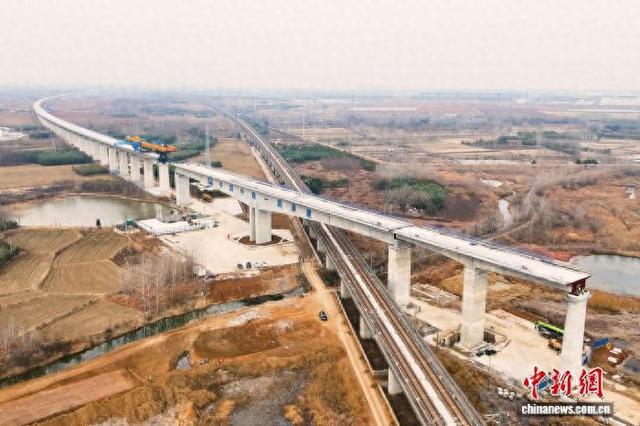
沪宁合高铁跨京沪高铁立交特大桥转体施工完成
Zhong Guo Xin Wen Wang· 2026-01-30 03:23
Group 1 - The completion of the rotation construction of the 2×32 meter T-shaped beam for the Shanghai-Nanjing-Hefei high-speed railway marks a significant milestone in the project [1][3] - The bridge spans approximately 17.6 kilometers and crosses multiple major transportation lines, including the Beijing-Shanghai high-speed railway [3] - The design includes a combination of "2×32 meter rotating T-shaped beams and 2×100 meter rotating T-shaped beams," with the latter already in place as of January 16 [3] Group 2 - The 2×32 meter rotating T-shaped beam measures 65.4 meters in length and 12.6 meters in width, with a total weight of approximately 4,800 tons [4] - The construction utilized a dynamic balance weighting method and a precision positioning system to ensure accurate rotation, supported by an intelligent monitoring system for real-time data collection [4] - The Shanghai-Nanjing-Hefei high-speed railway is a crucial part of China's "Eight Vertical and Eight Horizontal" high-speed railway network, enhancing connectivity between major urban areas [4]



沪宁合高铁南京枢纽项目迎多个关键建设节点新进展
Zhong Guo Xin Wen Wang· 2026-01-18 14:48
Core Insights - The completion of the main construction of the Nanjing Liuhe Grand Bridge, a key project in the Shanghai-Nanjing-Hefei High-Speed Railway (referred to as "Shu-Ning High-Speed Railway"), marks a significant milestone for the project [1][2] - The Shu-Ning High-Speed Railway is an essential part of China's "Eight Vertical and Eight Horizontal" high-speed rail network, connecting major cities and enhancing transportation efficiency in the Yangtze River Delta region [2] Group 1 - The Nanjing Liuhe Grand Bridge spans 520 meters, with a main span of 220 meters, and its completion lays the groundwork for subsequent bridge deck construction and overall line connectivity [1] - The project employs intelligent construction techniques, utilizing linear intelligent monitoring technology to collect and analyze data on stress, deformation, and temperature during construction, enabling precise adjustments for high-accuracy completion [1] - Recent advancements include the successful rotation of a 6,300-ton turning beam and the completion of the cross-Chu River cable-stayed bridge, facilitating further construction activities [1] Group 2 - The Shu-Ning High-Speed Railway, starting from Shanghai and passing through several cities, covers approximately 554 kilometers with a design speed of 350 km/h and includes 16 stations [2] - The railway is expected to serve as a major transportation route for passenger flows between the Yangtze River Delta and coastal areas, significantly contributing to the development of a rapid transit corridor in the region [2] - The completion of this project will optimize the railway network layout along the Yangtze River and enhance connectivity between urban agglomerations in Shanghai, Nanjing, and Hefei [2]
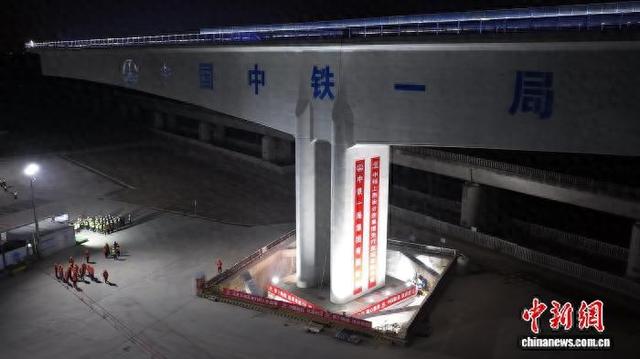
华东地区最大跨度跨高铁单T构梁成功转体
Zhong Guo Xin Wen Wang· 2026-01-16 08:26
Core Viewpoint - The successful rotation of the 2×100 meter prestressed concrete single T-beam for the Shanghai-Nanjing-Hefei high-speed railway marks a significant engineering achievement in the construction of the bridge over the Beijing-Shanghai high-speed railway [1][3]. Group 1: Engineering Achievement - The T-beam, weighing 17,000 tons, is the largest span single T-beam for high-speed rail in East China, measuring 201.5 meters in length and 12.6 meters in width [3][5]. - The rotation of the beam was facilitated by a ball hinge precision positioning traction system, which allowed for a 260-ton pull to rotate the beam [3][5]. Group 2: Construction Technology - An intelligent monitoring system was employed to monitor the rotation posture and stress changes in real-time, ensuring that the axial deviation during the rotation was controlled within millimeter levels [5]. - After the rotation, the base of the beam was locked, and concrete was poured to integrate it with the beam structure [3]. Group 3: Project Significance - The Shanghai-Nanjing-Hefei high-speed railway is a crucial part of the eastern segment of the Chengdu-Chongqing high-speed railway and an important component of China's "Eight Vertical and Eight Horizontal" high-speed railway network [5]. - Upon completion, the project will establish a new rapid transit corridor between the Shanghai metropolitan area, Nanjing metropolitan area, and Hefei metropolitan area [5].
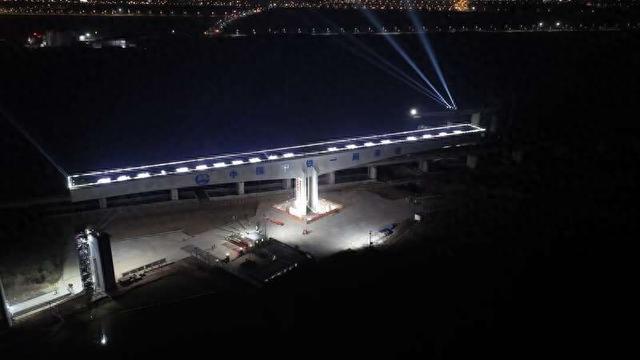
华东地区最大跨度跨高铁单T构梁实现转体
Zhong Guo Qing Nian Bao· 2026-01-16 05:18
Core Viewpoint - The successful completion of the 2×100 meter prestressed concrete single T beam rotation marks a significant milestone in the construction of the Shanghai-Nanjing-Hefei high-speed railway, laying a solid foundation for the line's connectivity and track-laying [1][3]. Group 1: Project Details - The cross-King-Hu high-speed railway bridge spans approximately 17.6 kilometers and crosses multiple major transportation lines, including the King-Hu high-speed railway and Tianqian Expressway [3]. - The control engineering feature, the 2×100 meter rotating single T beam, weighs 17,000 tons and intersects the busy King-Hu high-speed railway at an angle of 26.3 degrees, presenting challenges such as large tonnage, large span, small rotation angle, high precision requirements, and complex construction environment [3]. Group 2: Technological Innovations - To ensure the stability and precision of the beam rotation, the project team established a youth technical research team that innovatively applied dynamic balance weighting methods and a spherical hinge precise positioning traction system [3]. - An intelligent monitoring system was utilized to monitor the rotation posture and stress changes in real-time, successfully controlling the axial deviation to the millimeter level [3]. Group 3: Strategic Importance - The Shanghai-Nanjing-Hefei high-speed railway is a crucial segment of the eastern section of the Shanghai-Chongqing-Lanzhou high-speed railway and an important part of the national "eight vertical and eight horizontal" high-speed railway network along the Yangtze River [5]. - Upon completion, the railway will optimize the railway network layout in the Yangtze River region, support the coordinated development of the Yangtze River Economic Belt, and promote high-quality development in the Yangtze River Delta [5].
各地重点工程开足马力刷新“进度条”奋战“开门红” 高质量发展添动能
Yang Shi Wang· 2026-01-09 09:39
Group 1: Infrastructure Development - The Hu-Ning-He high-speed railway has achieved significant milestones, including the completion of the last steel box girder installation for the Chuhe cable-stayed bridge, laying the foundation for the entire line's connectivity [1][3] - Another critical project, the Nanjing Grand Bridge, successfully completed the rotation of a key beam, ensuring precise alignment with the main railway line under construction [5] - The Hu-Ning-He railway spans approximately 554 kilometers, connecting Shanghai, Jiangsu, and Anhui, with a design speed of 350 km/h, contributing to the high-quality development of the Yangtze River Delta integration [5] Group 2: Bridge Construction - The Dalian Changhai Bridge project has achieved a major breakthrough with the successful connection of the main pier steel platform, marking a key control node in the construction process [7] - The Dalian Changhai Bridge will be 25.5 kilometers long, with a 19-kilometer sea crossing and a 6.5-kilometer land section, designed to enhance the national highway system and support the high-quality development of Liaoning's marine economy [10] Group 3: Electric Vehicle Infrastructure - Hunan province has launched its first heavy-duty truck charging station at the Xianxiang South service area on the Lilu Expressway, with plans to build 48 additional charging stations and 200 charging spaces across 24 pairs of expressway service areas during the 14th Five-Year Plan [11] - Each charging station is equipped with a 720 kW charging pile, capable of serving two heavy-duty trucks simultaneously, meeting the energy needs of approximately 80 electric heavy-duty trucks daily [11] - The province aims to establish a green energy supply system for heavy-duty trucks, with a target of one charging station every 200 kilometers on major expressways and one every 300 kilometers on other routes [15]
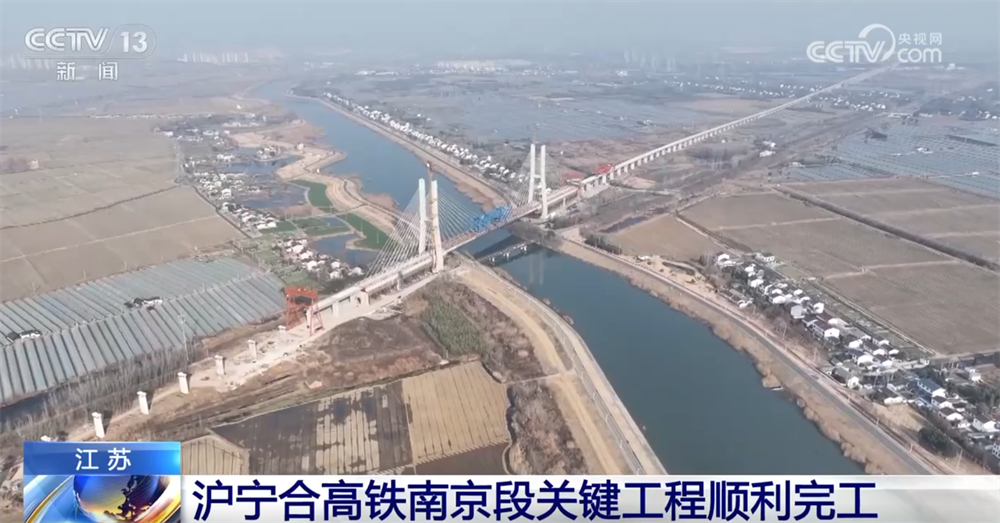
沪宁合高铁南京特大桥跨滁河斜拉桥顺利合龙
Xin Lang Cai Jing· 2026-01-09 08:21
Core Viewpoint - The successful completion of the Nanjing Grand Bridge's cable-stayed bridge over the Chuhe River marks a significant milestone in the construction of the Shanghai-Nanjing-Hefei high-speed railway, which is a crucial part of the national "Eight Vertical and Eight Horizontal" high-speed railway network [1] Group 1 - The Nanjing Grand Bridge has officially entered the bridge deck construction phase following the successful closure of the cable-stayed bridge [1] - The Shanghai-Nanjing-Hefei high-speed railway will optimize the railway network layout in the Yangtze River region [1] - The completion of this railway is expected to support the high-quality development of the Yangtze River Delta integration [1]
沪宁合高铁南京特大桥建设取得新进展
Zhong Guo Xin Wen Wang· 2026-01-07 13:39
Core Points - The construction of the Nanjing Grand Bridge for the Shanghai-Nanjing-Hefei High-Speed Railway (referred to as "Huhang High-Speed Railway") has made significant progress with the successful rotation of a 6,300-ton turning beam [1][2] - The Huhang High-Speed Railway is a crucial part of China's "Eight Vertical and Eight Horizontal" high-speed rail network, connecting major cities and enhancing transportation efficiency [2][4] Group 1 - The Huhang High-Speed Railway spans approximately 554 kilometers, with a design speed of 350 kilometers per hour and includes 16 stations [2] - The construction technique used for the turning beam involved a rotation method that addressed safety and precision challenges during the operation [2] - The project is vital for the development of a comprehensive transportation hub in the Yangtze River Economic Belt and will facilitate a new rapid transit corridor between Shanghai, Nanjing, and Hefei [4]
中国最长超深超大基坑地下高铁站海门北站核心区基坑底板“封底”
Zhong Guo Xin Wen Wang· 2025-10-30 08:41
Core Viewpoint - The completion of the last slab pour for the core pit of the Haimen North Station marks a significant milestone in the construction of the Shanghai-Nanjing-Hefei High-Speed Railway, showcasing advancements in engineering and project management in China [1][5]. Group 1: Project Details - Haimen North Station features a two-level six-line layout, with the first underground level serving as a transfer corridor and the second as the high-speed railway platform, while the third level is reserved for intercity rail [3]. - The station's continuous excavation length reaches 1.8 kilometers, equivalent to 8.5 CR400BF-Z type high-speed trains lined up, with a maximum excavation depth of 29.4 meters, comparable to a 10-story building [3]. - The total excavation volume is approximately 1.48 million cubic meters, with construction challenges arising from the soft geological conditions and high groundwater levels [3]. Group 2: Technological Innovations - The project team employs digital intelligent management techniques, including smart visualized drainage, servo compensation for pit support, and automatic monitoring systems to ensure safety and quality throughout the construction process [3]. Group 3: Project Progress and Significance - Over 80% of the overall construction of Haimen North Station has been completed, with wall and column construction expected to commence fully, aiming for completion of the main structure by the end of March 2026 [5]. - As part of the eastern segment of the Huhang Railway, the Shanghai-Nanjing-Hefei High-Speed Railway is a crucial component of China's "Eight Vertical and Eight Horizontal" high-speed rail network, enhancing connectivity between major urban areas and promoting high-quality development in the Yangtze River Delta [5].