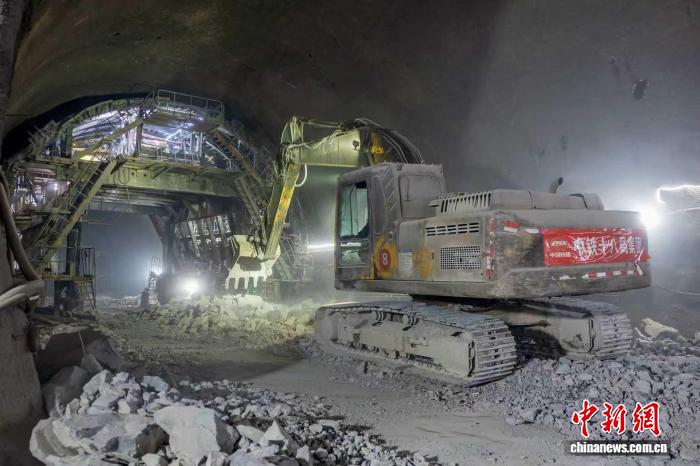
高速铁路建设

Search documents
雄商高铁山东段开启静态验收
Xin Hua Wang· 2026-02-01 09:26
Core Viewpoint - The static acceptance work for the Shandong section of the Xiong'an New Area to Shangqiu High-Speed Railway has commenced, marking a significant step in the project aimed at enhancing transportation connectivity in the region [1] Group 1: Project Overview - The Xiong'an-Shangqiu High-Speed Railway has a total length of 552 kilometers, with a design speed of 350 kilometers per hour, passing through 9 cities across Hebei, Shandong, and Henan provinces [1] - The Shandong section spans 269 kilometers and includes 7 stations: Linqing East, Liaocheng West, Yanggu East, Liangshan, Yuncheng, Heze East, and Caoxian West [1] Group 2: Static Acceptance Process - Static acceptance refers to a comprehensive inspection of the railway system's equipment installation and functionality verification after construction completion, crucial for ensuring safe high-speed railway operations [1] - The Jinan Power Supply Section of the China Railway Jinan Bureau employs a "1 maintenance train + 3 work vehicles" operational model for the static acceptance, focusing on the inspection and repair of contact lines and supporting structures [1] Group 3: Strategic Importance - The Xiong'an-Shangqiu High-Speed Railway is a vital part of China's "Eight Vertical and Eight Horizontal" high-speed railway network, specifically the Beijing-Hong Kong (Taiwan) corridor [1] - Upon completion, the railway will interconnect with other lines such as the Shijiazhuang-Jinan High-Speed Railway, Zhengzhou-Jinan High-Speed Railway, and Rizhao-Lanzhou High-Speed Railway, optimizing the transportation network in western Shandong and significantly reducing travel time to neighboring provinces [1]
华东地区最大跨度跨高铁单T构梁实现转体
Zhong Guo Qing Nian Bao· 2026-01-16 05:18
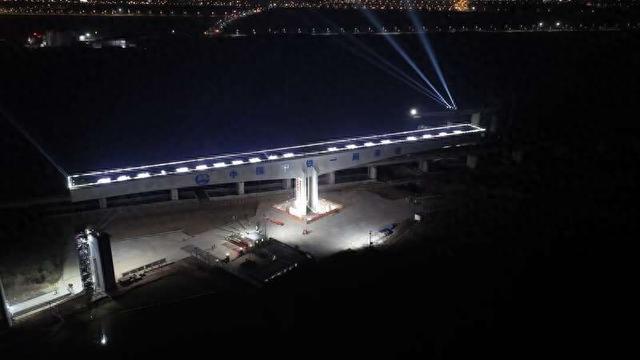
Core Viewpoint - The successful completion of the 2×100 meter prestressed concrete single T beam rotation marks a significant milestone in the construction of the Shanghai-Nanjing-Hefei high-speed railway, laying a solid foundation for the line's connectivity and track-laying [1][3]. Group 1: Project Details - The cross-King-Hu high-speed railway bridge spans approximately 17.6 kilometers and crosses multiple major transportation lines, including the King-Hu high-speed railway and Tianqian Expressway [3]. - The control engineering feature, the 2×100 meter rotating single T beam, weighs 17,000 tons and intersects the busy King-Hu high-speed railway at an angle of 26.3 degrees, presenting challenges such as large tonnage, large span, small rotation angle, high precision requirements, and complex construction environment [3]. Group 2: Technological Innovations - To ensure the stability and precision of the beam rotation, the project team established a youth technical research team that innovatively applied dynamic balance weighting methods and a spherical hinge precise positioning traction system [3]. - An intelligent monitoring system was utilized to monitor the rotation posture and stress changes in real-time, successfully controlling the axial deviation to the millimeter level [3]. Group 3: Strategic Importance - The Shanghai-Nanjing-Hefei high-speed railway is a crucial segment of the eastern section of the Shanghai-Chongqing-Lanzhou high-speed railway and an important part of the national "eight vertical and eight horizontal" high-speed railway network along the Yangtze River [5]. - Upon completion, the railway will optimize the railway network layout in the Yangtze River region, support the coordinated development of the Yangtze River Economic Belt, and promote high-quality development in the Yangtze River Delta [5].

渝昆高铁控制性工程华山松隧道贯通
Xin Hua She· 2026-01-10 06:27
Core Viewpoint - The successful completion of the Huashan Song Tunnel, a key project of the Yukun High-Speed Railway, marks a significant milestone in the construction of the railway, which is expected to enhance economic development in the regions along the route [1] Group 1: Project Details - The Huashan Song Tunnel, located in the Yunnan Province, has a total length of 16.4 kilometers and is classified as a high-risk tunnel due to its complex geological conditions [1] - The tunnel construction faced challenges such as crossing 23 fault lines and areas with developed karst topography, which could lead to instability and collapse if water is encountered [1] - The construction team employed a combination of "circular excavation, reserved core soil, and stepped support" to address the challenges of surrounding rock instability [1] Group 2: Railway Significance - The Yukun High-Speed Railway spans approximately 700 kilometers, with the Yunnan section measuring 388.6 kilometers, making it the first high-speed railway in Yunnan capable of reaching speeds of 350 kilometers per hour [1] - Once operational, the railway will reduce travel time between Chongqing and Kunming to approximately two and a half hours, significantly impacting regional economic and social development [1] - The construction of the Yukun High-Speed Railway is currently in the final stages, focusing on tunnel engineering, ballastless track, and post-station construction [1]
成渝中线高铁新建7座车站 预留时速400公里提速空间
Si Chuan Ri Bao· 2026-01-04 05:50
Core Viewpoint - The construction plan for the Chengyu Central Line High-Speed Railway, part of the new Shanghai-Chongqing-Rong High-Speed Railway, has been revealed through a bidding announcement, indicating significant investment and development in the region's transportation infrastructure [1][2] Group 1: Project Overview - The new Shanghai-Chongqing-Rong High-Speed Railway segment from Chongqing to Chengdu will cover a total length of 292.032 kilometers, with 100.749 kilometers in Chongqing and 191.283 kilometers in Sichuan, including 7 new stations [1] - The total investment for the project is approximately 714.5438 billion yuan [1] Group 2: Technical Specifications - The Chengyu Central Line High-Speed Railway will be classified as a high-speed railway with a double-track design, featuring a planned operational speed of 350 kilometers per hour and a provision for speeds up to 400 kilometers per hour, marking it as the first high-speed railway in China to propose such a speed [2]
崇启公铁长江大桥北引桥下层铁路梁现浇施工完工
Yang Zi Wan Bao Wang· 2025-12-16 09:50
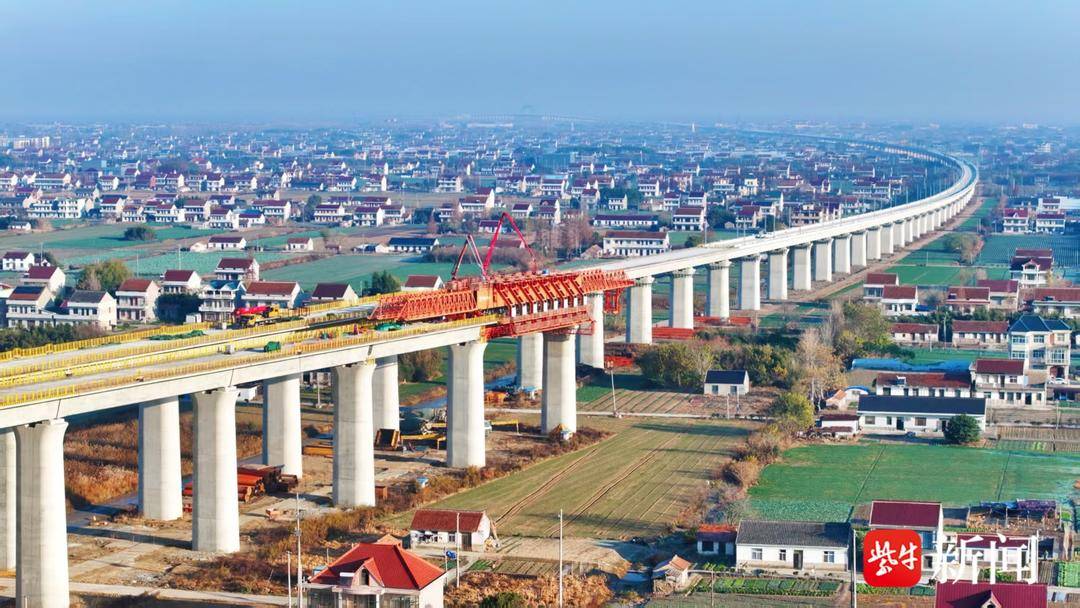
Core Viewpoint - The successful completion of the last segment of the movable formwork for the intercity side of the Chongqi Railway and Highway Yangtze River Bridge marks a significant milestone in the construction process, paving the way for the subsequent upper highway beam construction [1][3]. Group 1: Construction Progress - The Chongqi Railway and Highway Yangtze River Bridge has a total length of 1,069.27 meters, featuring a dual six-lane upper highway and a lower section for double-track high-speed rail and intercity rail [3]. - The last concrete beam poured was for the intercity side NC20-NC21 pier, measuring 40.6 meters in length and 12.2 meters in width, with a total concrete volume of 344 cubic meters [3]. - The use of a movable formwork system allows for segmental pouring of concrete beams between bridge piers, significantly shortening the construction cycle and minimizing environmental impact [3]. Group 2: Winter Construction Preparations - To prepare for the final segment of the movable formwork pouring, the project team avoided low-temperature periods below zero degrees Celsius and held special briefing sessions to optimize the construction plan [2]. - Technical personnel monitored concrete temperature throughout the process to ensure compliance with quality standards, and winter construction safety training was conducted to address equipment operation, anti-freezing measures, and emergency rescue protocols [2]. Group 3: Strategic Importance - The Shanghai-Nanjing-Hefei high-speed railway is a crucial part of the eastern segment of the Huhang Railway and an important component of the national "Eight Vertical and Eight Horizontal" high-speed railway network, enhancing passenger flow along the Yangtze River corridor [5]. - The completion of this project will establish a rapid new corridor between the Shanghai, Nanjing, and Hefei metropolitan areas, optimizing the railway network layout in the Yangtze River region and supporting the coordinated development of the Yangtze Economic Belt [5].
渝昆高铁洛泽河特大桥合龙
Zhong Guo Xin Wen Wang· 2025-12-16 01:57
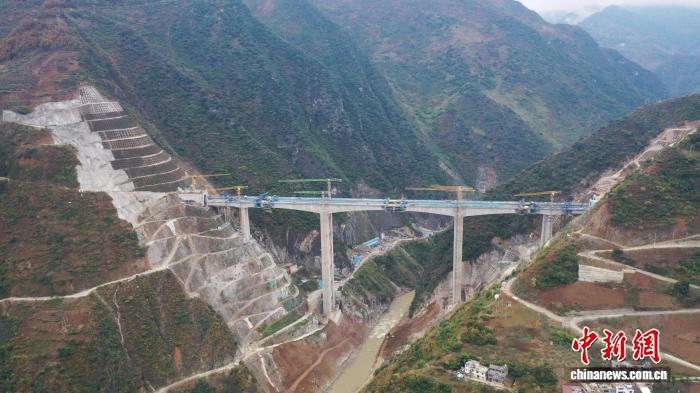
Core Viewpoint - The completion of the Luoze River Grand Bridge marks a significant milestone for the Yukun High-Speed Railway, ensuring its timely construction and operation [1][2]. Group 1: Project Details - The Luoze River Grand Bridge, constructed by China Railway Bridge Bureau Group, spans 524.9 meters and features a main span of 180 meters with a maximum pier height of 150 meters [1]. - The bridge is designed as a double-track single-line prestressed concrete rigid continuous beam bridge, typical for mountainous railway environments [1][2]. - The bridge will be the world's largest prestressed concrete beam bridge in terms of span and pier height for high-speed rail operating at 350 km/h [2]. Group 2: Construction Innovations - To address the high safety risks associated with constructing large-span bridges in complex mountainous canyon environments, the construction team optimized the main beam construction process to a large segment cantilever method [2]. - The maximum segment length was adjusted to 6 meters, reducing the number of cantilever segments to 17, which allowed for a two-month acceleration in the project timeline [2]. Group 3: Railway Impact - The Yukun High-Speed Railway will have a total length of approximately 700 kilometers, with the Yunnan section measuring 388.6 kilometers, making it the first high-speed railway in Yunnan operating at 350 km/h [2]. - Once completed, the travel time between Chongqing and Kunming will be reduced to approximately two and a half hours [2].
西十高铁完成全线铺轨
Ren Min Ri Bao· 2025-11-27 22:05
Core Insights - The completion of the last pair of long steel rails on the Shending River Grand Bridge in Shiyan, Hubei marks the successful completion of the track-laying project for the Xi'an-Shiyan High-Speed Railway, laying the groundwork for subsequent joint debugging and testing [1] Group 1 - The Xi'an-Shiyan High-Speed Railway is an important part of the national high-speed railway network [1] - The total length of the main line is 255.7 kilometers, with a designed speed of 350 kilometers per hour [1]
全长12.3公里 渝昆高铁控制性工程大坪隧道贯通
Xin Hua She· 2025-11-25 13:29
Group 1 - The Daping Tunnel, a key project of the Yukun High-Speed Railway, has successfully completed its construction, marking significant progress in the railway's development [1] - The Yukun High-Speed Railway spans approximately 700 kilometers, with 388.6 kilometers located within Yunnan Province, making it the first high-speed railway in the province designed for a speed of 350 kilometers per hour [2] - The completion of the Yukun High-Speed Railway will significantly reduce travel time between Chongqing and Kunming, enhancing transportation convenience in the southwestern region and promoting coordinated regional development [2] Group 2 - The construction of the Daping Tunnel faced complex geological conditions, including high-risk factors such as mud and water bursts, soft rock deformation, and high ground stress [1] - The construction team employed advanced techniques, including "long tunnel short strike" methods and various predictive technologies, to effectively manage the risks associated with the challenging geological environment [1] - With the Daping Tunnel's completion, 48 tunnels in Yunnan Province for the Yukun High-Speed Railway have been completed, exceeding 90% of the total tunnel construction [1]
我国在建最北高铁哈伊高铁全线铺轨贯通
Xin Hua She· 2025-11-25 11:23
Group 1 - The Hailar-Yichun High-Speed Railway (Ha-I High-Speed Railway) has completed its track-laying, marking a significant milestone in China's "14th Five-Year Plan" key projects [1] - The railway is an important extension of the "eight vertical and eight horizontal" high-speed rail network, specifically the Beijing-Harbin and Beijing-Hong Kong-Macau corridors [1] - The project faced various construction challenges, including the distribution of island-like permafrost and a short effective construction period due to extreme weather conditions [1] Group 2 - The construction utilized advanced group sleeper laying technology, achieving an average daily track-laying progress of 2.5 kilometers, which is a 50% efficiency improvement over traditional methods [1] - The project incorporated information technology and intelligent management techniques, enabling remote real-time monitoring of key equipment to ensure operational safety [1] - The next phase of the project will focus on fine-tuning the track, electrical systems, and testing, which is expected to enhance the high-speed rail network in Northeast China and promote regional economic development [2]
渝昆高铁云南段隧道贯通超九成
Zhong Guo Xin Wen Wang· 2025-11-25 10:23
Core Points - The Yukun High-speed Railway's Yunnan section has achieved over 90% tunnel completion with the recent breakthrough of the Daping Tunnel [1][3][5] - The Daping Tunnel, a critical project, spans 12.3 kilometers and is classified as a high-risk tunnel due to its challenging geological conditions [3][5] - The construction employs advanced technologies to mitigate risks, successfully navigating through high-risk segments [3][5] Group 1 - The Yukun High-speed Railway will significantly reduce travel time between Chongqing and Kunming, enhancing economic development along the route [5] - The Yunnan section of the railway is 388.6 kilometers long, with a design speed of 350 kilometers per hour, marking it as the first high-speed railway in Yunnan to reach this speed [5] - Currently, over 14,000 construction workers and more than 1,500 large machinery units are engaged in the project, with earthworks and bridge-tunnel construction nearing completion [5]