
轨道上的长三角

Search documents
南京北站全面转入地上结构施工阶段
Shang Hai Zheng Quan Bao· 2026-01-30 20:04
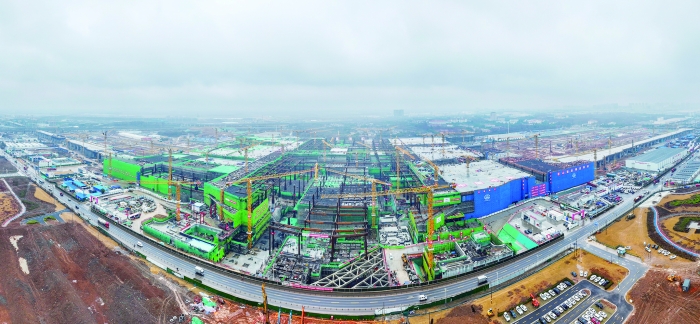
Core Viewpoint - The construction of Nanjing North Station has reached a significant milestone, with the completion of the underground structure, transitioning to the above-ground main structure phase, which is crucial for enhancing the railway hub in Nanjing [2] Group 1: Project Overview - Nanjing North Station has a total construction area of approximately 692,100 square meters, featuring a three-dimensional layout with four above-ground floors and two underground levels [2] - The station will include 16 platforms and 30 tracks, integrating high-speed rail, intercity rail, and conventional rail services [2] Group 2: Strategic Importance - The development of Nanjing North Station is expected to improve the layout of the Nanjing railway hub, contributing to the creation of a "railway-based Yangtze River Delta" [2] - The project is anticipated to promote high-quality development along the Yangtze River Economic Belt and enhance the radiating capacity of Nanjing as a central city in the metropolitan area [2]

合新高铁合泗段首月运送旅客逾15万人次
Xin Lang Cai Jing· 2026-01-30 17:41
Core Viewpoint - The opening of the Hefei-Xin High-Speed Railway (Hefei-Su segment) has significantly enhanced connectivity between the Yangtze River Delta and eastern Anhui, promoting economic opportunities in the region [2][3]. Group 1: Operational Impact - Over 150,000 passengers were safely transported along the line within the first month of operation [2]. - The railway line connects five stations: Hefei West, Dingyuan East, Mingguang West, Wuhua, and Sixian East, reshaping the transportation landscape in eastern Anhui [2]. - Initially, five pairs of scheduled trains operate daily, with plans to increase to eight pairs based on market demand and passenger flow changes in the first quarter of 2026 [2]. Group 2: Economic and Tourism Development - Local tourism departments have introduced policies to attract visitors, enhancing the integration of rail and tourism [3]. - Fivehe County is promoting its "Tuo Lake Crab" and "Wuhua Folk Songs" as key attractions, offering seasonal experiences for tourists [3]. - Dingyuan County is developing themed routes such as "Red Original Intention" and "Ling Shang Dingyuan" to enrich tourist experiences [3]. - Mingguang City is focusing on improving the quality and capacity of accommodation and dining along scenic routes [3]. Group 3: Passenger Services - Stations along the line have adjusted staff schedules during peak travel times to provide better services, including consultation, ticket changes, and assistance for key passengers [3]. - Coordination with local departments has been enhanced to increase the frequency of public transport connections to tourist attractions during busy periods [3].

沪宁合高铁南京枢纽项目迎多个关键建设节点新进展
Zhong Guo Xin Wen Wang· 2026-01-18 14:48
Core Insights - The completion of the main construction of the Nanjing Liuhe Grand Bridge, a key project in the Shanghai-Nanjing-Hefei High-Speed Railway (referred to as "Shu-Ning High-Speed Railway"), marks a significant milestone for the project [1][2] - The Shu-Ning High-Speed Railway is an essential part of China's "Eight Vertical and Eight Horizontal" high-speed rail network, connecting major cities and enhancing transportation efficiency in the Yangtze River Delta region [2] Group 1 - The Nanjing Liuhe Grand Bridge spans 520 meters, with a main span of 220 meters, and its completion lays the groundwork for subsequent bridge deck construction and overall line connectivity [1] - The project employs intelligent construction techniques, utilizing linear intelligent monitoring technology to collect and analyze data on stress, deformation, and temperature during construction, enabling precise adjustments for high-accuracy completion [1] - Recent advancements include the successful rotation of a 6,300-ton turning beam and the completion of the cross-Chu River cable-stayed bridge, facilitating further construction activities [1] Group 2 - The Shu-Ning High-Speed Railway, starting from Shanghai and passing through several cities, covers approximately 554 kilometers with a design speed of 350 km/h and includes 16 stations [2] - The railway is expected to serve as a major transportation route for passenger flows between the Yangtze River Delta and coastal areas, significantly contributing to the development of a rapid transit corridor in the region [2] - The completion of this project will optimize the railway network layout along the Yangtze River and enhance connectivity between urban agglomerations in Shanghai, Nanjing, and Hefei [2]
世界最长跨海铁路大桥首座主塔封顶
Xin Lang Cai Jing· 2026-01-17 07:27
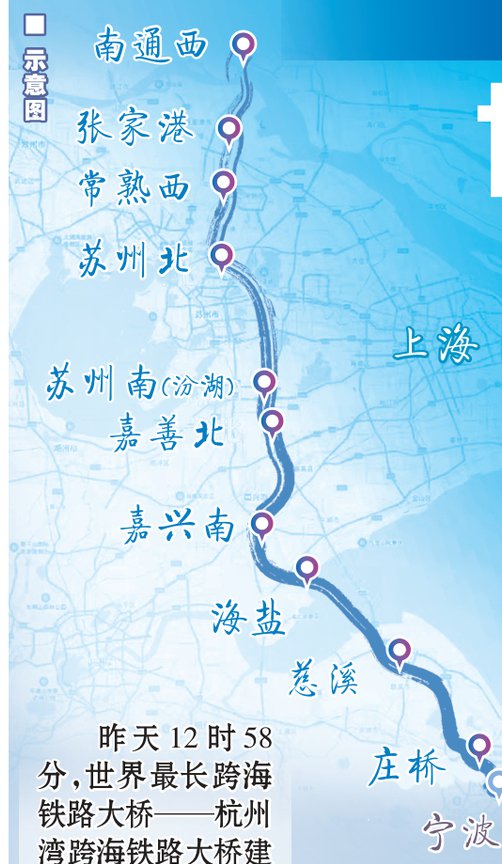
Core Viewpoint - The construction of the Hangzhou Bay Cross-Sea Railway Bridge, the world's longest cross-sea railway bridge, has reached a significant milestone with the successful topping of the main tower of the North Navigation Bridge, marking a major progress in this super engineering project [3][4]. Group 1: Project Overview - The Hangzhou Bay Cross-Sea Railway Bridge is a key project of the Tongzhou-Ningbo High-Speed Railway, spanning 29.2 kilometers and featuring three navigation bridges and a 26-kilometer long sea and shallow water approach bridge [4]. - The North Navigation Bridge, measuring 932.7 meters, is designed as the world's largest span ballastless track cable-stayed bridge, with a main span of 450 meters [4]. Group 2: Engineering Challenges - The bridge is located in a challenging marine environment characterized by strong tides, rapid currents, and frequent typhoons, with an average of 180 days of winds above level six annually and a maximum tidal range of nearly 9 meters [4]. - To ensure structural safety, the main pier of the North Navigation Bridge employs 52 drilled piles with a diameter of 2.5 meters and a maximum depth of 150 meters, effectively penetrating complex seabed layers [4]. Group 3: Innovative Construction Techniques - The project team has implemented innovative construction techniques, including a "large double-walled steel caisson" method, creating a robust "land-based working platform" at sea [5][6]. - A smart hydraulic climbing formwork system has been developed, integrating template, climbing, curing, and monitoring functions, ensuring high precision and safety during the construction of the tower columns [6]. Group 4: Future Developments - The construction plan for this year includes the comprehensive commencement of concrete precast box girder and steel girder installation, with segments weighing hundreds of tons being precisely assembled at heights of 60 meters [7]. - The Tongzhou-Ningbo High-Speed Railway is a crucial part of China's "eight vertical and eight horizontal" high-speed rail network along the coast, enhancing regional connectivity and promoting high-quality development in the Yangtze River Delta [7].
世界最大直径竖井掘进机太仓始发
Su Zhou Ri Bao· 2026-01-14 00:31
Group 1 - The world's largest diameter vertical shaft tunneling machine "Qiming" has officially commenced operation in Jiangsu Taicang, marking a new era for high-speed railway vertical shaft construction in China [1] - The Chongtai Yangtze River Tunnel is a key project under the national "Two Major" strategy, connecting Chongming Island and Taicang, with a total length of 14.25 kilometers and a design speed of 350 kilometers per hour [1] - The 2nd vertical shaft, located in Taicang, has a diameter of 24 meters and a depth of 56.08 meters, facing complex geological conditions and high construction risks [1] Group 2 - The "Linghang" shield machine, starting from Chongming, has already tunneled over 10,000 meters, with only about 850 meters remaining to the 2nd vertical shaft, which is crucial for its operation [2] - The completion of the Chongtai Yangtze River Tunnel will enable high-speed rail to cross the river without reducing speed, significantly shortening the travel time between Shanghai and Jiangsu [2] - The tunnel is expected to be operational by the second half of 2029, contributing to the integration of the Yangtze River Economic Belt and the high-quality development of the Yangtze River Delta [2]
沪渝蓉高铁南通地区建设提速
Zhong Guo Jing Ji Wang· 2026-01-13 12:32
Group 1 - The completion of the box girder installation for the Nanjing section of the Huhang Railway marks a significant progress in the main engineering phase, laying a solid foundation for subsequent bridge deck construction and track-laying operations [1] - The Huhang Railway Nanjing section spans 18.08 kilometers and includes various infrastructure components such as the main line, station renovations, and expansion projects [1] - The project team faced numerous technical challenges, including construction near operational lines and steep gradients, and successfully utilized an automated beam transport system to ensure stability and continuity during the construction process [1] Group 2 - The Huhang Railway is a crucial part of the national "eight vertical and eight horizontal" high-speed railway network and plays a key role in the intercity rail transit system of the Yangtze River Delta [2] - Upon completion, the project will significantly enhance the railway network layout in the Yangtze River region and support the high-quality development of the Yangtze Economic Belt and the integration strategy of the Yangtze River Delta [2]
沪苏锡常城际铁路太仓先导段双机并行
Su Zhou Ri Bao· 2026-01-04 02:08
Core Insights - The Taicang pilot section of the Huzhou-Su-Xi-Chang intercity railway has reached a critical milestone with the successful launch of the second shield machine "Qihang," marking the project’s entry into a new phase of "dual-machine parallel and synchronous excavation" [1] - The project is part of the key initiatives outlined in the "Yangtze River Delta Multi-level Rail Transit Planning," aiming to enhance regional rail connectivity and efficiency [2] Group 1 - The "Qihang" shield machine is utilized for the SG3 section from Taicang Station to Baiyun Road Station, featuring a total length of 116 meters and a digging diameter of 9.315 meters, equipped with an intelligent control system to handle complex geological conditions [1] - The left line shield machine "Sutie Pioneer" has already commenced excavation since November 2025, having progressed 135 meters so far [1] - Both shield machines will operate 24 hours continuously, with an initial excavation speed of 3 rings per day for the first 80 rings, increasing to 6 rings per day thereafter, aiming for section completion by mid-2027 [1] Group 2 - Upon completion, the project will enable metro-style operations, allowing passengers to use card swipes for seamless transfers with over ten subway lines and airport connections in Shanghai, significantly reducing commuting time from Taicang to downtown Shanghai [2] - This development will not only enhance the regional rail transit network but also facilitate the efficient flow of talent and resources among the four cities of Huzhou, Suzhou, Wuxi, and Changzhou, injecting strong momentum into the construction of the "Railway-based Yangtze River Delta" [2]
长三角高铁营业里程跃升至8100余公里
Jie Fang Ri Bao· 2026-01-03 01:55
Core Viewpoint - The opening of the Hefei-Suixian section of the Anhui-Xinjiang high-speed railway marks a significant expansion of the Yangtze River Delta high-speed rail network, increasing its operational mileage to over 8,000 kilometers [1] Group 1: Infrastructure Development - The Hefei-Suixian section, which is 198 kilometers long, officially commenced operations on December 30 last year [1] - During the 14th Five-Year Plan period, major railway projects in the Yangtze River Delta are set to reshape the regional economic landscape, significantly reducing "time-space distance" [1] - By the end of 2025, the total investment in railway construction during the 14th Five-Year Plan is expected to exceed 640 billion yuan, with 21 key projects operational [1] Group 2: Passenger Traffic Projections - By 2025, the cumulative number of passengers transported by the Yangtze River Delta railway is projected to surpass 900 million, setting a new historical record for annual passenger volume [1] - The operational mileage of regional railways is expected to exceed 15,400 kilometers, with high-speed rail mileage increasing to over 8,100 kilometers [1] Group 3: Ongoing Projects - There are currently 34 railway projects under construction in the region, with a total investment scale exceeding 900 billion yuan [1]
“超级环线”上的长三角“双城记”
Zhong Guo Fa Zhan Wang· 2025-12-31 08:23
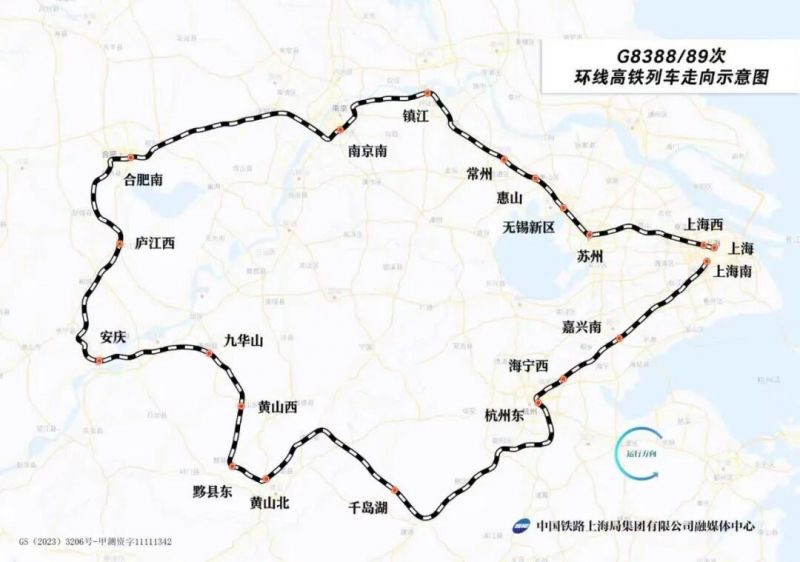
Core Viewpoint - The launch of the G8388 high-speed train has significantly enhanced connectivity in the Yangtze River Delta, facilitating a "super ring line" that connects major cities and promotes a dual-city lifestyle for commuters [1][10][11] Group 1: Infrastructure Development - The G8388 train covers a distance of 1200 kilometers, linking Shanghai, Nanjing, Hefei, and Hangzhou, along with 21 stations, effectively creating a "railway-based Yangtze River Delta" [1][10] - During the 14th Five-Year Plan, investment in the Yangtze River Delta railway construction has increased from approximately 90 billion yuan in 2021 to 142.38 billion yuan in 2024, with projections for 2025 to exceed 140 billion yuan [2][6] - By the end of 2024, the operational mileage of the Yangtze River Delta railway is expected to surpass 15,000 kilometers, with high-speed rail accounting for over 7,700 kilometers, marking a significant milestone in national railway development [7][11] Group 2: Economic and Social Impact - The convenience of rail transport has transformed commuting patterns, with over one million people now commuting across cities in the Yangtze River Delta, enhancing work efficiency and comfort [2][3] - The improved rail network has led to a 10.76% increase in domestic tourist numbers and a 13.28% rise in tourism revenue in Huangshan, indicating a positive economic impact from enhanced connectivity [7] - The integration of transportation and cultural tourism is evident, as the G8388 train facilitates access to various cultural sites, promoting a blend of travel and local experiences [10][11] Group 3: Policy and Mechanism Integration - The Yangtze River Delta region is actively pursuing "soft connectivity" through collaborative agreements among transportation departments to enhance credit information sharing and regulatory alignment [3] - The focus on creating a multi-layered rail network aims to achieve one-hour commuting within urban clusters and rapid connections between major cities, thereby fostering regional integration [6][7]
合新高铁安徽段(合泗段)开通 合肥“时钟型”交通枢纽成型
Xin Hua Cai Jing· 2025-12-30 06:31
Core Viewpoint - The opening of the Hefei to Sixian section of the Hexin High-Speed Railway marks a significant expansion of the Yangtze River Delta high-speed rail network, enhancing connectivity and reducing travel time in the region [1][2]. Group 1: Infrastructure Development - The Hefei to Sixian section of the Hexin High-Speed Railway officially opened on December 30, 2023, contributing to the total high-speed rail mileage in the Yangtze River Delta exceeding 8,000 kilometers [1]. - The new Hefei West Station, which is the largest station on this line, connects three major high-speed rail lines, enhancing the overall efficiency of the railway network in Hefei [2]. Group 2: Economic and Regional Impact - The new railway significantly reduces travel time from Hefei to Sixian from approximately 3-4 hours to about 1 hour and 15 minutes, integrating Sixian into Hefei's "one-hour traffic circle" [1]. - The completion of this railway section supports the development of the Yangtze River Economic Belt and promotes high-quality integration in the Yangtze River Delta region, facilitating commuting, trade, and tourism [2].