沪深300ETF天弘

Search documents
加仓!持续加仓
中国基金报· 2025-11-18 06:50
Core Viewpoint - The stock ETF market has shown resilience by attracting over 10 billion yuan in net inflows for two consecutive trading days, despite the overall market decline below 4000 points [2][4]. Group 1: Market Performance - As of November 17, the Shanghai Composite Index closed at 3972.03 points, down 0.46%, with total trading volume shrinking to 1.93 trillion yuan [4]. - The total scale of all stock ETFs (including cross-border ETFs) reached 4.39 trillion yuan, with a net inflow of 109.80 billion yuan on the same day [4][6]. Group 2: ETF Inflows - The leading categories for net inflows were industry themes and Hong Kong stock ETFs, with inflows of 38.7 billion yuan and 32.88 billion yuan, respectively [6]. - Major fund companies like E Fund and Huaxia Fund reported significant inflows, with E Fund's ETFs reaching a scale of 8160.6 billion yuan and a net inflow of 17.7 billion yuan [6][7]. Group 3: Specific ETF Performance - The top-performing ETFs on November 17 included the CSI 300 ETF with a net inflow of 16.58 billion yuan and the SSE 50 ETF with 11.6 billion yuan [10]. - The Southern Innovation ETF saw a net inflow of 9 billion yuan, driven by interest in AI-related sectors [11]. Group 4: Gold ETFs - Gold ETFs also attracted significant investment, with the Huaan Gold ETF receiving 7.6 billion yuan in net inflows, reflecting a trend towards safe-haven assets [11]. - The Guangfa Shanghai Gold ETF has shown a year-to-date increase of 49.71%, indicating strong demand for gold as a hedge against economic uncertainty [11][12]. Group 5: Outflows from Certain ETFs - Recent profit-taking has led to net outflows from cyclical ETFs such as chemical, coal, and non-ferrous metal ETFs, indicating a shift in investor sentiment [14].


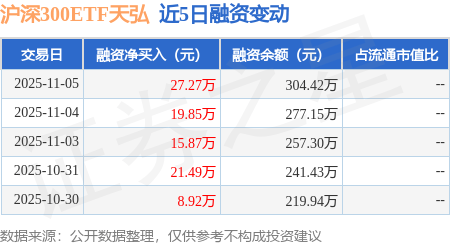
沪深300ETF天弘:11月5日融资净买入27.27万元,连续3日累计净买入62.98万元
Sou Hu Cai Jing· 2025-11-06 02:47
Core Insights - The financing net purchase of the Hu-Shen 300 ETF Tianhong (515330) on November 5 reached 272,700 yuan, with a financing balance of 3,044,200 yuan, marking a continuous net purchase of 629,800 yuan over the past three trading days [1][2]. Financing Activity Summary - On November 5, the financing net purchase was 272,700 yuan, with a financing balance of 3,044,200 yuan [2]. - The financing net purchases for the previous trading days were as follows: - November 4: 198,500 yuan, balance 2,771,500 yuan - November 3: 158,700 yuan, balance 2,573,000 yuan - October 31: 214,900 yuan, balance 2,414,300 yuan - October 30: 89,200 yuan, balance 2,199,400 yuan [2]. - The total margin financing and securities lending balance reached 3,097,100 yuan on November 5, reflecting an increase of 9.66% from the previous day [3]. Margin Financing Overview - The margin financing balance on November 5 was 3,097,100 yuan, with a change of 272,700 yuan, representing a 66% increase [3]. - The balance changes for the previous trading days were: - November 4: 282,430 yuan, change 198,000 yuan, 7.54% increase - November 3: 262,630 yuan, change 158,600 yuan, 6.43% increase - October 31: 246,770 yuan, change 214,300 yuan, 9.51% increase - October 30: 225,340 yuan, change 88,900 yuan, 4.11% increase [3].
C类产品规模遥遥领先,天弘基金ETF能否再创余额宝式辉煌?
Sou Hu Cai Jing· 2025-05-30 05:22
Core Viewpoint - Tianhong Fund has successfully transitioned from a small company to a leading fund manager in China, primarily driven by its innovative product, Yu'ebao, and its strategic focus on C-end users [1][7]. Group 1: Historical Development - In 2013, Tianhong Fund launched Yu'ebao, the first internet money market fund in China, which quickly gained popularity and led to a significant shift of funds from bank deposits to money market funds [1]. - By the end of Q1 2017, Tianhong Fund's public fund scale surpassed 1 trillion yuan, with Yu'ebao contributing 1.14 trillion yuan [1]. - Despite its rapid growth, Tianhong Fund was initially perceived as a "small company" due to its lower ranking in non-money market fund scales [1][2]. Group 2: Strategic Shifts - In response to regulatory pressures on money market funds, Tianhong Fund began focusing on other products, launching three ETFs in 2019 during a market low [2]. - The company adopted a low-cost strategy for its index products, reducing management fees to 0.5%, half of the industry average [3]. - Tianhong Fund shifted its strategy from low pricing to a "surrounding the onshore market" approach, converting traditional index funds into ETF-linked funds [3][4]. Group 3: C-end User Engagement - Tianhong Fund has leveraged its C-end user base, built through Yu'ebao, to enhance its ETF offerings, making them attractive to both retail and institutional investors [4][6]. - The company has implemented user-friendly features, such as low trading fees and innovative marketing strategies, including live streaming to engage with investors [4][5]. - As of Q1, Tianhong Fund's equity index fund scale reached 115.2 billion yuan, ranking 9th in the industry, with its ETFs attracting significant retail interest [4][6]. Group 4: Product Portfolio and Market Position - Tianhong Fund currently manages 27 ETFs covering various asset classes, with its flagship product being the Tianhong ChiNext ETF, which is the largest off-market index fund in its category [5]. - The company’s ETFs have been designed to cater to the preferences of retail investors, particularly those interested in short-term trading due to low transaction costs [5][6]. - By the end of 2024, passive index funds are expected to surpass actively managed equity funds in scale, highlighting the growing importance of this segment in the market [6]. Group 5: Future Outlook - Tianhong Fund aims to become the largest index fund service provider in China, focusing on retail investors and enhancing its product offerings [7]. - The company is also developing its B-end ecosystem, indicating a broader strategic vision beyond just C-end users [8]. - The potential for growth remains high, with the company positioned to capitalize on the increasing demand for index funds and ETFs in the market [9].
ETF战更趋火热,又一公募大厂批量更名旗下基金
Hua Er Jie Jian Wen· 2025-05-12 11:00
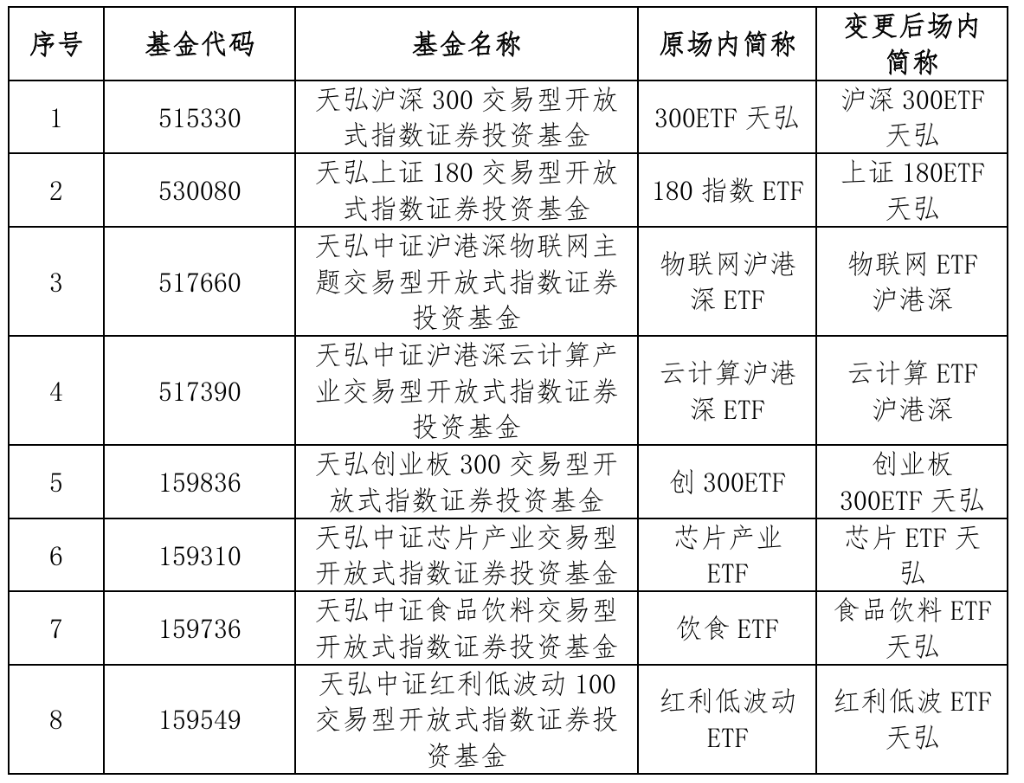
Core Viewpoint - Major public fund institutions are increasingly renaming their ETFs to enhance brand differentiation and improve investor recognition of product characteristics [1][4]. Group 1: ETF Renaming - Tianhong Fund announced that starting from May 12, 2025, it will change the trading names of several ETFs, including its large-scale CSI 300 ETF and specialized ETFs like the Internet of Things ETF and Cloud Computing ETF [1]. - The renaming strategy aims to clarify the underlying asset categories and improve the investment experience by aligning with investor search habits [1][2]. Group 2: Industry Trends - The trend of renaming ETFs is not isolated to Tianhong Fund; other major players like E Fund, Southern Fund, and Huaxia have also adjusted their ETF trading names recently [3]. - This shift indicates that the competition in the ETF market has entered a new phase, with firms focusing on brand identity rather than just competing for core product names [4].