
股票ETF

Search documents
A股回调,抄底资金涌入四大主线
21世纪经济报道· 2026-03-27 15:13
Core Viewpoint - The A-share market has experienced a significant pullback since March 12, with major indices like the Shanghai Composite Index and Shenzhen Component Index declining by approximately 5.91% and 5.94% respectively by March 26. Despite the downturn, there is a notable shift in fund allocation, with a trend towards risk aversion and a reallocation of assets into safer investments like money market and bond ETFs [1][3]. Group 1: Market Trends - The overall market ETF shares decreased by about 4 billion units, a decline of approximately 0.12%, with stock ETFs facing a net redemption of 11.9 billion units. Conversely, money market ETFs saw a net inflow of 2.2 billion units, and passive index bond ETFs increased by 300 million units, indicating a clear trend towards risk aversion [3]. - Over 200 ETFs experienced net subscriptions during the same period, highlighting a selective investment strategy amidst the broader market decline [3]. Group 2: Investment Focus Areas - Four main areas have emerged as focal points for fund inflows: 1. **Bond ETFs**: These are favored for their defensive characteristics, with short-term bond ETFs receiving a net inflow of 11.261 billion yuan, leading the pack [3]. 2. **Broad-based Indices**: Core assets like the CSI 300 and SSE Composite Index ETFs saw net inflows of 9.952 billion yuan and 4.699 billion yuan respectively, indicating continued confidence in large-cap stocks [4]. 3. **Sector and Theme Investments**: A "barbell" strategy is evident, with funds flowing into both growth sectors like new energy batteries (+2.145 billion yuan) and defensive high-dividend strategies like the CSI Dividend Index (+2.056 billion yuan) [6]. 4. **QDII Funds**: International stock ETFs, particularly those linked to Chinese technology assets, saw a net subscription of 6.8 billion units, reflecting long-term confidence in Chinese core tech assets [7]. Group 3: Market Outlook - Analysts suggest that the current market pullback is characterized by a focus on safety, low valuations, and certainty. Key asset categories attracting bottom-fishing capital include high-dividend defensive sectors, low-priced energy and cyclical assets, and reasonably valued growth leaders like semiconductors and innovative pharmaceuticals [9][10]. - The market is expected to remain in a phase of oscillation, with structural opportunities emerging as the focus shifts from speculative trading to a balance of undervalued value and high-quality growth [10].


2026年1月财富管理月报:居民持续边际增配权益,股票ETF规模收缩
GUOTAI HAITONG SECURITIES· 2026-03-13 13:30
Investment Rating - The report assigns an "Overweight" rating for the industry [6] Core Insights - In January 2026, residents' asset allocation remains primarily in low-risk deposits, with a marginal increase in equity investments. Securities firms, as key intermediaries for equity assets, will benefit from the influx of resident funds into the market [2][10] - The total market for wealth management products reached 353.2 trillion yuan, with a quarter-on-quarter change of +0.7% and a year-on-year change of +10.3%. The net increase in wealth management products was 2.5 trillion units, with a quarter-on-quarter change of -38.9% [7][11] - The equity market experienced fluctuations, but residents' risk appetite remained high, indicating a shift of funds from deposits to higher-yielding assets [12][16] Summary by Sections 1. Wealth Management Market Overview - In January 2026, the direction of residents' asset allocation is still primarily low-risk, with a marginal increase in equity investments. The total market for wealth management products reached 353.2 trillion yuan, with a quarter-on-quarter change of +0.7% and a year-on-year change of +10.3% [11][12] 2. Public Funds: Significant Increase in Equity New Issuance, Noticeable Reduction in Bond Funds - The total scale of public funds reached 37.8 trillion yuan, with a quarter-on-quarter change of +0.1% and a year-on-year change of +18.3%. The new issuance of equity funds increased significantly by 66.5% [23][31] - The total number of public fund units was 31.9 trillion, with a quarter-on-quarter change of -0.4% and a year-on-year change of +8.8% [24][25] 3. Private Fund/Asset Management: Steady Growth in Private Fund/Asset Management Scale - The scale of private funds reached 22.4 trillion yuan, with a quarter-on-quarter change of +1.3%. The scale of private asset management reached 12.4 trillion yuan, with a quarter-on-quarter change of +0.6% [11][12] 4. Wealth Management/Insurance/Deposits: Fixed Income Management Still Favored - The scale of bank wealth management reached 29.7 trillion yuan, with a quarter-on-quarter change of -0.15%. The scale of resident deposits was 168.0 trillion yuan, with a quarter-on-quarter change of +1.3% [11][12] 5. Investment Recommendations: Securities Firms Overall Benefit from Resident Funds Entering the Market - The low-interest-rate environment and the profit effect of the equity market are driving residents to gradually invest in the market. Securities firms are expected to benefit from the influx of incremental funds. Recommended stocks include Industrial Securities and GF Securities [7][12]
2026年1月财富管理月报:居民持续边际增配权益,股票ETF规模收缩-20260313
GUOTAI HAITONG SECURITIES· 2026-03-13 11:15
Investment Rating - The report assigns an "Overweight" rating for the industry [6] Core Insights - In January 2026, residents' asset allocation remains primarily in low-risk deposits, with a marginal increase in equity investments. Securities firms, as key intermediaries for equity assets, will benefit from the influx of resident funds into the market [2][10] - The total market for wealth management products reached 353.2 trillion yuan, with a quarter-on-quarter change of +0.7% and a year-on-year change of +10.3%. The net increase in wealth management products was 2.5 trillion units, with a quarter-on-quarter change of -38.9% [7][11] - The equity market experienced fluctuations, but residents' risk appetite remained high, indicating a shift of funds from deposits to higher-yielding assets [12][16] Summary by Sections 1. Wealth Management Market Overview - In January 2026, the direction of residents' asset allocation is still primarily low-risk, with a marginal increase in equity investments. The wealth management financial products include public funds, private funds, private asset management plans, insurance products, and bank wealth management [10][11] 2. Public Funds: Significant Increase in Equity New Issuance, Noticeable Reduction in Bond Funds - The total scale of public funds reached 37.8 trillion yuan, with a quarter-on-quarter change of +0.1% and a year-on-year change of +18.3%. The market saw a slight increase in public fund assets, while bond funds experienced a significant reduction [23][24] - In January 2026, new public fund issuance reached 1.2021 trillion units, with a quarter-on-quarter change of +6.2% and a year-on-year change of +44.4%. Equity funds saw a substantial increase in new issuance, while bond funds faced pressure [31] 3. Private Asset Management/Funds: Stable Growth in Private Fund/Asset Management Scale - The scale of private funds reached 22.4 trillion yuan, with a quarter-on-quarter change of +1.3%. The new registration scale of private funds was 64.06 billion yuan, with a quarter-on-quarter change of -35.2% [11][12] 4. Wealth Management/Insurance/Deposits: Fixed Income Wealth Management Remains Popular - The scale of bank wealth management reached 29.7 trillion yuan, with a quarter-on-quarter change of -0.15%. The total resident deposit scale was 168.0 trillion yuan, with a quarter-on-quarter change of +1.3% [11][12] 5. Investment Recommendations: Securities Firms Overall Benefit from Residents' Market Entry - The low-interest environment and the profit effect of the equity market are driving residents' funds into the market steadily. Securities firms are expected to benefit from the influx of incremental funds, with recommendations for specific firms such as Industrial Securities and GF Securities [7][12]
ETF资金流向视角下的行业轮动配置
Huafu Securities· 2026-03-04 13:27
Quantitative Models and Construction Methods 1. Model Name: Industry Allocation Model Based on ETF Fund Flows - **Model Construction Idea**: The model leverages ETF fund flow data to identify industry rotation opportunities. It incorporates short-term fund inflows/outflows, style-adjusted holding levels, marginal changes in holdings, and the divergence between ETF and active equity fund holdings to construct an industry allocation strategy[3][69][72] - **Model Construction Process**: 1. **Short-term Fund Flows**: Calculate the first-order difference of weekly ETF holdings to identify industries with significant inflows or outflows[40][44] 2. **Style-Adjusted Holdings**: Adjust industry holdings based on market style (e.g., large-cap vs. small-cap, growth vs. value) using a single-sided HP filter and factor momentum to determine style trends[49][50][57] 3. **Marginal Changes in Holdings**: Analyze the marginal changes in ETF holdings by ranking industries into five groups based on their monthly holding changes[22][25] 4. **Divergence with Active Equity Funds**: Compare ETF holdings with active equity fund holdings to identify industries with higher or lower relative allocations. Use regression-based methods to estimate active fund holdings when real data is unavailable[27][28][31] 5. **Final Strategy**: Combine the above factors equally, select the top six industries, and rebalance the portfolio bi-weekly[72] - **Model Evaluation**: The model effectively captures industry rotation opportunities by integrating multiple dimensions of ETF fund flow data and market style trends[72] --- Model Backtesting Results 1. Industry Allocation Model Based on ETF Fund Flows - **Annualized Return**: 15.57% - **Excess Annualized Return**: 7.56% (compared to equal-weighted industry benchmark) - **Information Ratio (IR)**: 0.93 - **Maximum Drawdown**: 8.30% - **Monthly Excess Win Rate**: 64% - **Payoff Ratio**: 1.38x[72] --- Quantitative Factors and Construction Methods 1. Factor Name: Short-term Fund Flows - **Factor Construction Idea**: Identify industries with significant short-term fund inflows or outflows to capture immediate price impacts[40][44] - **Factor Construction Process**: 1. Calculate the first-order difference of weekly ETF holdings 2. Rank industries based on the magnitude of fund flow changes[40][44] - **Factor Evaluation**: Demonstrates strong monotonicity in short-term returns, with industries experiencing inflows showing higher returns[44] 2. Factor Name: Style-Adjusted Holdings - **Factor Construction Idea**: Adjust industry holdings based on prevailing market styles (e.g., large-cap vs. small-cap, growth vs. value)[46][49] - **Factor Construction Process**: 1. Use a single-sided HP filter to smooth market style data (e.g., CSI 300/CSI 1000 index ratios) 2. Define factor momentum as the difference between the current value and the average of the previous two periods 3. Classify industries into five groups based on their adjusted holdings[49][50][57] - **Factor Evaluation**: Captures the relationship between industry holdings and market style trends, effectively identifying style-driven opportunities[47][57] 3. Factor Name: Marginal Changes in Holdings - **Factor Construction Idea**: Analyze the marginal changes in ETF holdings to identify industries with increasing or decreasing allocations[22][25] - **Factor Construction Process**: 1. Calculate the monthly difference in ETF holdings for each industry 2. Rank industries into five groups based on the magnitude of changes[22][25] - **Factor Evaluation**: Demonstrates a strong correlation with growth and value style trends, providing insights into industry rotation opportunities[47] 4. Factor Name: Divergence with Active Equity Fund Holdings - **Factor Construction Idea**: Compare ETF holdings with active equity fund holdings to identify industries with higher or lower relative allocations[27][28] - **Factor Construction Process**: 1. Use regression-based methods to estimate active fund holdings when real data is unavailable 2. Calculate the difference between ETF and active fund holdings and rank industries into three groups based on the magnitude of divergence[27][28][31] - **Factor Evaluation**: Highlights the pricing power of ETF flows relative to active funds, especially post-2021[31][65] --- Factor Backtesting Results 1. Short-term Fund Flows - **Absolute Return**: 6.17% (highest group) - **Annualized Volatility**: 21.22% - **Sharpe Ratio**: 0.29 - **Maximum Drawdown**: -37.61%[42] 2. Style-Adjusted Holdings - **Annualized Return**: 9.66% - **Excess Annualized Return**: 5.82% - **Information Ratio (IR)**: 0.75 - **Maximum Drawdown**: -29.11%[55] 3. Marginal Changes in Holdings - **Annualized Return**: 7.80% (highest group) - **Excess Annualized Return**: 6.91% - **Information Ratio (IR)**: 1.13 - **Maximum Drawdown**: -16.10%[71] 4. Divergence with Active Equity Fund Holdings - **Annualized Return**: 14.01% - **Excess Annualized Return**: 6.11% - **Information Ratio (IR)**: 0.76 - **Maximum Drawdown**: -28.80%[64][65]
韩国,拟100万亿韩元稳股市
财联社· 2026-03-04 10:41
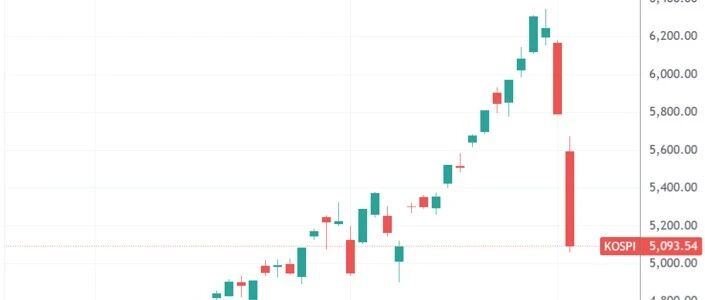
Core Viewpoint - The South Korean stock market experienced a historic drop, with the KOSPI index falling by 12.06%, marking the largest single-day decline ever recorded, surpassing the drop following the 9/11 attacks in 2001 [1] Group 1: Market Performance - The KOSPI index's increase for 2026 has narrowed from nearly 50% to 20%, following a 75% rise last year, which was the highest among major global markets [2] - The KOSDAQ index plummeted by 14%, also setting a record for the largest single-day decline [1] Group 2: Economic Factors - The ongoing Middle East crisis has exposed vulnerabilities in the South Korean economy, particularly its reliance on exports and energy from the region, leading to concerns about forced liquidations in the market [2] - Foreign investors have been leading the sell-off, contributing to a significant depreciation of the Korean won, nearing the 1,500 won per dollar mark [4] Group 3: Government and Central Bank Response - The South Korean government is under scrutiny for potential market stabilization measures, with President Yoon Suk-yeol selling his apartment to encourage investment in the stock market [5] - The Bank of Korea has postponed its participation in an IMF meeting to assess the financial market's latest trends, indicating that volatility in exchange rates, interest rates, and stock prices may persist depending on the geopolitical situation [6] - The Financial Services Commission held an emergency meeting to evaluate market conditions, attributing the volatility to rising geopolitical risks and profit-taking after previous market gains [6] Group 4: Regulatory Actions - The Financial Services Commission has emphasized a "zero tolerance" policy towards market manipulation and misinformation, with plans to activate a 100 trillion won market stabilization program if excessive volatility occurs [7]
37.77万亿,公募基金规模,连续10个月创新高
Zhong Guo Ji Jin Bao· 2026-02-27 23:13
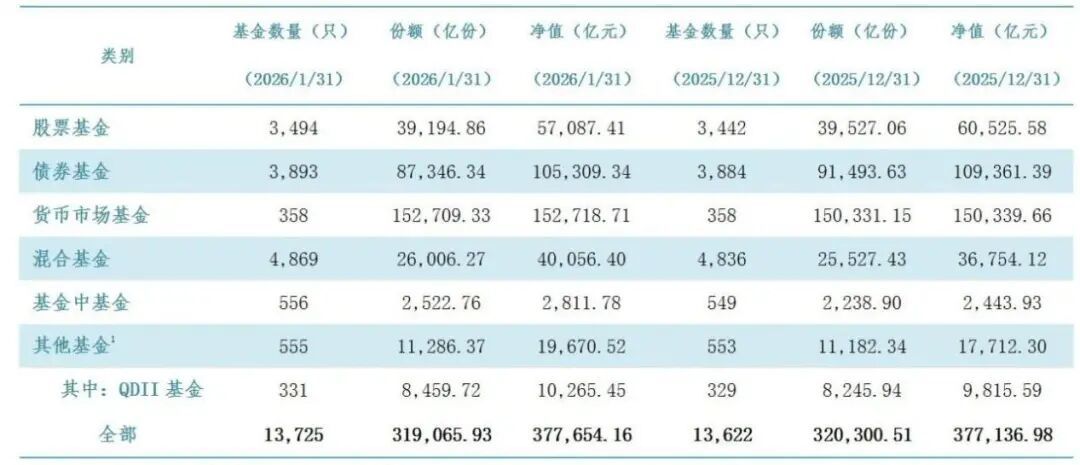
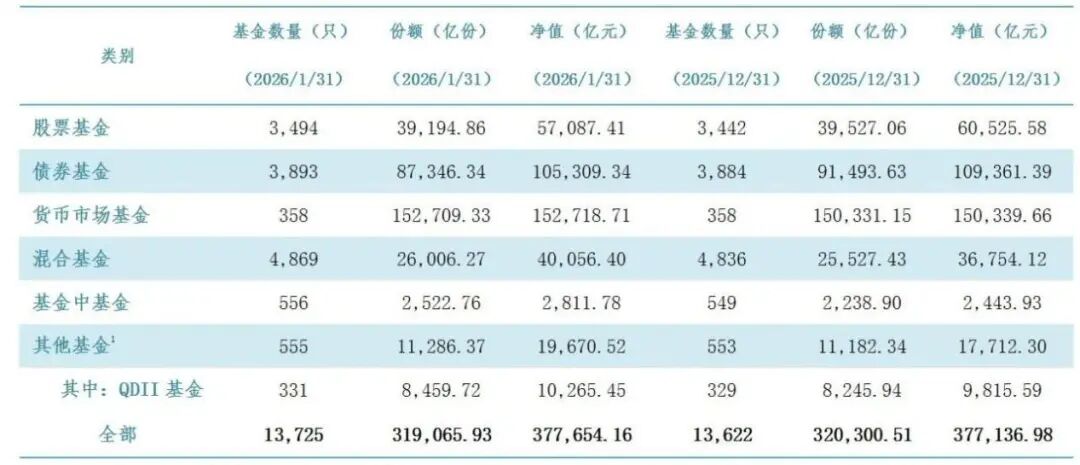
Core Insights - The public fund industry in China has reached a record high in total assets, amounting to 37.77 trillion yuan as of the end of January 2026, marking the tenth consecutive month of growth [2][4][5]. Fund Size and Growth - The total size of public funds has seen a continuous increase, with significant contributions from mixed, money market, and other funds, all achieving growth in the range of hundreds of billions [2][7]. - The Fund of Funds (FOF) has experienced a remarkable increase, with a 15.05% rise in shares and a 12.68% increase in scale, reaching 2,522.76 billion shares and 2,811.78 billion yuan respectively [9][11]. Fund Type Performance - Stock funds have faced a decline, with a reduction of over 3,400 billion yuan, while bond funds also decreased by more than 4,000 billion yuan due to the "stock-bond seesaw" effect [3][12]. - Mixed funds have shown strong performance, with a scale increase of 8.98%, reaching 40.06 trillion yuan, driven by net value growth [12]. - Money market funds have also seen a slight increase of 1.58%, with a total scale of 152.72 trillion yuan [11]. Market Dynamics - The public fund market has been buoyed by favorable market conditions and an influx of new capital, contributing to the sustained growth in fund sizes [1][7]. - Major commercial banks, such as China Merchants Bank and China Construction Bank, have played a significant role in promoting FOF products, leading to their rapid growth [9][11].
37.77万亿!公募基金规模,连续10个月创新高
Zhong Guo Ji Jin Bao· 2026-02-27 16:05
Core Viewpoint - The total scale of public funds in China has reached a historical high of 37.77 trillion yuan, driven by multiple factors including seasonal market activity and an influx of new capital [1][2]. Fund Scale and Growth - As of the end of January 2026, the total scale of public funds has increased for 10 consecutive months, with a net asset value of 37.77 trillion yuan, marking a 0.14% increase from the previous month [2][4]. - The number of public fund management institutions in China stands at 165, including 150 fund management companies and 15 asset management institutions with public qualifications [4]. Fund Type Performance - Mixed, money market, and other funds have been the main contributors to the growth of public fund scale, each achieving a growth of over 100 billion yuan [2]. - Fund of Funds (FOF) has seen a significant increase, with a 15.05% rise in shares and a 12.68% increase in scale, reaching 2,522.76 billion shares and 2,811.78 billion yuan respectively [7][9]. Fund Size Changes - Stock funds have experienced a reduction of over 340 billion yuan, with a total scale of 5.71 trillion yuan, reflecting a 5.68% decrease [3][10]. - Bond funds also faced a decline, shrinking by over 400 billion yuan, with a total scale of 10.53 trillion yuan, a decrease of 3.71% [3][10]. - In contrast, money market funds and mixed funds have shown positive growth, with money market funds increasing by 1.58% and mixed funds by 8.98% [9][10]. Market Dynamics - The market has shown strong momentum, with public fund management scales consistently reaching new highs since April 2025, when it first surpassed 33 trillion yuan [6]. - The significant redemption of broad-based ETFs has impacted the overall scale of stock funds, contributing to the observed declines [3][10].
超200亿,跑了!
Zhong Guo Ji Jin Bao· 2026-02-27 06:15
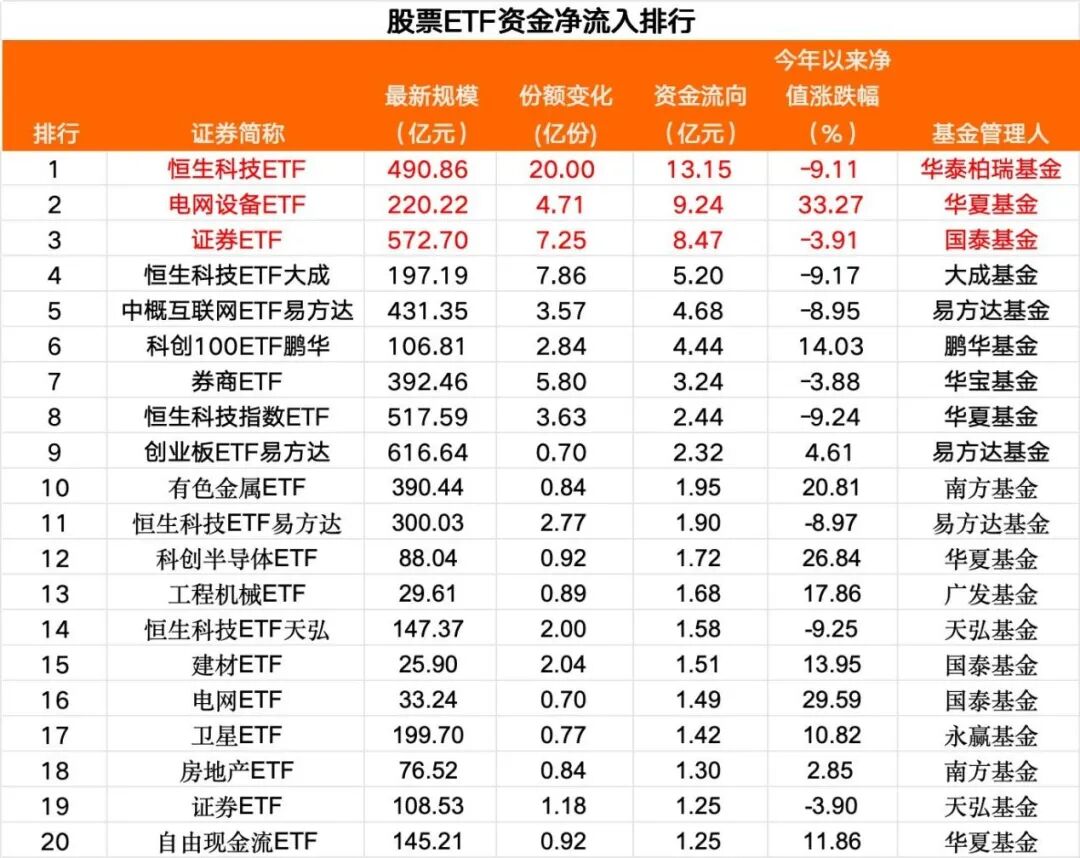
Core Viewpoint - On February 26, the A-share market experienced a high-level fluctuation phase after continuous gains, with a net outflow of over 23.5 billion yuan from stock ETFs, indicating a shift in investor sentiment as some funds opted to exit the market [1][2]. Summary by Category Market Overview - The total trading volume in the A-share market reached 2.54 trillion yuan on February 26, with a total of 1,344 stock ETFs amounting to 4.13 trillion yuan in total scale [2][6]. - The overall market saw a net outflow of 226.5 billion yuan, marking the second consecutive trading day of net outflows [2]. ETF Performance - On February 26, 80.73 million shares of stock ETFs were redeemed, leading to a net outflow of over 23.5 billion yuan, with 23 ETFs seeing inflows exceeding 1 billion yuan [2][3]. - The top three ETFs by net inflow were the Hang Seng Technology ETF (13.15 billion yuan), the Electric Grid Equipment ETF (9.24 billion yuan), and the Securities ETF (8.47 billion yuan) [4][6]. Sector Analysis - The Hang Seng Technology Index saw the highest net inflow of 25.07 billion yuan, while the CSI 500 Index experienced the largest net outflow of 60.08 billion yuan on the same day [3][5]. - From a five-day perspective, the Hang Seng Technology Index-related ETFs attracted over 13.2 billion yuan, and the China Internet 50 Index-related ETFs attracted over 3.7 billion yuan [3]. Fund Management Insights - Leading fund companies like E Fund and Huaxia Fund reported significant inflows in their ETFs, with E Fund's China Internet ETF reaching a scale of 431.35 billion yuan and a net inflow of 4.79 billion yuan [6]. - Huaxia Fund's Electric Grid Equipment ETF and Hang Seng Technology Index ETF also saw substantial inflows, with net inflows of 9.24 billion yuan and 2.44 billion yuan, respectively [6].
“落袋为安”?14亿 跑了
Zhong Guo Ji Jin Bao· 2026-02-26 04:47
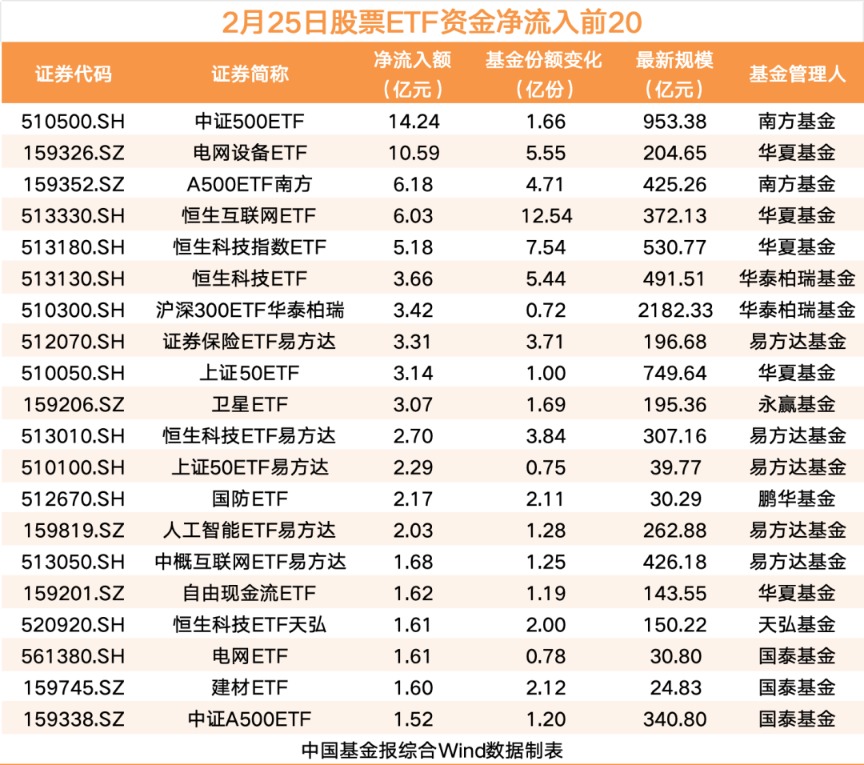
Group 1 - On February 25, the A-share market saw all three major indices rise collectively, while the stock ETF market experienced a net outflow of approximately 1.4 billion yuan [1][3] - As of February 25, the total scale of 1,344 stock ETFs in the market reached 4.18 trillion yuan, with a reduction of 503 million fund shares, resulting in a net outflow of about 1.48 billion yuan [3] - The Hong Kong stock market ETFs led in net inflows, totaling 1.881 billion yuan, with the CSI 500 Index ETF seeing the highest inflow of 1.678 billion yuan [3] Group 2 - On February 25, 32 ETFs had net inflows exceeding 100 million yuan, with the CSI 500 ETF leading at 1.424 billion yuan, followed by the Electric Grid Equipment ETF and A500 ETF with inflows of 1.059 billion yuan and 618 million yuan, respectively [4][5] - The Electric Grid Equipment ETF and the Hang Seng Internet ETF were among the top gainers, with net inflows of 1.059 billion yuan and 603 million yuan, respectively [5] - Conversely, the ChiNext Index ETF experienced the largest net outflow, amounting to 1.946 billion yuan [5][6] Group 3 - The top 15 ETFs with net outflows included the ChiNext ETF with a net outflow of 1.684 billion yuan, followed by the Chemical ETF and Semiconductor Equipment ETF with outflows of 1.268 billion yuan and 757 million yuan, respectively [6] - The report indicates that major fund companies, such as E Fund and Huaxia Fund, continue to attract net inflows into their ETFs, reflecting investor confidence in specific sectors [4][5] - Looking ahead, ICBC Credit Suisse Fund expresses a positive outlook on A-shares, citing that total demand adjustments are nearing equilibrium and supply-side adjustments will enhance confidence in capital returns [5]
研究所日报-20260226
Yintai Securities· 2026-02-26 01:34
Market Overview - Year-to-date, stock ETFs have shown a net outflow of 187.3 billion yuan as of February 24, 2026[2] - The total return of the Wind All A-Share Index is 6.53% year-to-date, despite significant ETF outflows, indicating a shift in market sentiment[2] International Developments - German Chancellor Friedrich Merz visited China from February 25 to 26, accompanied by a high-level delegation of 30 representatives from the German business sector[3] - The U.S. Trade Representative, Katherine Tai, indicated ongoing investigations into China's compliance with the Phase One trade agreement, suggesting potential tariff measures[3] Stock Market Performance - On February 25, the Shanghai Composite Index rose by 0.72%, while the Shenzhen Component Index increased by 1.29%, with total trading volume reaching 24,625.48 billion yuan, an increase of 2,604.86 billion yuan from the previous trading day[4] - The ChiNext Index rose by 1.41%, and the STAR 50 Index increased by 0.54%[4] Bond Market Insights - The yield on the 10-year government bond is 1.8195%, with a change of +1.42 basis points[5] - The average rates for R001 and R007 in the interbank market were 1.4652% and 1.5869%, respectively[5] Sector Performance - The top-performing sectors included steel (4.69%), non-ferrous metals (3.48%), and building materials (2.75%), while banking and media sectors saw declines of 0.46% and 1.15%, respectively[5]