
液晶

Search documents
温彬:进出口高位收官,2026出口有望量稳质升
Di Yi Cai Jing· 2026-01-15 03:16
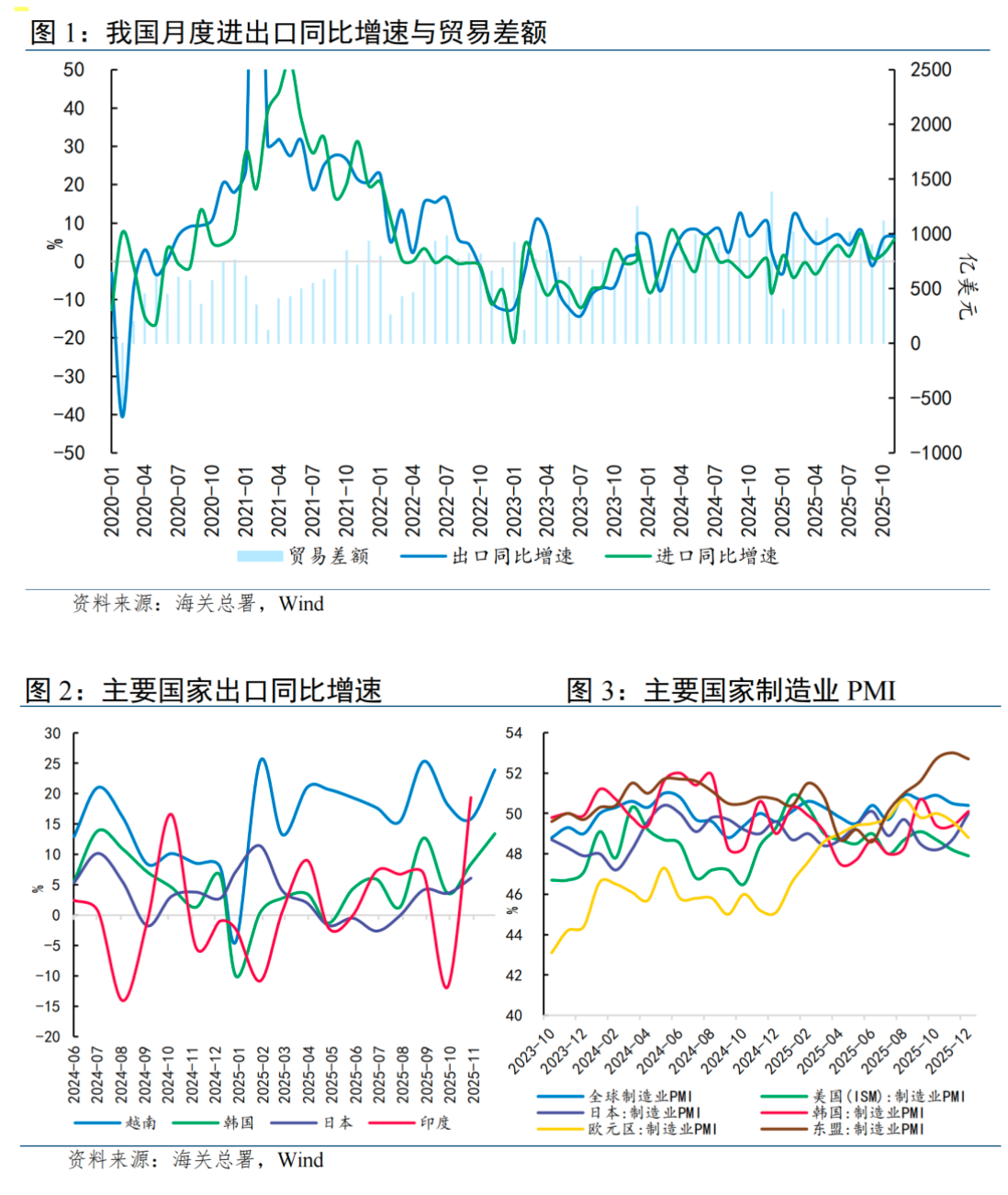
Core Viewpoint - China's export scale in December 2025 exceeded expectations, setting a historical monthly export record, while imports also reached a high point since 2022 [3][2]. Group 1: Import and Export Growth - In December 2025, China's total import and export value reached $601.42 billion, with a cumulative annual total of $635.48 billion, reflecting a year-on-year growth of 3.2% [2]. - Monthly exports amounted to $357.78 billion, a year-on-year increase of 6.6%, while annual exports totaled $3.77 trillion, up 5.5% [2]. - Monthly imports were $243.64 billion, showing a year-on-year growth of 5.7%, with annual imports at $2.58 trillion, remaining flat compared to the previous year [2]. Group 2: Factors Supporting Export Growth - Three main factors supported the high growth in exports: seasonal overseas stocking demand, AI-driven semiconductor industry growth, and steady international economic recovery [3]. - Seasonal demand from overseas retailers ahead of Christmas led to increased orders in consumer electronics, toys, and small appliances, contributing to a monthly export growth of 8.4% in December [3]. - The AI boom significantly boosted the semiconductor supply chain, with integrated circuit exports surging by 47.4%, and overall machinery and electronics product exports growing by 12.1% [3]. Group 3: International Economic Recovery - The global manufacturing PMI recorded 50.4 in December 2025, indicating a steady recovery in the international economy, with mixed performance among major economies [4]. - The U.S. ISM manufacturing PMI fell to 47.9, while the Eurozone and Japan showed slight declines, and South Korea's PMI rose to 50.1, reflecting a rebound in exports [4]. Group 4: Export Performance by Region - Exports to the U.S. in December 2025 were $34.2 billion, with a year-on-year decline of 30%, influenced by high base effects and tariff expectations [7]. - Exports to the EU reached $51.9 billion, the highest for the year, with an 11.6% year-on-year increase, driven by seasonal demand for consumer goods [7]. - Exports to ASEAN countries totaled $66.4 billion, also the highest for the year, with a year-on-year growth of 11.2% [9]. Group 5: Import Trends - Imports from the U.S. continued to decline for ten consecutive months, with a year-on-year drop of 28.7% in December 2025 [10]. - Imports from ASEAN countries fell by 5.3%, while imports from other regions, including Hong Kong and Japan, showed growth [10]. - High-tech product imports increased by 13.5%, indicating a diverse performance across various categories [15]. Group 6: Export Structure Improvement - The export structure continued to improve, with machinery and electronics leading the growth, particularly in automotive and semiconductor sectors [13]. - Exports of integrated circuits increased by 47.7%, with both volume and price rising [14]. - Labor-intensive products continued to decline, although the rate of decline has narrowed for some categories [14].

分析|去年12月出口增速超预期,全年进出口总值创历史新高
Xin Lang Cai Jing· 2026-01-14 12:26
Core Viewpoint - China's foreign trade data for December 2025 and the entire year shows a positive growth trend, with exports and imports both increasing, leading to a significant trade surplus. The data indicates that China maintains its position as the world's largest goods trader despite facing external uncertainties in 2026 [1][3][9]. Group 1: December 2025 Trade Data - In December 2025, China's total import and export value reached $601.42 billion, a year-on-year increase of 6.2%, with exports at $357.78 billion (up 6.6%) and imports at $243.64 billion (up 5.7%) [1][4]. - The trade surplus for December 2025 was $114.14 billion, reflecting strong export performance driven by seasonal demand and the global AI investment trend [1][4][5]. Group 2: Annual Trade Performance - For the entire year of 2025, China's total import and export value was $6.35 trillion, a 3.2% increase from the previous year, with exports at $3.77 trillion (up 5.5%) and imports at $2.58 trillion (flat) [2][3]. - The trade surplus for 2025 was $1.19 trillion, marking a historical high in trade value [2][3]. Group 3: Factors Influencing Trade Growth - The growth in December exports was supported by overseas seasonal stocking, demand from emerging markets, and the AI investment boom, particularly in the semiconductor industry [4][5]. - The shift in trade dynamics, with a focus on markets outside the U.S., has helped mitigate the impact of declining exports to the U.S. [6][10]. Group 4: Import Trends - December 2025 saw imports grow by 5.7%, driven by high processing trade ratios and a drop in international oil prices, which boosted domestic crude oil import demand [7][8]. - The annual import value reached a record high of 18.48 trillion yuan, maintaining China's position as the world's second-largest import market [8]. Group 5: Outlook for 2026 - The external environment for trade in 2026 is expected to remain challenging, with global trade growth projected to slow down significantly [9][10]. - Despite potential slowdowns, China's trade fundamentals are expected to remain solid, with continued resilience in exports and imports supported by domestic demand policies [9][10].

OCS,AI新型网络架构下的创新光学底座
2025-09-23 02:34
Summary of Conference Call Records Industry Overview - The conference call discusses the optical communication industry, specifically focusing on Optical Circuit Switch (OCS) technology and its market potential. The industry is expected to maintain high growth, particularly for leading optical module manufacturers in 2027-2028, making them a recommended investment direction [1][2]. Key Points and Arguments - **Investment Opportunities**: - Leading optical module manufacturers are highlighted for their high earnings certainty and reasonable valuations, with no signs of bubble formation for 2026 [2]. - Secondary overseas computing chain optical module manufacturers are also noted for having upward performance revision potential for 2026, presenting investment opportunities [3]. - **Emerging Technologies**: - New technologies are creating investment opportunities in three networking directions: Skill out (CPO/CPC), Skill up (OCS/OIO), and Skill across (hollow fiber). OCS is particularly noted for its low latency, low power consumption, and cross-generational hardware reuse advantages [1][5]. - **OCS Technology**: - OCS technology allows for direct switching of optical signals, achieving low latency (tens of nanoseconds) and low power consumption, while being transparent to data formats. However, it has longer switching delays (tens of milliseconds) and higher insertion losses [6][12]. - Major OCS technology solutions include MEMS (Google, Lumentum, Huawei) and liquid crystal (Coherent). MEMS is economically favorable but has longer switching times, while liquid crystal offers high reliability and scalability but requires optimization for switching times [7][8]. - **Market Growth Predictions**: - The OCS market is projected to exceed $1.6 billion by 2029, with potential market space estimated at $2 billion by Coherent [4][12]. Additional Important Content - **Challenges with Traditional Circuits**: - Traditional circuits face issues like packet loss during data transmission. OCS networking aims to reduce data loss and enhance performance in large-scale training clusters by providing more reliable data transmission paths [13]. - **Impact of Supernode Networking**: - The increasing demand for supernode networking highlights OCS's advantages in high predictability and high certainty traffic transmission scenarios, particularly in interconnections between racks or pods [14]. - **OCS Industry Chain**: - The OCS industry chain includes core components such as MEMS chips, optical circulators, lenses, and wavelength division multiplexers. It also involves the entire OCS system manufacturing process [15]. - **Domestic Participation**: - Domestic companies are primarily involved in various optical components or crystal materials and system manufacturing, playing a significant role in advancing OCS technology [16].
飞凯材料20250828
2025-08-28 15:15
Summary of Feikai Materials Conference Call Company Overview - **Company**: Feikai Materials - **Industry**: Semiconductor and Display Materials Key Financial Performance - **Q2 2025 Revenue**: Approximately 762 million CNY, a year-on-year increase of 2.9% [2][5] - **Net Profit**: Approximately 97 million CNY, a year-on-year increase of 61% [2][5] - **Net Profit Excluding Non-recurring Items**: Approximately 99 million CNY, a year-on-year increase of 67% [2][5] - **H1 2025 Revenue**: Approximately 1.46 billion CNY, a year-on-year increase of 3.8% [3] - **H1 2025 Net Profit**: Approximately 217 million CNY, a year-on-year increase of 80.45% [3] - **H1 2025 Net Profit Excluding Non-recurring Items**: Approximately 180 million CNY, a year-on-year increase of 40.5% [3] Segment Performance - **Liquid Crystal Revenue**: 550 million CNY, a year-on-year increase of 27% [2][6] - **Functional Wet Electronic Chemicals Revenue**: 154 million CNY, a year-on-year increase of 27% [2][6] - **Optical Fiber Coating Revenue**: 164 million CNY, a year-on-year increase of 19% [2][6] - **Photosensitive Materials Revenue**: 180 million CNY, a year-on-year increase of 60% [2][6] - **Semiconductor Materials Revenue**: Decreased by 4.75% due to the divestment of Taiwan demand [2][5] Strategic Developments - **Acquisition of JNC Liquid Crystal Business**: Aimed at expanding into the small and medium-sized liquid crystal panel market [4][12] - **Advanced Packaging Initiatives**: Introduction of 2.5D/3D packaging photoresists and development of temporary bonding materials [11] - **TMO Product Development**: Expected annual revenue of 30 to 40 million CNY from TMO products [10] Cost Management and Supply Chain - **Cost Control Measures**: Effective negotiation with suppliers and in-house production of TMO to mitigate the impact of rising prices of photoinitiators [8][9] - **Impact of Raw Material Prices**: Decrease in raw material prices significantly contributed to improved profit margins in Q2 [7] Market Trends and Future Outlook - **Semiconductor Sector Growth**: Anticipated stable growth driven by AI computing and data center chip demand [16] - **Display Materials Stability**: Expected stability in screen display materials, with potential growth from the integration of JNC's liquid crystal business [16] - **Automotive Exterior Parts Project**: Progressing towards stable mass production expected next year [13] Additional Insights - **Trading Financial Assets**: Value fluctuations primarily due to early-stage investments in venture capital funds, with expected reduction in future impacts as most projects exit [14] - **EMC Epoxy Encapsulation**: Increased focus on advanced packaging applications, with new production lines established to meet higher process requirements [15] This summary encapsulates the key points from the conference call, highlighting the financial performance, strategic initiatives, market trends, and future outlook for Feikai Materials.

飞凯材料20250520
2025-05-20 15:24
Summary of the Conference Call for Feikai Materials Industry Overview - The semiconductor materials business of Feikai includes functional wet electronic chemicals, solder balls, and EMC epoxy encapsulants, with projected revenue of approximately 670 million yuan in 2024, accounting for 24% of total revenue, marking it as a strategic pillar for future development [2][3][4]. Key Points and Arguments - **Revenue Growth**: In the first four months of 2025, functional wet electronic chemicals grew by 29% year-on-year, while EMC epoxy encapsulants increased by 2.3%. However, the solder ball business declined due to the sale of the Taiwan plant, although the Shanghai plant saw a 9% increase [2][6]. - **Client Base**: Major clients for functional wet electronic chemicals include Changdian Technology, Tongfu Microelectronics, and Huada Semiconductor. Solder ball clients include ASE and SPIL, while EMC epoxy encapsulants are used by companies like Yangjie Technology and BYD for IGBT substrates [2][5]. - **Competitive Advantage**: Feikai has over ten years of experience in wet electronic chemicals, establishing a competitive edge through comprehensive solutions and rapid response services. The company benefits from a strong moat due to process safety advantages and customer certification barriers [2][9]. - **Gross Margin Stability**: The gross margin for functional chemicals is approximately 35%-40%, while demand-type materials have a margin of about 20%, and EMC epoxy encapsulants around 30%. Fluctuations in raw material prices have minimal impact on margins, which are expected to remain stable in the coming quarters [2][10]. - **Future Expansion**: Feikai is constructing a third EMC epoxy encapsulant plant in Anqing, focusing on supplying leading domestic memory chip manufacturers. The company plans to collaborate with JNC to acquire its China operations and patents, aiming to replace Merck as a leading global LCD supplier [3][17]. - **Market Trends**: The semiconductor materials business is expected to achieve revenue of approximately 700 million yuan in 2025, reflecting a 20% growth when excluding contributions from the Taiwan plant. The demand structure is benefiting from trends in artificial intelligence and advanced packaging technologies [3][14][21]. Additional Important Insights - **Downstream Demand**: The overall demand for advanced packaging solutions is increasing, with a 5% growth observed in the semiconductor packaging segment. This growth is attributed to the rising adoption of semiconductor packaging solutions to address front-end process challenges [4][6]. - **Competition Landscape**: Feikai faces competition from international suppliers such as Japan's Ishihara, Korea's Dongjin, and US companies like Rohm and Haas and Dow DuPont. However, the company’s established client relationships and experience provide a buffer against new entrants [11][12]. - **Domestic Market Development**: The domestic EMC epoxy encapsulant market is still developing, with the new plant expected to take one to two years to achieve significant market penetration and cost reduction [13][14]. - **Liquid Crystal Market Dynamics**: The global liquid crystal market demand is approximately 1,000 tons annually, with China accounting for about 900 tons. The middle-sized panel market is dominated by Merck, but Feikai aims to expand its share through collaboration with JNC [15][16][20]. This summary encapsulates the key insights from the conference call, highlighting the strategic direction, market dynamics, and competitive positioning of Feikai Materials in the semiconductor and liquid crystal industries.