渴望

Search documents
天元宠物:目前“渴望”“皇家”品牌均属于玛氏集团旗下品牌
Mei Ri Jing Ji Xin Wen· 2026-02-11 09:41
Core Viewpoint - The company confirmed that the acquisition of a brand will not trigger any cooperation restrictions from brand owners, ensuring no revenue loss in its existing pet food business [1] Group 1 - An investor inquired about potential channel exclusivity clauses related to brands like Mars and Royal Canin, which the company currently represents [1] - The company reassured investors that the acquisition will not lead to any financial losses in its current pet food operations [1]
农林牧渔行业专题:新生代主导养宠潮,本土公司深耕品牌升级
Huaan Securities· 2026-01-30 08:41
Investment Rating - Industry Investment Rating: "Overweight" [1] Core Insights - The pet market in urban China is projected to reach CNY 312.6 billion in 2025, growing by 4.1% year-on-year, with dog and cat consumption markets at CNY 160.6 billion and CNY 152.0 billion, respectively [14][16] - The pet food market is expected to grow by 5.9% in 2025, with a market size of approximately CNY 167.9 billion, accounting for 53.7% of total pet spending [28][31] - The majority of pet owners (70%) prefer online channels for purchasing pet products, with Tmall/Taobao and JD being the top choices [48] Summary by Sections 1. Pet Market Growth - The urban pet market is expected to grow to CNY 4,050 billion by 2028, with dog and cat markets reaching CNY 1,923 billion and CNY 2,184 billion, respectively [14] - The number of urban pets is projected to increase to 126.32 million in 2025, with a year-on-year growth of 1.8% [16] 2. Pet Food Market Dynamics - Pet food remains the primary consumption area for pet owners, with the share of pet food in total spending rising to 36.4% in 2025 [31] - Major brands like Royal Canin and Mafu Di lead the market, with their usage rates at 15.7% and 14.9%, respectively [35] 3. Consumer Demographics - The 90s generation continues to dominate pet ownership, accounting for 42.7% of pet owners, while the post-00s generation is rapidly growing [23] - High-consumption pet owners, defined as those spending over CNY 500 monthly, make up 26.7% of the market, with 50.1% of them being 90s generation [23] 4. Online Purchasing Trends - Online channels are the preferred choice for pet product purchases, with Tmall/Taobao and JD leading at 88.2% and 48.3% market share, respectively [48] - The preference for online shopping has increased compared to 2024, with notable growth in platforms like Pinduoduo and Douyin [48] 5. Brand Performance - Key brands in the pet food sector are experiencing significant growth, with Mafu Di and Freka achieving sales increases of 23.9% and 90.2%, respectively [52] - The sales of pet food across major e-commerce platforms are projected to reach CNY 306 billion in 2025, reflecting a year-on-year growth of 10.1% [49]
天元宠物股价3天暴涨66%!并购淘通科技能否逆转低盈利困局?
Xin Lang Cai Jing· 2025-05-21 07:26
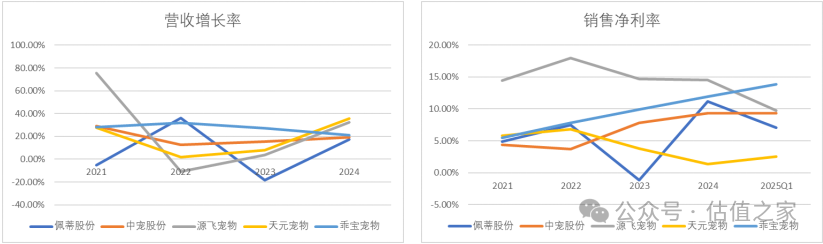
Core Viewpoint - Tianyuan Pet's stock price surged significantly, with a cumulative increase of 66% over three consecutive trading days, attributed to a recent acquisition plan despite the overall market's minimal growth [1][5]. Group 1: Company Performance - Tianyuan Pet's market capitalization rose from 3.893 billion to 5.607 billion, highlighting the stock's strong performance relative to the Shanghai Composite Index's 0.18% increase [1]. - The company's revenue grew from 1.854 billion in 2021 to 2.764 billion in 2024, achieving a compound annual growth rate (CAGR) of 14%, surpassing the industry average growth rate of 7.5% [2]. - However, net profit declined from 107 million in 2021 to 45.96 million in 2024, indicating a trend of increasing revenue without corresponding profit growth [2]. Group 2: Industry Context - The pet economy in China is thriving, with the urban pet consumption market reaching 300.2 billion, reflecting a 7.5% growth compared to 2023, outpacing GDP growth [2]. - Tianyuan Pet's sales net profit margin is below 5%, significantly lower than comparable companies, which typically have margins between 10% and 15% [2]. Group 3: Brand and Competitive Position - The primary challenge for Tianyuan Pet is the lack of a strong proprietary brand, as it mainly operates as an OEM for foreign brands and has limited market influence [4]. - In contrast, competitors like Guibao Pet have established strong proprietary brands, with Guibao's gross margin reaching 42% compared to Tianyuan's 16% [4]. Group 4: Acquisition and Future Prospects - The recent acquisition of Guangzhou Taotong Technology aims to enhance Tianyuan Pet's e-commerce capabilities, leveraging a 70-person live streaming team and digital infrastructure [5]. - Despite the positive market reaction, uncertainties remain regarding the completion of the target company's audit and the integration of teams post-acquisition [5][6].