
潜艇发动机

Search documents
财经观察:造假丑闻频出,“日本制造”被什么绊住脚步?
Huan Qiu Shi Bao· 2026-01-04 22:53
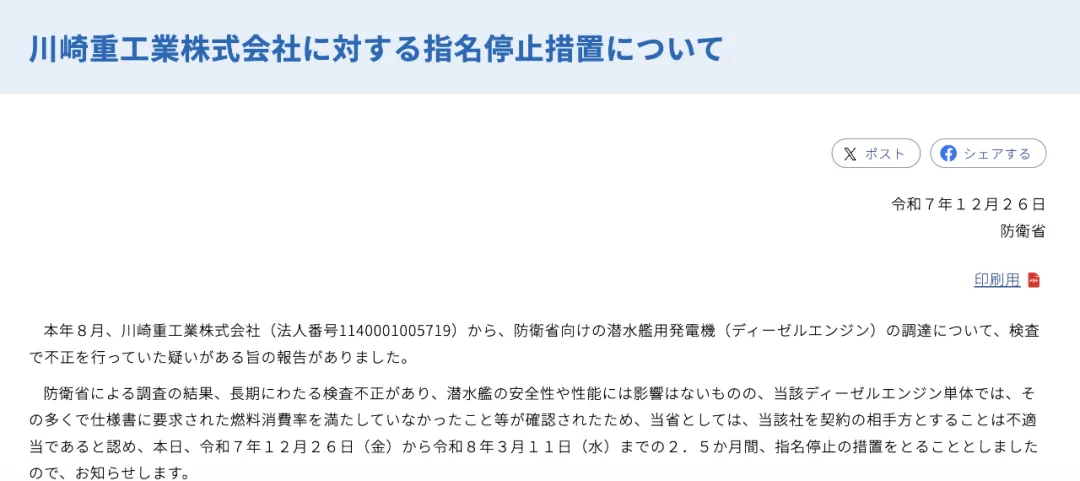
Core Viewpoint - The article highlights the ongoing issues of data falsification in Japanese manufacturing, particularly focusing on Kawasaki Heavy Industries, which has been found to have falsified fuel efficiency data for submarine engines over a span of more than 30 years, raising concerns about the integrity of Japan's manufacturing reputation [1][2][3]. Group 1: Company-Specific Issues - Kawasaki Heavy Industries has been penalized with a two-and-a-half-month "designation suspension" by the Japanese Ministry of Defense, preventing the company from participating in competitive bidding from December 26, 2025, to March 11, 2026 [1]. - The falsification of fuel efficiency data has been ongoing since 1988, affecting 66 engines used in 33 submarines, which has raised questions about the quality control processes within the company [1][2]. - This incident is part of a broader pattern of quality issues within Kawasaki Heavy Industries, including previous scandals related to railway safety and air conditioning equipment [2]. Group 2: Industry-Wide Concerns - The article discusses a series of data falsification incidents across various sectors in Japan, including the automotive and railway industries, indicating a systemic issue rather than isolated cases [2][3]. - The Japanese automotive industry has faced scrutiny, with major manufacturers like Toyota and Honda found to have engaged in improper practices during the certification process for 38 vehicle models [2]. - The railway sector has also been implicated, with multiple companies found to have altered safety data following a serious incident involving a freight train derailment [3]. Group 3: Underlying Causes - Experts attribute the rise in falsification incidents to a fundamental shift in management practices within Japanese companies, moving away from quality-centric approaches to prioritizing profit maximization [4][5]. - The reliance on temporary workers has weakened the commitment to quality, as these employees often lack a sense of belonging and responsibility [5]. - Insufficient investment in research and development has also been identified as a critical factor, as companies have become conservative in their spending post-economic bubble, opting for short-term gains over long-term innovation [5][6]. Group 4: Implications for Trust and Reputation - The frequent scandals are eroding consumer trust in "Made in Japan" products, which were once synonymous with high quality and reliability [6][7]. - The article suggests that the current economic environment has forced companies into a dilemma between maintaining high standards and controlling costs, leading some to resort to deceptive practices [7]. - The Japanese government is beginning to strengthen regulatory oversight in response to these issues, but experts emphasize the need for a cultural shift within organizations to address the root causes of the problem [7].
有理儿有面:日本躬匠表演撕碎日本制造神话
Xin Lang Cai Jing· 2025-12-28 14:15
Core Viewpoint - The scandal involving Kawasaki Heavy Industries has exposed systemic issues in Japan's manufacturing sector, particularly in military and civilian industries, revealing a long history of data manipulation and quality control failures [1] Group 1: Company Issues - Kawasaki Heavy Industries has been found to have falsified performance data for 66 submarine engines supplied to the Japan Maritime Self-Defense Force, with actual endurance capabilities only 70% of the designed values [1] - The company has engaged in fraudulent activities for over 30 years, manipulating key performance indicators such as fuel consumption and output power [1] - The Japanese Ministry of Defense's punishment of a two-and-a-half-month suspension of bidding is seen as ineffective, as there are no related projects during this period, highlighting the lack of accountability [1] Group 2: Industry Implications - The scandal reflects a broader crisis of trust in Japanese manufacturing, with similar incidents occurring in other companies like Kobe Steel and Mitsubishi Materials, indicating a pattern of data falsification [1] - The monopolistic position of Kawasaki Heavy Industries in submarine engine supply has created a regulatory environment where the Ministry of Defense is reluctant to impose severe penalties, leading to a cycle of fraud and minimal consequences [1] - The implications of this scandal extend to Japan's military capabilities, as all 25 active submarines are now considered to be operating with compromised systems, prompting a reassessment of collaborative military operations with the U.S. [1] Group 3: Market and Reputation - The incident has severely damaged Japan's international reputation in military exports, with potential clients now hesitant to engage due to concerns over quality and reliability [1] - The brand value of "Made in Japan" has been tarnished, leading to a significant decline in consumer trust and confidence in Japanese products [1] - The ongoing issues in the manufacturing sector raise concerns about the future of Japan's industrial integrity, emphasizing the need for a robust regulatory framework and a cultural shift towards transparency and accountability [1]
川崎重工丑闻缠身,为何军工订单却“接到手软”?
Xin Lang Cai Jing· 2025-12-28 13:11
Core Viewpoint - The credibility of "Made in Japan" is declining, particularly affecting the defense industry, as evidenced by the recent suspension of Kawasaki Heavy Industries from bidding for two and a half months due to data manipulation in submarine engine tests [1][3]. Group 1: Company Misconduct - Kawasaki Heavy Industries admitted to falsifying fuel efficiency data for submarine engines supplied to the Japan Maritime Self-Defense Force (JMSDF), with the fraudulent activity occurring from 1988 to 2021, affecting 66 engines used in 33 submarines [8]. - The Japanese Ministry of Defense described the incident as a "long-term, systematic fraud," although it stated that there was no impact on operational actions or safety [8]. - The company’s president, Yasuhiko Hashimoto, expressed a serious commitment to addressing the issue and restoring trust, indicating that disciplinary actions against involved employees are being considered [8]. Group 2: Financial and Contractual Implications - Kawasaki Heavy Industries holds significant contracts with the Japanese Ministry of Defense, with a reported contract amount of 638.3 billion yen (approximately 4.1 billion USD) for the fiscal year 2024, marking a 60% increase from the previous year [14]. - The company is projected to see its defense business sales rise to between 500 billion and 700 billion yen by fiscal year 2030, with optimistic forecasts suggesting sales could exceed 700 billion yen [17]. Group 3: Broader Industry Context - The recent scandals involving Kawasaki Heavy Industries are not isolated, as similar fraudulent activities have been reported involving other companies like Mitsubishi Heavy Industries and Japan Marine United Corporation, indicating a systemic issue within the defense procurement process [14][21]. - The Japanese defense sector is experiencing increased scrutiny and calls for regulatory reforms, yet Kawasaki Heavy Industries continues to thrive despite its scandals, raising questions about the effectiveness of the penalties imposed [19][21].

日本军工巨头造假
Xin Lang Cai Jing· 2025-12-28 09:12
Core Points - Kawasaki Heavy Industries has been found to have falsified fuel efficiency data for submarine engines used by the Japan Maritime Self-Defense Force (JMSDF) for over 30 years, leading to a suspension from bidding on contracts for two and a half months [1] - The fraudulent activities, which involved 66 engines for 33 submarines, occurred from 1988 to 2021 and were described as a "long-term, systematic fraud" by the Ministry of Defense [1] - The company has a significant contract amount of 638.3 billion yen (approximately 4.1 billion USD) for the fiscal year 2024, ranking second in defense procurement [1] Company Summary - Kawasaki Heavy Industries has been implicated in falsifying data related to submarine engine fuel efficiency, which has raised serious concerns about its integrity in the defense sector [1] - The company has also been accused of inflating budgets and has been under scrutiny for potentially illegal financial practices for about 40 years [1] - The president of Kawasaki Heavy Industries publicly apologized for the violations and expressed a commitment to restoring public trust through preventive measures [1] Industry Summary - The Japan Maritime Self-Defense Force operates 25 submarines, all equipped with engines produced by Kawasaki Heavy Industries, highlighting the company's central role in Japan's military capabilities [1] - The Ministry of Defense has taken disciplinary actions against 11 JMSDF personnel for accepting gifts from Kawasaki Heavy Industries, indicating a broader issue of ethical conduct within the defense procurement process [1] - The Ministry of Defense is considering requiring Kawasaki Heavy Industries to return funds equivalent to the breach of contract amounts, which could have significant financial implications for the company [1]
日本制造业巨头川崎重工被指篡改潜艇发动机数据
Xin Lang Cai Jing· 2025-12-27 00:10
Core Viewpoint - The Japanese Ministry of Defense announced a 2.5-month ban on Kawasaki Heavy Industries from participating in tenders due to the manipulation of marine engine test data [1] Group 1: Company Actions - Kawasaki Heavy Industries acknowledged in a supplementary report that there were also alterations in fuel efficiency data for submarine engines manufactured for the Japan Maritime Self-Defense Force [1]