
新军国主义

Search documents
朝中社:日本“新军国主义”迅猛抬头 威胁世界和平与稳定
Xin Lang Cai Jing· 2026-01-11 08:59
Core Viewpoint - The article argues that Japan's current extreme right-wing government is openly challenging historical trends and poses significant risks to regional and global security, with "new militarism" leading Japan towards potential destruction [1][2] Summary by Sections Japan's Political Shift - The current extreme right-wing government in Japan is attempting to revise the "National Security Strategy" and other security documents within the year, indicating a shift away from its identity as a "peaceful nation" towards a militaristic and aggressive stance [1] Historical Context and Implications - The article suggests that Japan is trying to deny its past atrocities and rapidly rearm to rebuild its former empire, which is a clear manifestation of "new militarism" [1] Government Actions and Developments - Since its establishment, the current regime has been striving to achieve constitutional amendments that previous administrations failed to implement, reflecting the long-standing ambitions of extreme right-wing political forces [1] Military Expansion - Japan is actively developing space combat capabilities and constructing hundreds of munitions depots across the country, raising concerns about a potential return to militarism [1] Media and Public Sentiment - Japanese media has begun to express concerns that the country may not be able to avoid a return to the fascist paths of its militaristic past [1] Conclusion on Militarism - The article concludes that "new militarism" will ultimately lead to Japan's destruction, reinforcing the historical lesson that militarism does not result in a "strong Japan," but rather in its demise [2]
朝中社批日本新军国主义
Xin Lang Cai Jing· 2026-01-11 02:47
Core Viewpoint - The article argues that Japan's new militarism will lead to its complete destruction, highlighting the risks it poses to regional and global security [1] Group 1: Japan's Militarization - Japan's current extreme right-wing government is openly challenging historical trends and increasing risks to security [1] - The government plans to revise the "National Security Strategy" and other security documents within the year, indicating a shift towards militarization [1] - There is a significant effort to shed Japan's image as a "peaceful nation" and transform it into a militaristic and aggressive state [1] Group 2: Historical Context and Implications - The article claims that Japan is attempting to deny its past atrocities and rapidly rearm to rebuild its former empire, which is a clear manifestation of "new militarism" [1] - The current regime has been striving to achieve constitutional amendments that previous administrations failed to implement, reflecting the long-standing ambitions of extreme right-wing political forces [1] - The development of space combat capabilities and the establishment of hundreds of munitions depots across Japan are also highlighted as part of this militarization trend [1] Group 3: Media and Public Perception - Japanese media has expressed concerns about the potential for Japan to revert to a fascist path reminiscent of its militaristic past [1] - The article emphasizes that the characteristics of Japan's new militarism include hatred towards other nations, revenge-seeking, and a desire for conquest, which began to rise during the Abe administration and has intensified [1] - It concludes that new militarism will ultimately lead to Japan's demise, as history has shown that militarism does not result in a "strong Japan," but rather in its destruction [1]
朝中社评论:新军国主义只会给日本带来彻底毁灭
Xin Hua She· 2026-01-11 02:10
Core Viewpoint - The article argues that Japan's new militarism will lead to its complete destruction, as it challenges historical and contemporary trends towards peace and stability [1] Group 1: Japan's Political Shift - The current extreme right-wing government in Japan is openly challenging historical trends, increasing risks to regional and global security [1] - Japan plans to revise its National Security Strategy and other security documents within the year, indicating a shift away from its identity as a "peaceful nation" towards a militaristic state [1] Group 2: Historical Context and Implications - The article suggests that Japan is attempting to deny its past atrocities and rapidly rearm to rebuild its former empire, which is a clear manifestation of "new militarism" [1] - The current regime has been striving to achieve constitutional amendments that previous governments failed to implement, reflecting the long-standing ambitions of extreme right-wing political forces [1] Group 3: Military Developments - Japan is actively developing space combat capabilities and constructing hundreds of munitions depots across its islands, raising concerns about a potential return to militarism [1] - Japanese media has expressed concerns that the country may not be able to avoid a return to fascist paths reminiscent of its militaristic past [1] Group 4: Consequences of New Militarism - The article characterizes Japan's new militarism as driven by hatred, revenge, and a desire for conquest, which began to rise during the Abe administration and has intensified [1] - It emphasizes that new militarism will ultimately lead to Japan's destruction, asserting that the end of militarism is not a "strong Japan," but rather a "destroyed Japan" [1]
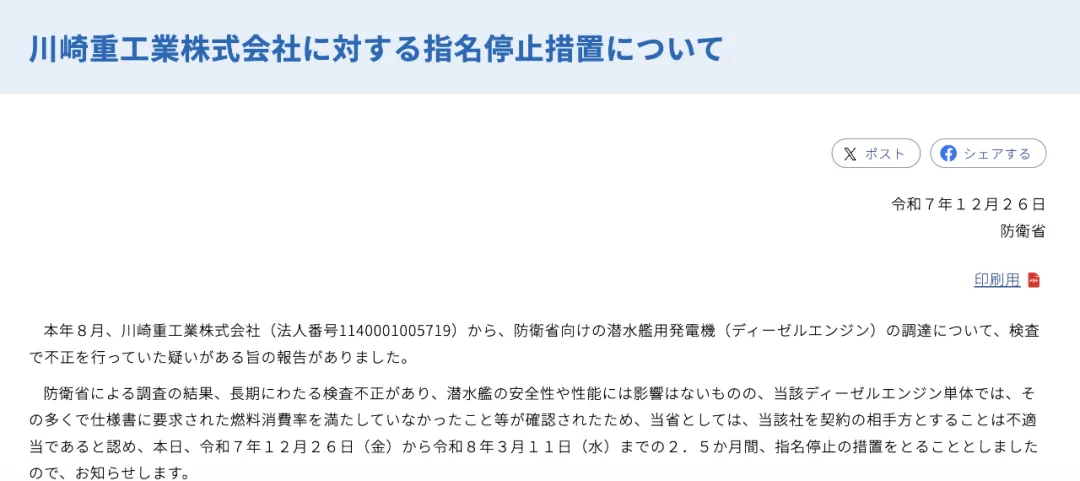
川崎重工丑闻缠身,为何军工订单却“接到手软”?
Xin Lang Cai Jing· 2025-12-28 13:11
Core Viewpoint - The credibility of "Made in Japan" is declining, particularly affecting the defense industry, as evidenced by the recent suspension of Kawasaki Heavy Industries from bidding for two and a half months due to data manipulation in submarine engine tests [1][3]. Group 1: Company Misconduct - Kawasaki Heavy Industries admitted to falsifying fuel efficiency data for submarine engines supplied to the Japan Maritime Self-Defense Force (JMSDF), with the fraudulent activity occurring from 1988 to 2021, affecting 66 engines used in 33 submarines [8]. - The Japanese Ministry of Defense described the incident as a "long-term, systematic fraud," although it stated that there was no impact on operational actions or safety [8]. - The company’s president, Yasuhiko Hashimoto, expressed a serious commitment to addressing the issue and restoring trust, indicating that disciplinary actions against involved employees are being considered [8]. Group 2: Financial and Contractual Implications - Kawasaki Heavy Industries holds significant contracts with the Japanese Ministry of Defense, with a reported contract amount of 638.3 billion yen (approximately 4.1 billion USD) for the fiscal year 2024, marking a 60% increase from the previous year [14]. - The company is projected to see its defense business sales rise to between 500 billion and 700 billion yen by fiscal year 2030, with optimistic forecasts suggesting sales could exceed 700 billion yen [17]. Group 3: Broader Industry Context - The recent scandals involving Kawasaki Heavy Industries are not isolated, as similar fraudulent activities have been reported involving other companies like Mitsubishi Heavy Industries and Japan Marine United Corporation, indicating a systemic issue within the defense procurement process [14][21]. - The Japanese defense sector is experiencing increased scrutiny and calls for regulatory reforms, yet Kawasaki Heavy Industries continues to thrive despite its scandals, raising questions about the effectiveness of the penalties imposed [19][21].

“阴魂不散、借尸还魂!”人民日报起底日本军国主义
Xin Lang Cai Jing· 2025-12-27 16:36
Core Viewpoint - The article discusses the resurgence of Japanese militarism, emphasizing its historical roots, characteristics, and the potential threats it poses to regional and global peace [3][15][23]. Group 1: Historical Context and Evolution - Japanese militarism has been a driving force behind the country's foreign aggression and expansion, serving as the ideological foundation for post-war right-wing movements [5]. - The ideology of Japanese militarism has evolved, with a gradual erosion of democratic principles and an increase in militaristic rhetoric, leading to a "new militarism" that threatens international order [15][22]. Group 2: Characteristics of Japanese Militarism - The militaristic ideology is characterized by the sanctification of aggressive wars, where the dead are glorified, and citizens are manipulated into becoming willing participants in warfare [7]. - There is a promotion of racial superiority, with narratives that depict the Japanese as a superior race entitled to dominate others, often justifying invasions as liberation efforts [8]. - A disregard for human life is evident, with historical precedents showing that Japanese leaders have initiated conflicts under the guise of national interest, echoing past justifications for aggression [9][13]. Group 3: Modern Implications and Threats - The concept of "existential crisis" is frequently used in Japan to justify military actions, reflecting a historical pattern of framing aggression as self-defense [11][12]. - The rise of "new militarism" is marked by a revival of militaristic symbols and ideologies, such as visits to Yasukuni Shrine by political leaders, which serve to legitimize past war crimes and promote a militaristic agenda [17][19]. - This resurgence poses significant risks to regional stability and international relations, as it undermines peace efforts and fosters a climate of tension in Asia [23][26].
环球时报社评:军费狂飙,日本“新军国主义”加速显形
Xin Lang Cai Jing· 2025-12-27 00:11
Core Viewpoint - Japan's defense budget for fiscal year 2026 has been approved at a record high of 9.0353 trillion yen, marking the 14th consecutive year of military spending increases, reflecting a shift towards a more aggressive military posture [1][2]. Group 1: Defense Budget and Military Strategy - The approved defense budget is only the initial figure, with total defense spending expected to reach approximately 11 trillion yen by the end of 2025, accounting for 2% of GDP [1]. - Japan is moving away from its post-war pacifism, undermining the "self-defense" principle and Article 9 of its constitution, transitioning towards a "capable military nation" [1][2]. - The budget emphasizes offensive capabilities, focusing on long-range strike capabilities, enhancement of air and naval forces, and deployment in the southwestern islands [1][2]. Group 2: Shift in Military Doctrine - Japan's military strategy is shifting from passive defense to proactive deterrence, enabling preemptive military actions [2]. - The deployment of long-range missiles and military assets in the southwestern islands indicates a fundamental change in the nature of Japan's Self-Defense Forces [2]. - Japan's ambitions in space and cyber capabilities are expanding, with increased investment in space and plans to establish an "Aerospace Self-Defense Force" [2]. Group 3: Historical Context and International Implications - Japan's current military expansion contradicts post-war commitments and legal frameworks aimed at preventing militarism, as outlined in documents like the Potsdam Declaration [3]. - The rise in military spending and offensive weaponry raises concerns about Japan's international reputation and its potential to create security anxieties in the region [3]. - The narrative of "China threat" propagated by Japanese right-wing forces is reminiscent of pre-war militaristic rhetoric, indicating a strategic shift towards militarism [3]. Group 4: Regional Stability Concerns - Japan's militaristic path poses risks not only to its own future but also to peace and stability in East Asia [4]. - The choice facing Japan is whether to return to peaceful development or continue challenging regional order through militarization [4].
社评:军费狂飙,日本“新军国主义”加速显形
Xin Lang Cai Jing· 2025-12-26 16:58
Core Viewpoint - Japan's cabinet has approved a record defense budget of 9.0353 trillion yen for the fiscal year 2026, marking the 14th consecutive year of military spending increases, reflecting a shift towards a more aggressive military posture [1][2]. Group 1: Defense Budget and Military Policy - The approved defense budget is only the initial figure, with actual defense spending expected to reach approximately 11 trillion yen by the end of 2025, accounting for 2% of GDP [1]. - The budget indicates a systematic overturning of Japan's "self-defense" principle and a move towards becoming a "capable military nation," with a focus on offensive capabilities, including long-range strike capabilities and enhanced air and naval forces [1][2]. Group 2: Strategic Shift and Military Ambitions - Japan is transitioning from a passive defense strategy to an active deterrence strategy, with the development of "counterattack capabilities" and the deployment of long-range missiles in strategic locations [2]. - The budget includes increased investments in space and cyber capabilities, with plans to establish an "Aerospace Self-Defense Force" and develop "aerospace aircraft carriers," raising concerns about a new arms race in space [2]. Group 3: Historical Context and International Implications - Japan's military expansion contradicts post-World War II commitments to peace, as outlined in documents like the Potsdam Declaration and Article 9 of the Peace Constitution, which mandates the renunciation of war [3]. - The aggressive military policy is seen as a result of right-wing forces in Japan, which have been promoting narratives of external threats to justify military buildup, reminiscent of pre-war militarism [3][4]. Group 4: Regional Stability Concerns - Japan's current military trajectory poses risks not only to its own future but also to peace and stability in East Asia, raising questions about its commitment to peaceful development versus militarization [4].
人民日报寰宇平:警惕日本军国主义阴魂不散
Ren Min Ri Bao· 2025-12-24 23:57
Core Viewpoint - The article discusses the resurgence of militaristic rhetoric in Japan, particularly through the statements of Prime Minister Kishi Nobuo regarding Taiwan, which are seen as a reflection of Japan's unresolved militaristic past and a challenge to international order [1][9][16]. Group 1: Historical Context - Japan's militaristic expansion has historically been justified through the notion of "crisis," as seen in events leading to wars such as the First Sino-Japanese War and the Pacific War [3][4]. - The ideology of Japanese militarism is rooted in concepts like "Emperor-centered nationalism" and "Bushido," which have been manipulated to promote a sense of superiority and justification for aggression [4][5]. Group 2: Current Political Climate - Recent statements by Japanese leaders, particularly regarding Taiwan, indicate a shift towards militaristic policies, with Kishi Nobuo suggesting that a crisis in Taiwan could justify Japan's collective self-defense [1][12]. - The Japanese government is increasing its defense budget significantly, with plans to raise it to a record approximately 11 trillion yen, indicating a move towards a more aggressive military posture [12][17]. Group 3: Cultural and Educational Implications - There is a push within Japan to revise historical narratives in education, downplaying or denying events like the Nanjing Massacre, which reflects a broader trend of historical revisionism [13][24]. - The revival of militaristic values in education, such as the potential reintroduction of the "Military Code," signals a return to pre-war ideologies that glorify sacrifice for the state [14][11]. Group 4: International Relations and Reactions - Japan's recent militaristic rhetoric and actions have drawn criticism from neighboring countries and the international community, raising concerns about regional stability and Japan's commitment to post-war agreements [16][22]. - The Chinese government has formally protested against Japan's militaristic statements, emphasizing the historical context of Japan's actions in Taiwan and the need for accountability [22][20]. Group 5: Future Outlook - The article warns that if Japan continues down this path of militarism, it could lead to significant geopolitical tensions and undermine the post-war international order established after World War II [21][24]. - The potential for a resurgence of militarism in Japan poses risks not only to regional peace but also to Japan's own future stability and international relations [17][19].
警惕日本军国主义阴魂不散(寰宇平)
Ren Min Ri Bao· 2025-12-24 22:59
Core Viewpoint - The article discusses the resurgence of militarism in Japan, highlighting the dangerous implications of recent political statements and actions by Japanese leaders, particularly regarding Taiwan and historical revisionism related to Japan's wartime actions [1][9][16]. Group 1: Historical Context and Military Resurgence - Japan's militaristic rhetoric has resurfaced, with Prime Minister Kishi Nobuo linking Taiwan's situation to Japan's collective self-defense, marking a significant shift in Japan's post-war stance [1][9]. - Historical patterns show that Japan has often framed its military actions as responses to perceived threats, a tactic that has been used since the late 19th century to justify invasions [3][4]. - The ideology of Japanese militarism is deeply rooted in cultural narratives that promote national superiority and the sanctification of war, which have been perpetuated through education and political discourse [5][6][7]. Group 2: Political and Military Developments - The Japanese government has increased defense spending significantly, with a budget proposal for 2025 that includes an additional 1.1 trillion yen, raising total defense expenditures to a record 11 trillion yen [12]. - There is a push within Japan to redefine the Self-Defense Forces as a national defense army, moving away from the post-war pacifist constitution [12][14]. - The political climate in Japan is shifting towards a more aggressive military posture, with calls for a departure from the "peace constitution" and an increase in military capabilities [11][12]. Group 3: Cultural and Educational Implications - The rise of "new militarism" in Japan is accompanied by efforts to revise historical narratives in education, downplaying or denying wartime atrocities such as the Nanjing Massacre [13][20]. - There is a concerted effort by right-wing factions to instill a sense of nationalism that glorifies Japan's military past, which poses risks for future generations [11][13]. - The use of historical revisionism in textbooks reflects a broader trend of denying Japan's wartime responsibilities, which could lead to increased tensions with neighboring countries [13][20]. Group 4: International Relations and Regional Stability - Japan's recent military rhetoric and actions have strained relations with China and South Korea, raising concerns about regional stability and the potential for conflict [16][22]. - The international community is increasingly wary of Japan's militaristic resurgence, with calls for accountability regarding its historical actions and commitments to peace [22][24]. - Japan's attempts to redefine its military role and historical narrative could undermine established international norms and provoke responses from other nations [21][24].
人民日报寰宇平文章:警惕日本军国主义阴魂不散
Xin Hua She· 2025-12-24 16:05
Core Viewpoint - The article emphasizes the persistent threat of Japanese militarism, highlighting recent actions and statements by Japanese officials that suggest a revival of militaristic ideologies and a disregard for historical accountability [1][10][18]. Group 1: Historical Context and Current Developments - The article discusses the historical context of Japanese militarism, tracing its roots back to various conflicts and the ideologies that justified Japan's expansionist actions [3][4][5]. - Recent statements by Japanese Prime Minister Kishi Nobuo linking Taiwan's situation to Japan's self-defense rights are seen as a provocative shift towards militarism, marking a significant departure from post-war pacifism [1][10][13]. Group 2: Ideological Underpinnings - The article outlines how the militaristic ideology in Japan is intertwined with concepts like "Kōkashikan" (the belief in Japan's divine right to rule) and the glorification of the samurai spirit, which have been manipulated to support militaristic agendas [4][5][6]. - The notion of "self-defense" has been historically used to justify aggressive military actions, reflecting a pattern where Japan portrays itself as a victim to rally domestic support for expansionist policies [3][5][6]. Group 3: Political and Military Implications - The article highlights the increasing military budget, which has reached a record of approximately 11 trillion yen, indicating a shift towards a more aggressive military posture [13]. - The push for revising military terminology and the potential elevation of the Self-Defense Forces to a formal military status are seen as steps towards normalizing militarism in Japan [13][14]. Group 4: Cultural and Educational Aspects - The article points out the ongoing efforts to revise historical narratives in educational materials, downplaying or denying Japan's wartime atrocities, which is part of a broader trend of historical revisionism [14][15]. - The influence of right-wing groups in shaping public perception and education about Japan's militaristic past is noted, with implications for future generations [12][14]. Group 5: International Relations and Regional Stability - The article discusses the implications of Japan's militaristic resurgence on regional stability, particularly in relation to China and Korea, where Japan's historical actions continue to evoke strong reactions [17][20]. - The potential for Japan's militarism to disrupt the post-war international order and provoke conflicts is emphasized, with calls for the international community to remain vigilant against these trends [21][22].