热缩套管

Search documents
沃尔核材:一根铜线牵动算力浪潮!
市值风云· 2026-03-17 10:11
Core Viewpoint - The article highlights the impressive growth of沃尔核材 (002130.SZ), showcasing its strong revenue and profit increases, driven by advancements in high-speed communication cables and a solid market position in the radiation-modified materials sector [3][5]. Group 1: Financial Performance - In 2025, the company achieved a total revenue of 8.45 billion, representing a year-on-year growth of 22% [6]. - The net profit attributable to shareholders reached 1.135 billion, reflecting a significant increase of 33.95% compared to the previous year [5][6]. - The operating profit was reported at 1.415 billion, marking a 29.98% increase year-on-year [6]. Group 2: Market Position and Product Development - The company has established itself as a leader in the domestic radiation-modified materials market, particularly in heat shrink tubing, with a long-standing market share at the forefront of the industry [4]. -沃尔核材 has successfully developed and mass-produced high-speed communication cables, breaking the monopoly of international giants in this segment [7]. - The electronic communication business generated 2.666 billion in revenue during the first half of 2025, showing a year-on-year growth of 32%, becoming a key driver of the company's overall performance [7]. Group 3: Strategic Investments and Future Outlook - The company is in a phase of business expansion, with capital expenditures reaching 740 million in the first three quarters of 2025, the highest in its history [8]. - Despite a slight cash flow deficit of 115 million, these investments are aimed at meeting the surging demand for high-speed communication cables and positioning the company for future market share gains [9].



同为世界行业老大又同时上市,涨幅天壤之别,背后藏着什么秘密?
Sou Hu Cai Jing· 2026-02-14 00:51
Group 1 - The article highlights a contrasting performance between two companies:沃尔核材, which experienced a modest increase of 2.94% on its first trading day, and海致科技, which saw a dramatic surge of 242% despite continuous losses [1][2][3]. - 沃尔核材 holds a significant market share of 20.6% globally and 58.5% domestically, with a net profit of 822 million in the first three quarters [1][2]. - 海致科技's IPO was marked by an excessive subscription rate of 5065 times and a low winning rate of 0.06%, indicating a misjudgment in pricing by the company and underwriters [4][5]. Group 2 - The modest increase of 沃尔核材 reflects a well-calibrated pricing strategy, with an issue price of 12.2 HKD that aligns with market expectations, allowing the company to secure necessary funds [6][7]. - In contrast, 海致科技's pricing misstep resulted in a significant loss of potential capital, as the difference between the issue price of 27 HKD and the closing price of 92 HKD should have benefited the company [4][8]. - The article emphasizes that the true winners in the market are those who understand their value and price accordingly, as demonstrated by 沃尔核材's successful IPO strategy [8][10]. Group 3 - The market's reaction to 海致科技's story-driven appeal, despite its financial instability, illustrates a broader trend where speculative investments overshadow fundamental value [9][10]. - The article discusses the dichotomy in investor behavior, where rational assessments of companies do not always translate into buying decisions, leading to a preference for high-risk, high-reward stocks like 海致科技 [15][16]. - Ultimately, the article concludes that the real lesson from this IPO event is that a company like 沃尔核材, which focuses on stable growth and accurate pricing, is more likely to succeed in the long run compared to a company like 海致科技, which relies on market hype [17].

行业聚焦:全球热缩制品市场头部企业份额调研(附Top10 厂商名单)
QYResearch· 2025-12-15 02:43
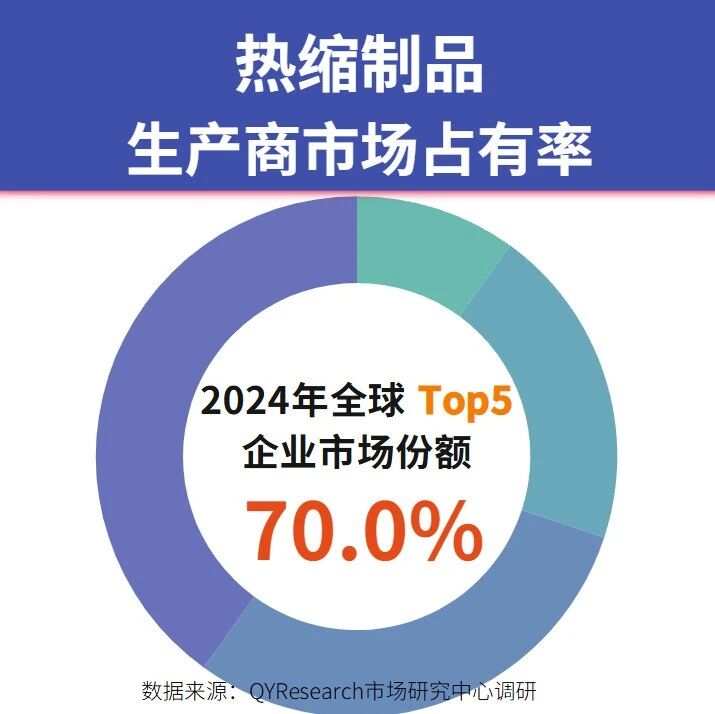
Core Viewpoint - The heat shrink products market is expected to grow significantly, driven by the increasing demand in emerging sectors such as renewable energy, electric vehicles, and 5G communication, with a projected market size of $2.22 billion by 2031 and a CAGR of 4.9% from 2025 to 2031 [4][15]. Market Overview - Heat shrink products are essential industrial and electronic applications, providing insulation, protection, waterproofing, corrosion resistance, stress relief, and mechanical reinforcement [2]. - The global market for heat shrink products is dominated by major manufacturers, with the top five companies holding approximately 70% market share in 2024 [10]. Key Manufacturers - TE Connectivity is a leading provider of electronic connection and sensing solutions, with a focus on heat shrink technology across various sectors [10]. - Shenzhen Woori Material Co., Ltd. is a prominent player in China's heat shrink materials industry, offering a range of products for electronics, power cables, and automotive applications [11]. - Sumitomo Electric Industries, established in 1897, is a global enterprise with a strong presence in automotive and electronic cable sectors, producing various heat shrink products [12]. - DSG-Canusa specializes in heat shrink and cold shrink solutions, providing protective solutions for electrical insulation and industrial applications [14]. Market Drivers - The heat shrink products industry is experiencing robust growth due to rapid expansion in new energy, electric vehicles, and 5G communication sectors, which require high-performance insulation and protective materials [15]. - Continuous innovation in material technology, proactive environmental policies, and global supply chain upgrades are key factors supporting long-term industry growth [15]. Market Challenges - The industry faces challenges such as intense competition, fluctuations in raw material costs, and supply chain instability, which could hinder market expansion [16]. - Increasing technical barriers may lead to higher R&D investments, while intellectual property disputes and changes in the international trade environment pose additional uncertainties [16]. Downstream Demand Trends - There is a trend towards diversification and high-end requirements in downstream demand, particularly in electronics, automotive, and energy sectors, emphasizing miniaturization, lightweight design, and high reliability [17]. - The shift towards sustainable development and environmental consciousness is driving the industry towards greener product transformations, creating high-value opportunities and indicating steady future demand growth [17].