
特高压直流工程

Search documents
114.96%!2025成渝地区双城经济圈重大项目建设交“答卷”
Xin Lang Cai Jing· 2026-01-25 15:08
Core Viewpoint - The construction of the Chengdu-Chongqing economic circle is progressing well, with 181 major projects completing a total investment of 296.144 billion yuan, achieving an annual investment completion rate of 114.96% [2] Group 1: Infrastructure Network - Modern infrastructure projects completed an investment of 136.586 billion yuan, with an annual investment completion rate of 104.77% [3] - Key transportation projects include the successful completion of the Yuwan High-speed Railway tunnel and the opening of the highway from Hechuan to Bicheng to Jiangjin, significantly improving travel efficiency [3] - Energy and water resource projects have also advanced, including the completion of the Hami-Chongqing ±800 kV UHVDC project and the full water supply of the Western Water Resource Allocation Project, benefiting nearly ten million people [3] Group 2: Modern Industrial System - Modern industrial projects achieved an investment of 62.624 billion yuan, with an annual investment completion rate of 143.68% [4] - Significant advancements in advanced manufacturing include the trial operation of a 6-inch IGBT power semiconductor production line and the completion of the main plant for the fiberglass and high-performance composite materials base [4] - The new energy sector is thriving, with the completion of a lightweight chassis for smart connected vehicles and the acceleration of lithium battery separator production, filling a regional capacity gap [4] Group 3: Technological Innovation and Open Cooperation - Investment in technology innovation and open projects reached 17.271 billion yuan, with an annual investment completion rate of 125.43% [5] - The construction of innovation platforms is progressing, including the establishment of the Zhangjiang Laboratory in Chongqing and advancements in neutron technology for scientific applications [5] - The Western Land-Sea New Corridor is being developed, with key logistics nodes like the Chongqing South Comprehensive Logistics Park taking shape [5] Group 4: Ecology, Consumption, and Livelihood - Projects focused on ecology, consumption, and livelihood completed an investment of 79.663 billion yuan, with an annual investment completion rate of 114.01% [6] - Ecological restoration projects, such as the Longxi River ecological restoration, have achieved stable water quality standards [7] - The transformation of the Jiefangbei-Chaotianmen area has enhanced its appeal as an international consumption destination, while healthcare facilities are being improved to better serve the community [7]


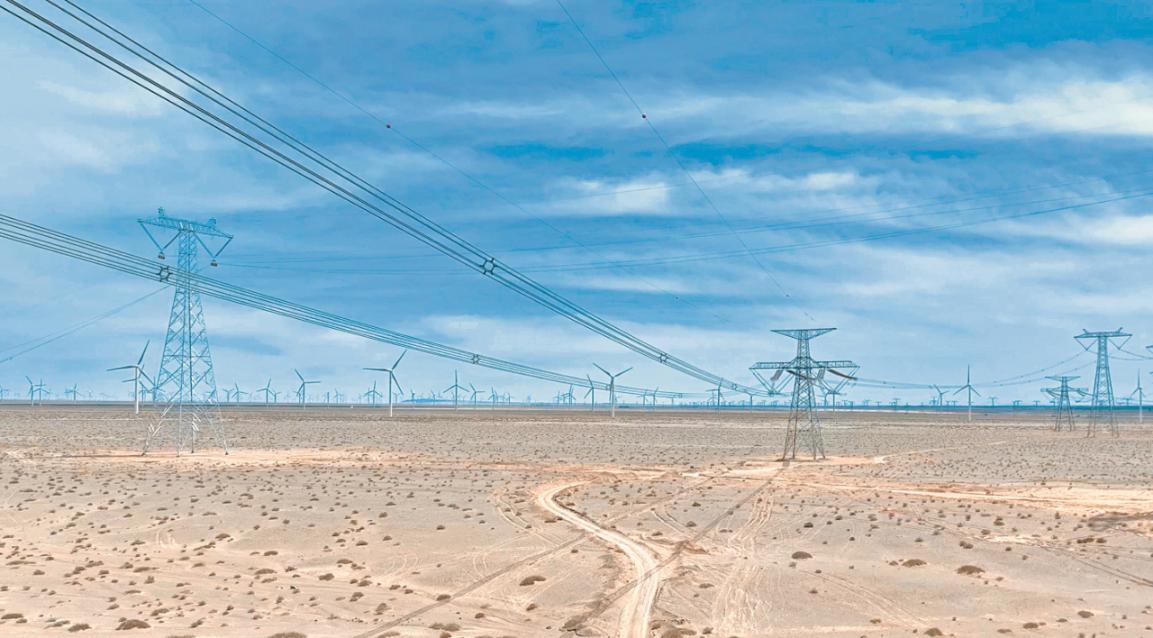
西北电网2025年跨区直流及750千伏工程投产规模创历史新高
Zhong Guo Neng Yuan Wang· 2026-01-06 08:59
Core Insights - The Northwest Power Grid is set to achieve a record scale of cross-regional direct current and 750 kV projects by 2025, with the addition of 4 cross-regional direct current projects and 35 new 750 kV projects, enhancing national energy security and supporting high-quality regional economic development [1][3] Group 1: Project Developments - By 2025, the Northwest Power Grid's direct current transmission capacity will exceed 95 million kilowatts, an increase of 24.6 million kilowatts compared to 2024, surpassing the total increase during the "13th Five-Year Plan" period [1] - Key 750 kV projects, including the Shaanxi Xiazhou to Gansu Qingyang North and Xinjiang Huan Tarim Basin ring network, will further optimize the main grid structure, enhancing both power transmission capacity and supply reliability [3] Group 2: Infrastructure Expansion - In 2025, the Northwest Power Grid will see the construction of 15 new substations, 36 main transformers, and 57 new lines, marking a historic high in scale [3] - The total scale of the Northwest Power Grid is expected to grow by over 50% compared to the end of the "13th Five-Year Plan," reinforcing its role in power security and cross-regional resource optimization [3]
城市24小时 | 这些省份,为何都在“组CP”?
Mei Ri Jing Ji Xin Wen· 2025-12-31 02:01
Group 1: Project Developments - The construction of the back-to-back interconnection projects in Yuchuan-Guizhou, Hunan-Guangdong, and Fujian-Jiangxi has commenced, enhancing power supply stability and resource optimization in these regions [1][3] - The Hunan-Guangdong project, which started on December 27, aims to facilitate flexible interconnection between the State Grid and the Southern Grid, improving power supply stability in Hunan [1] - The Yuchuan-Guizhou project, initiated on December 26, will strengthen interconnectivity between the State Grid and Southern Grid, benefiting both Chongqing and Guizhou [1] - The Fujian-Jiangxi project, which began on December 25, will establish Jiangxi's first flexible DC back-to-back converter station, creating a high-speed interconnection channel for the two provinces [1] Group 2: Technical Insights - The back-to-back interconnection project involves a converter station that connects asynchronously operating power grids through an "AC-DC-AC" conversion process, allowing for safe and efficient power transfer [2] - This technology acts as a high-efficiency "power converter" for two regional power grids, enabling bidirectional power exchange [2] Group 3: Investment and Infrastructure - A total investment of 24.4 billion yuan (approximately 3.4 billion USD) has been approved for five back-to-back interconnection projects, which will include the construction of five converter stations with a capacity of 3 million kilowatts each and a total line length of 1,227 kilometers [3] - The projects include the Yuchuan-Guizhou and Hunan-Guangdong projects led by the State Grid, while the Hunan-Guizhou project is led by the Southern Grid [3] Group 4: Market Implications - The acceleration of building a unified national electricity market is aimed at facilitating cross-province electricity trading and optimizing resource allocation [4] - The completion of these interconnection projects is expected to significantly enhance regional power support capabilities and provide a solid physical foundation for regular cross-grid electricity trading [4]

蒙西到京津冀特高压工程:每年可向河北输送电量超360亿千瓦时
Yang Shi Wang· 2025-12-30 17:03
Core Viewpoint - The construction of the ±800 kV UHVDC project from Western Inner Mongolia to Beijing-Tianjin-Hebei has officially commenced, marking the first transmission channel for the "Shagora" renewable energy base in Inner Mongolia [1] Group 1 - The project is significant as it represents the first high-voltage direct current (HVDC) transmission line from Inner Mongolia, aimed at facilitating the delivery of renewable energy [1] - This initiative is part of a broader strategy to enhance energy transmission capabilities and support the integration of renewable energy sources into the national grid [1]

国家能源局:前8个月我国能源重点项目完成投资1.97万亿元
Xin Hua Cai Jing· 2025-10-31 13:58
Core Insights - National energy investment in China has shown rapid growth, with key projects completing investments of 1.97 trillion yuan in the first eight months of the year, representing an 18.2% year-on-year increase [1] Group 1: Investment Growth Characteristics - Nuclear power, power grids, new energy storage, and coal power have been significant drivers of investment growth in energy projects [1] - Wind power, modern coal chemical industry, oil and gas storage facilities, charging infrastructure, and hydrogen energy investments have seen rapid increases, with wind power investment growing over 40% year-on-year [2] - Solar power generation, integrated energy systems, oil and gas exploration, and pumped storage investments have steadily increased, with solar power project investments rising by 17.5% year-on-year [3] Group 2: Regional Investment Highlights - Six provinces (Shandong, Jiangsu, Guangdong, Xinjiang, Yunnan, Inner Mongolia) each completed investments exceeding 100 billion yuan in the first eight months [1] - Significant investment in wind power projects has been noted in regions such as Xinjiang, Hebei, Guangxi, Shandong, and Hunan [2] - Major oil and gas projects are progressing in the Bohai Sea and Jianghan shale gas fields, with proven reserves of 165 billion cubic meters [3]