
琉璃阁

Search documents
琉璃阁旧纹承新韵
Xin Lang Cai Jing· 2026-02-08 08:13
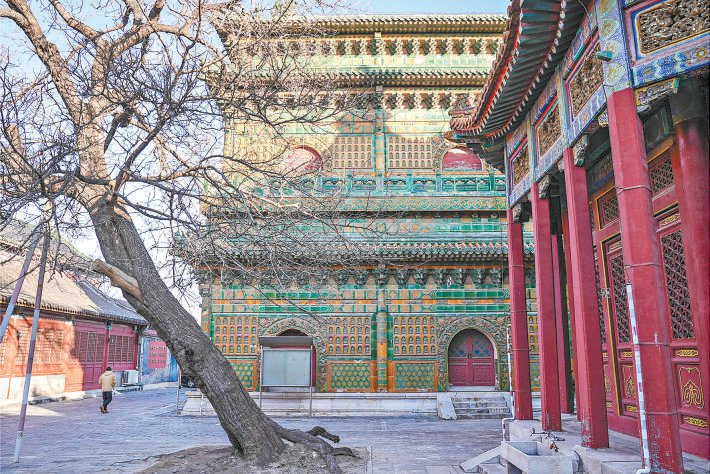
Core Viewpoint - The recent relocation and handover ceremony of the Liuli Pavilion in Beihai Park has garnered significant attention, with public anticipation for the future opening of this historical site [2]. Historical Significance - The Liuli Pavilion, located within the Xitian Fan Jing architectural complex in Beihai Park, is a rare example of Qing Dynasty official glazed architecture, originally built in the 24th year of the Qianlong reign (1759) [2][3]. - There are two main theories regarding the construction date of the Liuli Pavilion: one states it was built in 1759, replacing a previously burned pagoda, while the other suggests its origins date back to 1755, referring to the initial pagoda built at that site [2][3]. Architectural Details - The Liuli Pavilion is recognized as one of China's three major beamless glazed buildings, constructed entirely from brick and stone, featuring a unique aesthetic without beams or columns [4]. - The pavilion is adorned with 1,424 pieces of yellow and green glazed bricks, each requiring six production processes, showcasing the high craftsmanship of the time [4]. Cultural Impact - During the Republic of China period, the Liuli Pavilion became a popular gathering place for locals, described in the 1936 edition of the "Beiping Travel Guide" as a winter retreat for residents [5]. - The pavilion has been a site of cultural significance, attracting literary figures such as Xu Zhimo and Xu Deyuan, who celebrated its beauty in their works [5]. Preservation Efforts - After the establishment of the People's Republic of China, the preservation and cultural transmission of the Liuli Pavilion became more systematic and professional, with it being officially designated as a cultural heritage site in Beijing in 1957 [6].

七佛塔碑与琉璃阁
Xin Lang Cai Jing· 2026-01-28 23:07
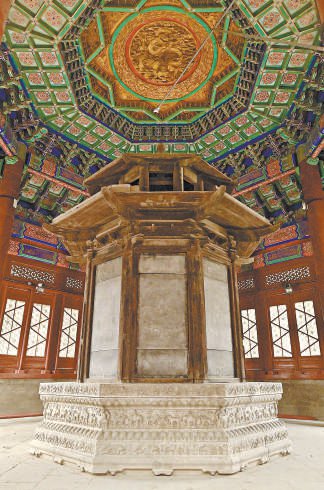
Core Viewpoint - The article discusses the cultural significance and historical context of the Seven Buddha Tower Stele in Beihai's "Western Paradise," highlighting its role in reinforcing cultural identity and political authority during the Qianlong Emperor's reign [2][6][7]. Cultural Integration Wisdom of the Seven Buddha Tower Stele - The Seven Buddha Tower Stele represents a synthesis of Confucian and Tibetan Buddhist cultures, showcasing the Qianlong Emperor's efforts to maintain cultural unity and stability in the frontier regions [2][4]. - The stele features inscriptions in Mandarin, Manchu, Mongolian, and Tibetan, emphasizing the centrality of Han culture while respecting diverse cultural identities [3][5]. Cultural Authority of the Qianlong Era - The Qianlong Emperor's initiative to establish the Seven Buddha Tower Stele was part of a broader strategy to assert cultural authority over Tibetan Buddhism and reinforce the Qing dynasty's legitimacy [7][8]. - The stele serves as an official interpretation of Tibetan Buddhist teachings, thereby consolidating the central government's control over religious narratives in the region [7][8]. Architectural Significance of the Liuli Pavilion - The Liuli Pavilion, constructed from remnants of a previously destroyed tower, exemplifies the peak of Qing dynasty craftsmanship and serves as a cultural landmark [9][10]. - The pavilion integrates both Han and Tibetan architectural elements, reflecting the harmonious coexistence of different cultural influences during the Qianlong period [9][10]. Historical Context of the Liuli Pavilion - The construction of the Liuli Pavilion was initiated after a fire destroyed the original tower, showcasing the Qianlong Emperor's commitment to cultural and religious projects [9][10]. - The pavilion not only serves as a religious site but also as a repository for important Buddhist texts, highlighting its dual function of worship and scholarship [10].
琉璃阁院落腾退移交,北海公园“西天梵境”何时向公众开放?
Xin Jing Bao· 2026-01-22 08:28
Core Viewpoint - The relocation and handover ceremony of the Liuli Pavilion courtyard to Beihai Park marks the restoration of the "Western Heaven" cultural heritage, which has a history of over 400 years, aiming to enhance public access and cultural appreciation [1][2]. Group 1: Cultural Heritage Restoration - The Liuli Pavilion courtyard is a significant part of the "Western Heaven" architectural complex in Beihai Park, featuring notable structures such as the Huayan Qingjie Hall and the Seven Buddha Pagoda Pavilion, showcasing the architectural excellence of the Qing Dynasty [1][2]. - The courtyard covers over 4,000 square meters, with an actual usable area of more than 1,600 square meters, previously serving as an office and storage for cultural relics [2]. Group 2: Archaeological and Cultural Significance - The Liuli Pavilion is adorned with 1,424 glazed figures of the Infinite Life Buddha, making it a rare example of Qing Dynasty official glazed architecture, while the Seven Buddha Pagoda Pavilion features inscriptions that highlight ancient Chinese architectural skills [2]. - The Beijing Archaeological Research Institute has moved to a new location, continuing its commitment to archaeological research and the protection of cultural heritage, emphasizing the importance of the Liuli Pavilion in the historical narrative of Beijing [3]. Group 3: Future Plans for Public Access - The Beijing Municipal Bureau of Cultural Heritage aims to expedite the opening of the Liuli Pavilion courtyard to the public, facilitating the living transmission of cultural heritage and enhancing visitor experiences [4][6]. - Future activities may include immersive experiences related to the history of the Liuli Pavilion, with plans for exhibitions and improved visitor facilities to enhance the overall experience [6][7].