瑞士钟表

Search documents
瑞郎强势震荡政策维稳 避险博弈主导走势
Jin Tou Wang· 2026-01-23 02:54
Core Viewpoint - The Swiss Franc (CHF) is experiencing a strong yet constrained trading pattern against the US Dollar (USD) and Euro, driven by the Swiss National Bank's (SNB) zero interest rate policy and global risk sentiment fluctuations, with expectations that the zero interest rate will persist until the second half of 2027 [1][2]. Group 1: Swiss National Bank Policy - The SNB has maintained a policy interest rate of 0%, with no immediate plans to shift to negative rates, even in the face of potential short-term deflation [1][2]. - The SNB's policy is designed to alleviate pressure on key export sectors such as watchmaking and pharmaceuticals, which are facing challenges, including a 7.3% year-on-year decline in watch exports as of November 2025 [1][2]. Group 2: Economic Indicators and Forecasts - The Swiss economy is projected to see GDP growth slow from 1.2% in 2025 to 1.0% in 2026, with a rise in unemployment from 2.8% to 3.0%, indicating insufficient recovery momentum [2]. - Inflation is expected to remain low, with the Consumer Price Index (CPI) nearing 0% at the end of 2025, and the SNB forecasts inflation to rise to 0.3%-0.6% in 2026-2027, within the target range of 0%-2% [1][2]. Group 3: Currency Dynamics and Market Sentiment - The USD/CHF exchange rate is under pressure due to narrowing interest rate differentials, with the market anticipating a 50 basis point rate cut from the Federal Reserve in 2026, delaying the first cut until June [2]. - The CHF continues to attract safe-haven flows amid global uncertainties, including trade tensions and geopolitical conflicts, despite temporary outflows following signals of reduced geopolitical risks from events like the Davos Forum [2]. Group 4: Technical Analysis and Market Outlook - The USD/CHF is expected to trade within a range of 0.79-0.81 throughout 2026, with key resistance levels at 0.8010-0.8020 and support at 0.7970 [3][4]. - The SNB's foreign exchange interventions, the Federal Reserve's interest rate decisions, and global geopolitical risks will be critical factors influencing the CHF's performance [4].
十里洋场“造梦机”:近代上海百货公司与南京路的景观
Xin Lang Cai Jing· 2025-12-20 06:57
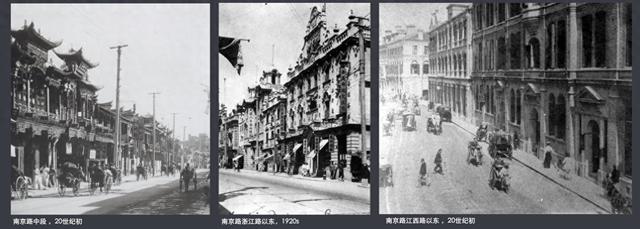
Core Concept - The article discusses the transformation of Nanjing Road in early 20th century Shanghai, driven by the rise of four major Chinese department stores: Sincere, Wing On, Sun Sun, and Taikoo. These stores acted as "dream machines," creating a collective fantasy of modernity through strategic capital operations, architectural practices, and cultural coding [1][2]. Group 1: Department Stores as "Dream Machines" - The focus on department stores is justified as they are pivotal in understanding Shanghai's modernity and urban culture, integrating capital, goods, space, and desires [1][2]. - The metaphor of "dream machines" highlights how department stores manufactured and showcased the dream of modernity, transforming abstract concepts into tangible goods and experiences [2]. Group 2: Spatial Positioning and Commercial Restructuring - Before the emergence of department stores, Nanjing Road was already a commercial hub, but its core was concentrated in the eastern section. The arrival of department stores shifted this focus westward, creating a new commercial geography [2][4]. - The founders of Sincere and Wing On strategically positioned their stores in a prime location, leading to a competitive landscape that established a high-density "scenic consumption belt" along Nanjing Road [4][5]. Group 3: Architectural Aesthetics and Modernization - The architectural styles of the four department stores, characterized by eclecticism, symbolized power and modernity, reshaping the urban skyline and breaking traditional spatial scales [6][10]. - The illumination of these buildings at night transformed Nanjing Road into a vibrant "city that never sleeps," enhancing the consumerist atmosphere [6][10]. Group 4: Consumer Practices and Urban Experience - The department stores transcended mere shopping, offering a multifaceted modern lifestyle experience, including dining, entertainment, and accommodation, thus becoming essential public spaces in Shanghai [10][11]. - The marketing of fashion and lifestyle products in these stores played a crucial role in shaping modern identities, linking consumption with social status and personal identity [11][12]. Group 5: Legacy and Contemporary Impact - The legacy of these department stores continues to influence the character of modern Shanghai, with contemporary shopping venues still reflecting the consumerist and modernist ethos established during that era [13].

东方表行集团(00398.HK)中期净利润1.01亿港元 同比下降15.1%
Ge Long Hui· 2025-11-19 12:08
Core Viewpoint - The luxury goods market is under significant pressure due to changing consumer spending habits, leading to a decline in the financial performance of the company [1][2] Financial Performance - For the six months ending September 30, 2025, the company's revenue decreased by 10.1% year-on-year to HKD 1.618 billion (2024: HKD 1.8 billion) [1] - Gross profit fell by 12.9% year-on-year to HKD 488 million (2024: HKD 560 million), with a slight decrease in gross margin to 30.2% (2024: 31.1%) [1] - Profit attributable to shareholders dropped by 15.1% year-on-year to HKD 101 million (2024: HKD 119 million) [1] Market Conditions - The luxury goods market is expected to remain under pressure in the short term, with Swiss watch exports to mainland China and Hong Kong declining by 16.3% and 8.3% respectively from January to September 2025 [2] - The industry faces challenges from weak discretionary spending and macroeconomic uncertainties, leading to a forecast of continued weak consumer demand in mainland China [2] Strategic Response - The company is adopting a balanced strategy, focusing on strengthening partnerships with leading brands and selectively opening new stores in prime locations to expand market coverage [2] - The company aims to enhance customer loyalty through high-quality service while implementing strict cost management and improving operational efficiency to support sustainable profitability [2]
记者观察丨法国皮具、瑞士钟表、德国汽车……业绩集体“跳水”
Xin Hua She· 2025-11-17 09:16
Core Viewpoint - The European high-end manufacturing industry, particularly luxury goods, is facing significant pressure due to U.S. tariff policies, leading to a collective decline in performance among companies in this sector [2]. Group 1: Impact on European Brands - European luxury brands, including French leather goods, Swiss watches, and German luxury cars, are experiencing a sharp decline in performance as a direct result of U.S. trade protectionism measures [2]. - The tariff storm is not only damaging the profits of European brands but also severely impacting consumer confidence in the U.S. market [2]. Group 2: Market Reactions - In response to the ongoing tariff pressures, European companies are being forced to raise prices to offset costs, which in turn is causing American consumers to tighten their spending [2]. - The sustained impact of tariffs is leading to short-term profit pressures for European high-end manufacturing firms, with significant uncertainty regarding the industry's growth prospects [2].
国际观察|美关税冲击欧洲高端制造
Xin Hua She· 2025-11-12 05:36
Core Viewpoint - The European high-end manufacturing industry, particularly luxury goods, is facing significant pressure due to U.S. tariff policies, leading to a decline in performance across various sectors [1][2]. Group 1: Impact on Luxury Goods - European luxury brands are experiencing a downturn, with LVMH reporting a revenue drop in its fashion and leather goods division from €299.2 billion to €276.1 billion, a decrease of approximately 8% year-on-year [2]. - Kering's revenue also fell by about 12% to €11 billion, with its flagship brand Gucci seeing a 22% decline in revenue [2]. - The high-end automotive sector is similarly affected, with Porsche's operating profit plummeting by approximately 99%, from €40.35 billion to €400 million [2]. Group 2: Swiss Watch Industry - The Swiss watch industry is under severe strain, with a 39% tariff imposed on Swiss watches leading to a 56% year-on-year drop in exports to the U.S. in September [3]. - Swatch Group, which includes brands like Omega, relies heavily on the U.S. market, which constitutes nearly 17% of its exports [3]. Group 3: Consumer Confidence in the U.S. - The U.S. market accounts for over 23% of global personal luxury goods sales, and the tariff pressures are causing European luxury brands to raise prices, which is dampening American consumer purchasing intent [4]. - Porsche and Swatch have announced price increases of 5% to 15% in the U.S. market, reflecting the industry's response to cost pressures [4]. - Experts indicate that consumer confidence is crucial for luxury spending, and uncertainty in the economic and policy environment is leading to a cautious approach among American consumers [4]. Group 4: Long-term Industry Uncertainty - While price increases may provide short-term relief, they pose long-term risks to brand image and consumer loyalty, potentially deterring younger customers [5]. - Some European luxury brands are exploring local production in the U.S. to avoid tariffs, but face challenges such as a lack of skilled labor and low production efficiency [5][6]. - Efforts to optimize supply chains to control costs are also costly and may jeopardize craftsmanship standards, contributing to significant uncertainty in the global high-end consumer market [6].
国泰海通:关注后续估值有望修复标的中报发布 行业短期关注安踏体育等
Zhi Tong Cai Jing· 2025-08-25 08:46
Group 1 - The textile and apparel sector in Hong Kong has shown strong stock performance following the release of interim reports, with a recommendation to focus on quality stocks with cautious or clear interim expectations and stable full-year performance, such as Shenzhou International, Jiangnan Buyi, and Anta Sports [1] - Notable stock price increases post-interim report include: Yue Yuen (+10.25%), Samsonite (+0.18%), Crystal International (+13.49%), Xtep International (+16.75%), and Li Ning (+8.78%), attributed to results meeting or slightly exceeding market expectations and stable full-year performance forecasts for 2025 [2] - The low valuation and dividend attributes of these companies are highlighted, with projected P/E ratios and dividend yields for 2025/26 as follows: Yue Yuen (7.3X/6.5X, 10%/11%), Samsonite (11X/10X, 4%/5%), Crystal International (10X/9X, 5.8%/6.4%), Xtep International (12X/11X, 4.0%/4.4%), and Li Ning (18.6X/17.8X, 2.7%/2.8%) [2] Group 2 - In July, Swiss watch exports (excluding the US) improved on a month-on-month basis, with Singapore and Hong Kong leading the growth, while overall global exports showed a year-on-year increase of 6.9% [3] - The export figures for July indicate a significant increase in the US due to tariff disruptions, with global exports (excluding the US) showing a year-on-year decline of 0.9% but an improvement from June's -3.2% [3] - Cumulative export data from January to July shows a year-on-year increase of 1.0% for global exports, while specific regions like China and Hong Kong experienced declines [3]


在美上市瑞士钟表股下跌,特朗普对瑞士进口产品征收39%关税
news flash· 2025-08-01 15:26
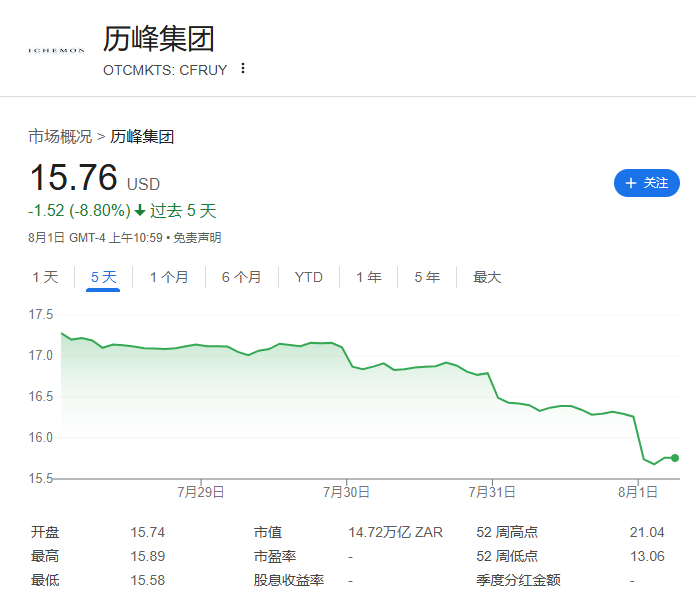
Core Viewpoint - The announcement by President Trump to impose a 39% tariff on Swiss imports has led to a significant decline in the stock prices of Swiss watch companies listed in the U.S. market [1] Group 1: Stock Performance - Richemont Group's ADR fell by 3.08%, resulting in a cumulative decline of 8.80% for the week [1] - Watches of Switzerland Group's ADR dropped by 7.73% [1] - Swatch Group's ADR experienced a decline of 8.7% [1] Group 2: Market Data - Richemont Group's stock opened at 15.74 USD, with a market capitalization of 14.72 trillion ZAR and a 52-week high of 21.04 USD [4] - Watches of Switzerland Group's stock opened at 4.37 USD, with a market capitalization of 756 million GBP and a 52-week high of 7.52 GBP [7][9]